
Famous Landmarks in Milan: The Four That Are Worth the Time
2022年11月18日
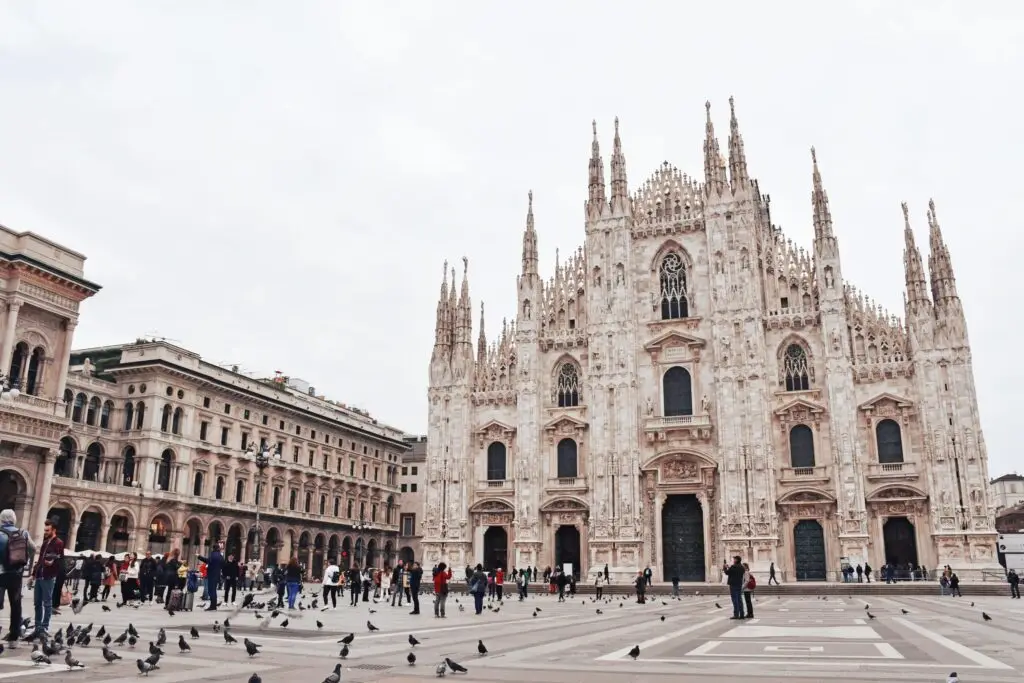
Milan is a working city, and that is the point
Milan is not an open-air museum like Florence or Venice. It is Italy's business capital, it was heavily bombed in 1943, and much of it is nineteenth and twentieth century. Visitors who arrive expecting a Tuscan hill town leave disappointed.
What Milan has instead is a small number of extraordinary things, and they are extraordinary. Here are the four to build a visit around, plus the practical detail that makes or breaks each one.
The Duomo, and the roof
Milan's cathedral took roughly six centuries to complete and is covered in thousands of statues and spires, which is why the front looks like it is made of lace. Inside is dark and vast, and worth twenty minutes.
But the reason to come is the roof. You can walk on the terraces, among the flying buttresses and the marble spires, with the city underneath and the Alps visible on a clear day. Nothing else in Italy lets you get up into a Gothic cathedral like this.
Buy the ticket that includes the terraces, and take the lift rather than the two hundred-odd steps unless you actively want the climb. Go early or late; the queue in the middle of the day is long and the terrace is exposed.
The Galleria Vittorio Emanuele II
Next to the cathedral, the Galleria is a nineteenth-century shopping arcade under an iron and glass dome, and it is one of the earliest of its kind anywhere. The shops are luxury brands and the cafés are expensive; you are here for the architecture, not the retail.
On the floor at the centre, look for the mosaic of a bull. Local custom says you put your heel on the bull and spin a full turn for good luck, which is why there is a worn hollow in the tiles. Everyone does it, and it is repaired regularly.
The Sforza Castle
The Castello Sforzesco is the fortress of the family who ruled Milan in the Renaissance, and today it holds a set of museums on one ticket. The one to see is Michelangelo's Rondanini Pietà, the sculpture he was working on in the last days of his life and never finished. It is displayed alone, in a bare room, and the unfinished parts are exactly what makes it worth standing in front of.
Behind the castle, the Parco Sempione is the city's big park and a good place to stop when the heat is heavy.
The Last Supper, and the booking problem
Leonardo's Last Supper is painted on the refectory wall of Santa Maria delle Grazie. Visits are in small groups for a strictly limited time, which means tickets are released in batches and sell out months in advance.
If you want to see it, book before you book anything else about the trip. If you have left it too late, the church itself is free to enter and worth seeing, and the Ambrosiana library holds Leonardo drawings; neither is a substitute, but both are better than standing outside a sold-out door.
If you have longer
The Navigli, the surviving canals in the south of the city, are where Milan drinks in the evening; the aperitivo, a drink with a plate of food included, is a Milanese habit worth adopting.
The Cimitero Monumentale is an open-air gallery of nineteenth and twentieth-century sculpture, free to enter, and almost empty. The Pinacoteca di Brera holds the paintings. And the Bosco Verticale, the two residential towers planted with hundreds of trees, is worth the metro ride to see what a city can do with a façade.
Seeing Milan by playing it
Milan's landmarks are far enough apart that the walk between them matters, and that walk goes past courtyards, tram lines and façades most visitors never look at. A city game gives that walk a route and clues, so the time between the Duomo and the castle becomes part of the day instead of dead ground. It works well with friends and with a work group.
Frequently asked questions
How many days do I need in Milan?
Two days covers the Duomo, the Galleria, the castle and one museum. Three if you have Last Supper tickets and want the Navigli properly.
How far ahead should I book the Last Supper?
Months. Tickets are released in batches and sell out quickly, and the viewing slot is short and strictly timed.
Is the Duomo roof worth the extra ticket?
Yes. It is the best thing in the city and there is nothing else quite like it in Italy.
When is the best time to visit?
Spring and autumn. July and August are hot and much of the city closes in mid-August, when Milan empties.
Do I need a car?
No. The metro reaches everything here, and the centre is walkable. Driving into the centre involves a congestion charge.
Come and play in Milan
If you want the city between the landmarks, walk it with a playing route. Here is how it works, and for team outings and larger groups we have formats on this page. Questions about dates, group sizes or routes? Get in touch. More on playing here: quests in Milan.