
Things to Do in Tournai: Two UNESCO Sites and a Frankish Past
27. oktober 2022
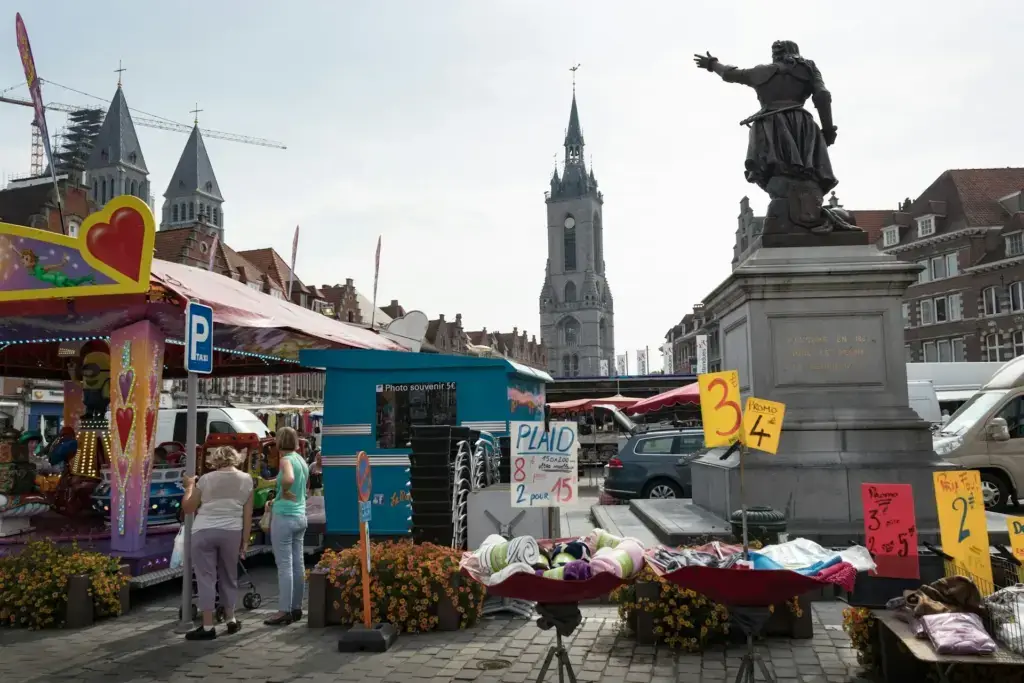
One of the oldest cities in Belgium, and it shows
Tournai sits on the Scheldt in the far west of Wallonia, close enough to France that the border is a short drive. It was a Roman settlement, then a seat of the Frankish kings: the tomb of Childeric I, father of Clovis, was found here in the seventeenth century. Very few Belgian towns can point that far back and still have something standing to show for it.
Two of the things standing are on the UNESCO World Heritage list, and they are three minutes' walk apart.
Notre-Dame Cathedral
The cathedral is the reason to come. Five towers rise together over the town, which is unusual anywhere in Europe, and the building splits neatly in two: a heavy Romanesque nave from the twelfth century and a soaring Gothic choir added later. Standing where the two meet, you can see the change in ambition happen in front of you.
Long-running restoration work has been part of the cathedral for years, so parts may be screened off. Check what is accessible before you go, and treat the scaffolding as evidence that the thing is being kept alive rather than as a disappointment.
The belfry
Tournai's belfry is the oldest in Belgium and, like the cathedral, a UNESCO site. Belfries were civic rather than religious buildings: a bell tower owned by the town, ringing for the town's own reasons, which in the Middle Ages was a statement about who held power locally. Climb it if the stairs are open. It is the fastest way to understand the layout of Tournai and to see all five cathedral towers at once, which you cannot really do from the ground.
The tapestry museum
From the fifteenth century Tournai was a major weaving centre, and its tapestries hung in courts across Europe. The Musée de la Tapisserie shows historic pieces alongside contemporary textile art and keeps a working restoration workshop, so you often see conservators at the loom. Once you understand that a large tapestry represented years of work by a team, the room reads differently: this was the most expensive art form of its day, and Tournai sold it.
Horta's museum of fine arts
The Musée des Beaux-Arts was designed by Victor Horta, the architect who defined Belgian Art Nouveau. He laid the galleries out radiating from a central hall so daylight reaches the paintings the way he intended. It is worth walking through for the building alone, and the collection is a genuine surprise for a town this size.
The Scheldt, the Pont des Trous and the Grand-Place
The river cuts straight through the middle of town and the quays are the pleasant part of an evening here. The Pont des Trous, the medieval fortified bridge over the water, was substantially rebuilt in recent years when the Scheldt was widened for modern shipping, and that work reshaped the view. It remains the postcard spot, with the argument about how it should have been done still audible locally.
The Grand-Place is triangular rather than square, which throws people at first, and it is ringed with terraces. Much of what you see around it is post-war: Tournai was heavily bombed in May 1940 and rebuilt afterwards.
Seeing Tournai by playing it
Tournai packs a lot into a small centre, and the risk is doing the cathedral, the belfry and then leaving. A city game sends you through the streets between the monuments solving clues, so you notice the blue Tournai stone in the doorways, the river gates and the odd shape of the square. It works with family, with friends and with a work group, and it turns a two-hour stop into a proper visit.
Frequently asked questions
How long do I need in Tournai?
A full day covers the cathedral, the belfry, one museum and the river. Two days if you want both museums and a slower pace.
What is Tournai famous for?
Its five-towered cathedral and its belfry, both UNESCO sites, plus its tapestry tradition and its Frankish and Roman history.
Is Tournai worth visiting with children?
Yes, in short bursts. The belfry climb and the riverside work well; the museums are better in one focused hour than a long morning.
Can I visit Tournai without a car?
Easily. The station is a short walk from the centre and everything described here is walkable from there.
Is French the only language spoken?
Tournai is in French-speaking Wallonia, so French is the everyday language. English is widely understood in tourist places, less so elsewhere; a couple of French phrases go a long way.
Come and play in Tournai
If you would rather explore the town than tick off two monuments, try a playing route through it. Here is how it works, and for team outings and larger groups we have formats on this page. Questions about dates, group sizes or routes? Get in touch. Heading on to the capital afterwards? Start with Brussels.