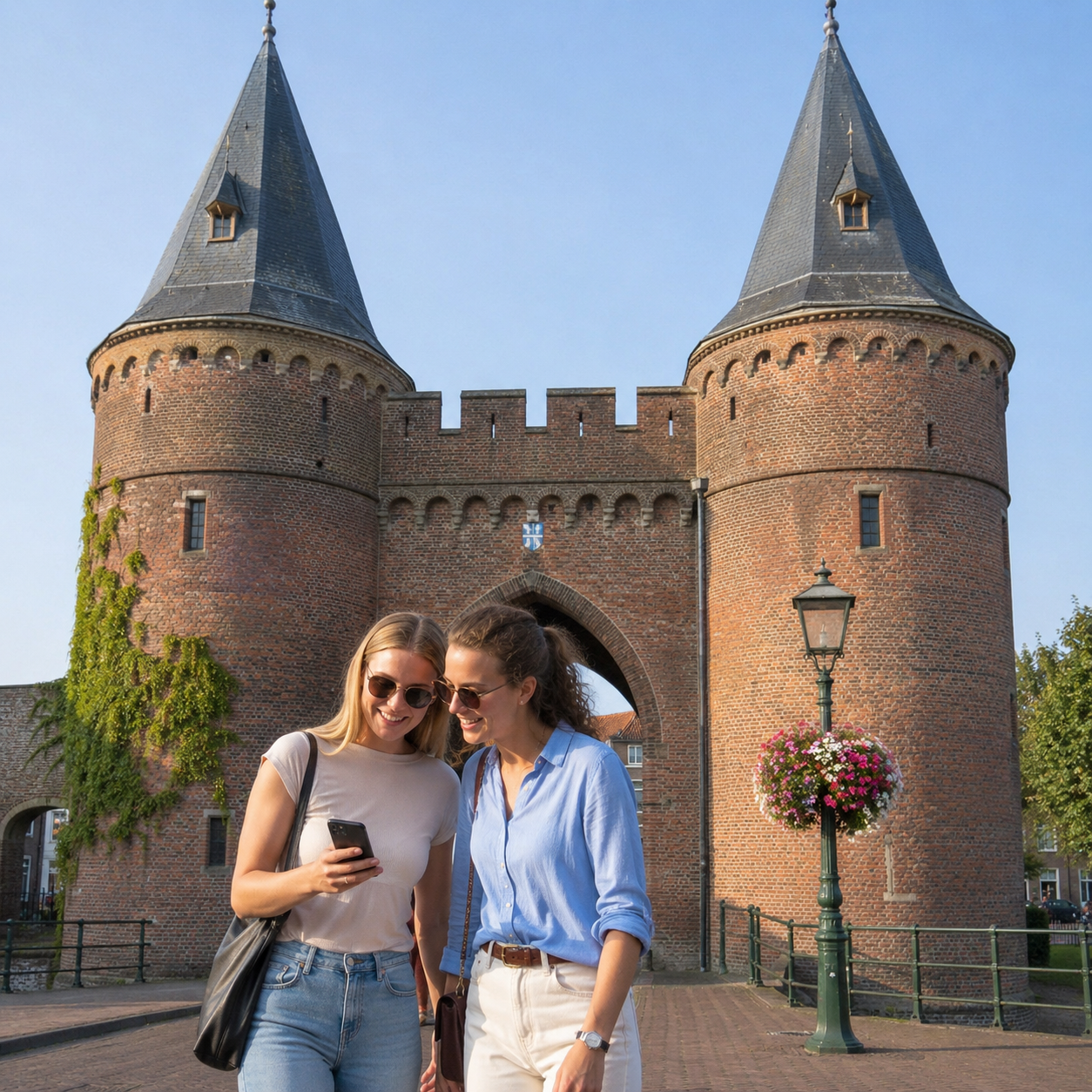

To escape outdoor means playing an escape game in the open air: your team works through a story and a chain of puzzles while walking a real city, instead of solving them inside a locked room. This guide is for the first time you try it.
The format is simple enough to book on a whim, but a few things surprise first-timers: how much walking is involved, how the hints work, and how much of the day you actually control. The how to play page covers the booking side; this article covers the day itself.
What an outdoor escape actually looks like
You meet your group at a starting point in the city centre, open the game on one phone per team, and get the first piece of the story. From there the route unfolds stop by stop: a clue points at something real, you work it out together, and the answer sends you on. There is no host walking beside you and no other teams to wait for.
What surprises people the first time
- The pace is yours. Nothing counts down. Teams that stop for coffee halfway usually enjoy it more.
- The city does the work. Answers hide in plaques, statues, house numbers and shop signs you would otherwise never read.
- Talking beats thinking alone. Most puzzles fall apart the moment someone says their half-formed idea out loud.
- It is a walk. Expect a few kilometres over a couple of hours, on cobbles and over bridges.
Before you start
- Pick a city you can reach easily and a concept that matches your group.
- Choose a date and a starting time. Mornings are quieter; late afternoons end nicely at a terrace.
- Charge one phone per team and bring a power bank for longer routes.
- Wear shoes you can walk cobblestones in, and dress for the forecast.
- Book a table near the finish before you set off.
Playing time, distance and available languages differ per city and concept, so check the destination page in the list of cities where you can play a City Game.
Choosing your first route
If you want the pressure of a case
The Syndicate city escape game gives you an antagonist and a case to close, which is the closest thing to an indoor escape room.
If you want to see the city as you go
The Secrets of exploration game keeps the puzzles lighter and spends more of the route on the parts of town you would otherwise walk past.
If you are booking for a group
Split into teams of four and run the same route in parallel; the scores make the finish. Group bookings are arranged on the page for companies and groups.
Getting the most out of the route
- Read every clue out loud. Skimming causes most wrong answers.
- Stop walking before you look at the phone, and step clear of traffic and cyclists first.
- Pass the phone around so nobody spends the whole route as navigator.
- Take a hint before frustration sets in. Hints exist so the route keeps moving.
- Photograph the odd details you find; they are what the group talks about afterwards.
Frequently asked questions
What does escape outdoor mean?
It means playing an escape-room-style game outdoors, along a city route, using real locations as the puzzles instead of a themed room.
Is it harder than an indoor escape room?
Not harder, but different: more observation and walking, less searching through furniture, and no clock forcing you along.
How long does it take?
Most routes take a couple of hours including breaks, and you set the pace yourself. Exact playing times are listed per city.
What happens if we get stuck?
Every challenge has hints built in, so your team can always continue to the next location.
Can we play with children?
Yes, and mixed teams of adults and children usually do best. Check the walking distance on the city page if you are playing with young children.
Ready for your first one?
Pick a compact city centre, a concept that suits your group and a starting time that leaves room for a long lunch. If you want the full comparison with indoor escape rooms first, read our guide to the outdoor escape format.
The Syndicate
Solve puzzles and crack codes across the city. See the games ›