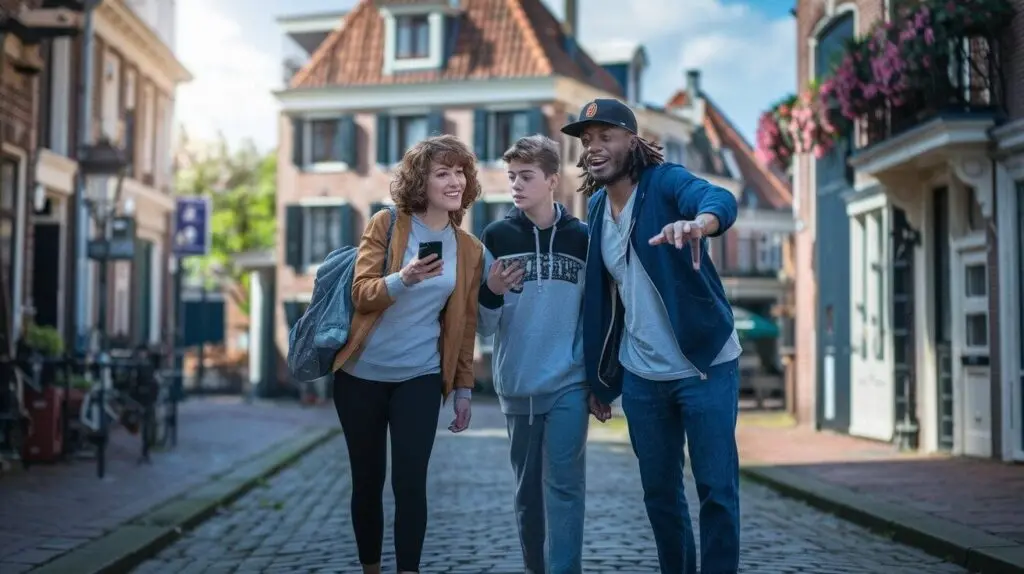
A family scavenger hunt is one of the few activities that costs nothing, works indoors and out, and can be put together in twenty minutes. The hard part isn't the clues. It's that families rarely have children of the same age, and a hunt pitched at the eleven-year-old bores the six-year-old, while a hunt pitched at the six-year-old is over in four minutes for the eleven-year-old.
Solving that is most of the work. Here's how.
The mixed-age problem, and three ways to fix it
Give each child their own list
Same route, different tasks. The younger one collects and counts; the older one solves riddles and reads. Both finish at the same stops, so nobody is waiting.
Pair them up as one team
The older child reads, the younger one finds and fetches. This works well if they get on and badly if the older one just does everything. Give the younger child something the older one can't do - carrying the bag, deciding the direction, holding the pen.
Make the older one the game master
For a big age gap, let the eleven-year-old hide the items and write clues for the younger ones. Making a hunt is more interesting at that age than doing one, and it takes the competition out entirely.
Where to run it
Indoors, on a rainy day. A house has more hiding places than you think. Twelve items, one room per clue, done in half an hour.
The garden or a park. The natural version: something round, something rough, three different leaves, something older than you. Works from about three upwards with an adult.
Around town. The most interesting one, and the one children remember. Clues tied to shop signs, statues, house numbers and dates carved above doorways.
On holiday. A hunt around an unfamiliar town is a good way to spend a morning that would otherwise be spent asking what there is to do.
Writing clues by age
Three to five: pictures rather than words. Find something red, something with wheels, something that makes a noise.
Six to eight: short written clues an adult reads aloud, with a counting or finding task. How many windows does the blue house have?
Nine to twelve: proper riddles, wordplay, and clues that lead to the next stop. This is the age at which a hunt becomes a real game.
Teenagers: harder puzzles and a phone. Or, more reliably, put them in charge.
Practical things that decide the mood
Keep it shorter than you think. Forty-five minutes to an hour for young children, up to two hours for nine to twelves. Children lose interest well before adults expect them to.
Write more items than they can find, so the hunt ends because you say so and not because they've run out.
Have a small prize, and make it silly rather than valuable. A valuable prize turns siblings competitive in a way that ends in tears.
Take snacks and water. Most family meltdowns halfway round are hunger, not boredom.
And let them win occasionally. A parent who solves every clue first has misunderstood the exercise.
Twelve items that work almost anywhere
Something older than everyone playing. Something with a date on it. Something that has been repaired. Something the same colour as your shoes. A door with more than one lock. An animal that isn't real. A number bigger than a hundred. Something that has changed since you last looked. A word in another language. Something round that isn't a wheel. Something growing where it shouldn't. And the best one for children: something nobody else in the family has noticed.
If you'd rather not write one
Writing a hunt around town takes an afternoon of walking and checking, and one clue about a shop sign that has changed will stall everyone. Ready-made city routes have that already tested: the puzzles are tied to things that are permanently there, and you follow them from a phone at your own pace.
You can see which cities have routes and pick one near home or where you're going on holiday. The page on how the game works is worth reading to the children before you set off.
For a birthday party or a school group, there's a setup for groups and companies.
Frequently asked questions
What age can children do a scavenger hunt?
From about three with picture clues and an adult, from six with clues read aloud, and from nine independently.
How long should a family scavenger hunt be?
Forty-five minutes to an hour for under-eights, up to two hours for older children. Stop before they want to.
How do you handle a big age gap?
Different lists on the same route, or make the oldest the game master rather than a player.
What can you use as a prize?
Something small and daft. Choosing the film that evening works better than anything expensive.
Can you do it indoors?
Yes, and it's the best rainy-day activity there is. One clue per room, twelve items, half an hour.
What if one child finds everything first?
Give them a harder list next time, or hand them the job of writing the clues. Both work better than asking them to go slower.
In short
Solve the age gap first, keep it short, and pick a prize nobody would fight over. If you'd rather play a ready-made one in town, we've written about treasure hunts in the city with children.
Wondering whether a route suits your children's ages? Ask us through the contact page.
Secrets of …
Discover the stories behind the facades. For everyone. See the games ›