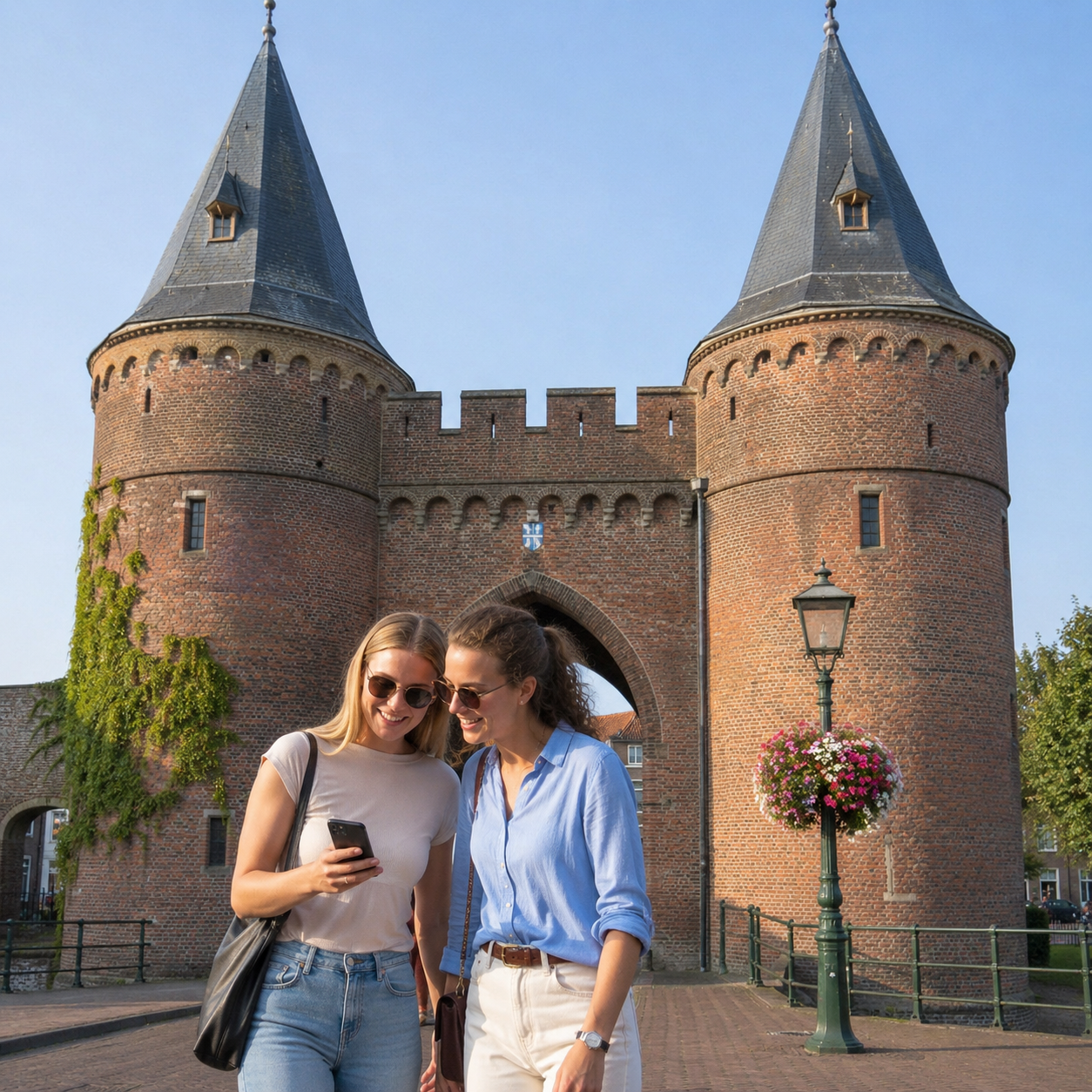
An outdoor escape game takes the mechanics of an indoor room - chained puzzles, a story, a team working against each other's assumptions - and moves them into a city centre. The clues are attached to real buildings, statues, plaques and inscriptions, and you walk from one to the next.
It's a genuinely different experience, better in some ways and worse in others. This is an honest account of both.
How it works in practice
You get a starting point and a route on a phone. At each stop there's a puzzle you can only solve by looking at what's in front of you: counting something on a facade, reading a date, working out which of four statues the riddle describes. A correct answer unlocks the next stop.
There's no locked door, no games master watching on camera, and no countdown that ends the game. You set your own pace, and if you want to stop for coffee halfway, the game waits.
What you gain compared with an indoor room
No fixed time slot. You start when your group is actually ready, not when a booking system says so. If someone's train is late, nothing is lost.
No size limit. An indoor room holds six. Outdoors, twenty people play as four teams on the same route, and compare scores at the end. This is the single biggest practical difference for work groups and parties.
You see the city. Most people walk past the details a route points at - a carved animal, an odd inscription, a building that used to be something else. Noticing them is a real part of the experience, even though the game isn't a history tour.
Nobody feels shut in. Anyone uneasy about small spaces or locked doors can play without that being a conversation.
It's cheaper per person at scale, because you're not paying for a room per six people.
What you lose
The set design. An indoor room's lighting, sound and props create an atmosphere a street cannot. If the theatricality is what you love about escape rooms, outdoors will feel plainer.
The physical props. No boxes to open, no hidden drawers, no keys. Outdoor puzzles are observation and reasoning rather than searching.
The pressure. Without a ticking clock and a door, the tension is lower. Some groups miss that; others are relieved by it.
Weather. This is the honest downside. Light rain is fine. Heavy rain means postponing, which is easy since there's no slot, but it's still a factor an indoor room doesn't have.
Who it suits
Groups larger than six, because splitting into teams is the natural format. Work outings, where nobody wants to be crammed into a small room with their manager. Families with children from around eight, who last much better walking than sitting still. Visitors to a city who want to see it and do something at the same time. And anyone who has done a few indoor rooms and wants the puzzles without the booking.
It suits less well: groups who specifically want the horror-theme experience, anyone who can't manage a few kilometres on foot, and days with genuinely bad weather.
Practical things worth knowing
Distance. Routes are usually two to four kilometres through a city centre, flat, with plenty of natural stops. The distance is stated before you start.
Time. Two hours for most routes, two and a half with children or a large group.
Phones. One per team, charged. This is the most common thing that goes wrong.
Getting stuck. Hints are built in. Nobody is watching, so take them freely.
Season. Spring and autumn are the most comfortable. Summer afternoons in southern cities are hot enough to be worth starting early.
Where you can play
Routes exist in city centres across Europe and beyond, from small historic centres to capitals. You can see the full list of cities with routes and pick one nearby or somewhere you're visiting.
If you've only done indoor rooms, the page on how the game works explains what changes in a couple of minutes.
For teams and larger groups playing at the same time, there's a setup for companies and groups.
Frequently asked questions
How long does an outdoor escape game take?
About two hours, or two and a half with children or a group larger than ten. There's no time limit, so you can take longer.
How far do you walk?
Usually two to four kilometres, flat, through a city centre. The exact distance is shown before you book.
Can you do it in winter?
Yes, with a coat. The limiting factor is daylight rather than temperature - check what time it gets dark before starting late in the afternoon.
Is it suitable for children?
From around eight upwards children play well; from five they need an adult reading the clues. Below five it's mostly the adults playing.
What if it rains?
Light rain is fine. For heavy rain, move the start - there's no fixed slot, so you can shift it the same day.
Do you need a guide?
No. Each team is self-guided by the phone, which is why several teams can play at once.
In short
An outdoor escape game trades atmosphere and props for flexibility, group size and daylight. If those are what your group needs, it's the better format; if you want the theatre of a themed room, it isn't. For the wider comparison, we've written a general guide to how escape rooms work.
Not sure whether a route suits your group or a particular city? Ask through the contact page before you book.
The Syndicate
Solve puzzles and crack codes across the city. See the games ›