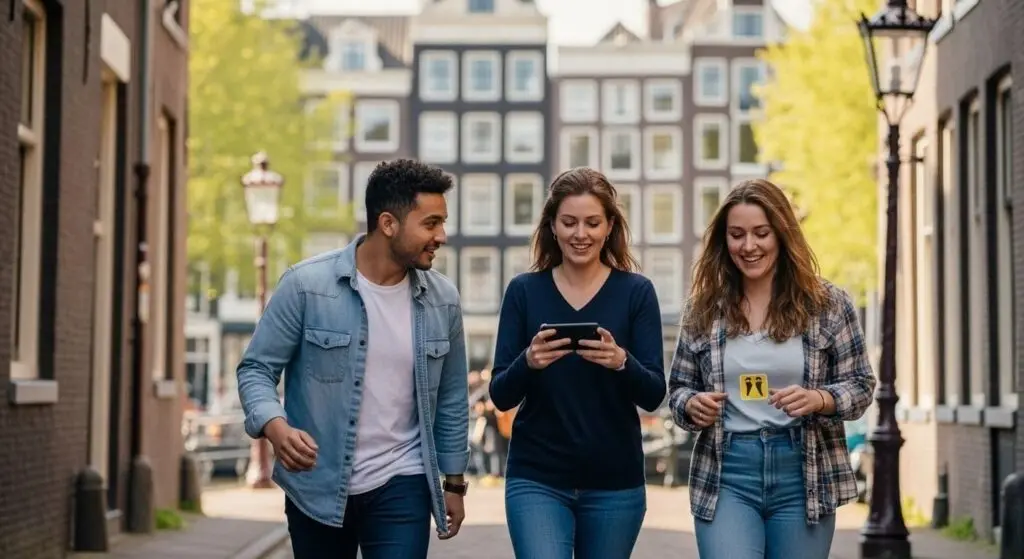
A self-guided walking tour is a route you follow yourself, from an app, a printed sheet or an audio track, without anyone leading. It costs a fraction of a guided tour, starts when you want, and stops when you've had enough - which for a lot of people is the whole appeal.
It's also worse than a guide in one specific way, and it's better to know that before you set off than halfway round.
What you gain
You set the pace. Twenty minutes in a church because you liked it, or ninety seconds because you didn't. No group waiting, no group waited for.
No fixed start. Late train, slow breakfast, sudden rain - none of it costs you a booking.
You can stop. Lunch halfway through, a nap, a shop you walked past. A guided tour doesn't allow any of that.
It's cheap. Often a fraction of a guide's fee, and priced per route rather than per person on some formats, which matters for a family.
It works for two people. Small guided tours frequently need a minimum number to run at all.
What you lose
You lose the answer to the question you didn't know you had. That's the honest gap. A good guide notices you looking at something and tells you what it is; they answer the follow-up, and they know which of two stories about the fountain is the one historians actually believe.
Self-guided content can't respond. It tells you what it decided to tell you, and if that raises a question, you're on your own with a search engine.
You also lose access. A guide can sometimes get you into a courtyard, a chapel or a building that isn't otherwise open. No app does that.
The four formats, and what they suit
Audio tours
Closest to a guide. Good for solo walkers, and genuinely immersive when the writing is good. Bad in a group, because everyone listening to their own headphones in silence is a strange way to spend an afternoon together.
App-based routes with text
Flexible, easy to share between two people, easy to skip ahead. The weak ones are generated from map data and read like a checklist.
Printed or PDF routes
Cheapest, no battery, and pleasingly analogue. The problem is that nobody updates them, so they age badly - a route pointing at a café that closed in 2019 is worse than no route.
Puzzle and game routes
The same walking but with something to solve at each stop. Better in a group, because a puzzle gives people a reason to talk; less informative than an audio tour, because you're looking rather than listening.
How to pick a good one
Look at a sample stop. If it reads like a Wikipedia summary of the building, the whole route will. If it points at a specific detail on the facade, someone stood there and wrote it.
Check when it was last updated. Routes rot. Restaurants close, buildings get scaffolding, museums change opening days.
Check the length and the terrain. Two to four kilometres is normal; steps and cobbles are the part that gets left out of the description.
Check whether it works offline. Abroad, this is the difference between a tour and a walk.
Check the language. Not what the site is translated into - what the route actually runs in.
Planning the day around it
Start earlier than feels necessary. Old centres are pleasant at nine and crowded at noon, and the same route is a different experience.
Look up opening hours yourself for anything you plan to go inside. Self-guided routes rarely track them, and Mondays close a surprising number of museums across Europe.
Book somewhere for afterwards. The most common failure of a self-guided day isn't the route; it's three hungry people at half past two looking for a table.
And charge the phone. Two hours of screen and location is the one practical thing that ends a self-guided tour early.
Where to find routes
You can see which cities have routes and pick one where you live or where you're travelling. The page on how the game works explains the puzzle-route format, which differs from an audio tour in what it asks of you.
For a group walking as several teams, there's a setup for companies and groups.
Frequently asked questions
Are self-guided walking tours worth it?
For flexibility and cost, yes. For depth of information, a good guide is still better.
How long does one take?
Usually two to three hours for two to four kilometres, longer if you go inside anything along the way.
Do you need internet?
Depends on the format. Some download in advance; some need signal at every stop. Check before travelling abroad.
Are they suitable for children?
Audio tours generally aren't. Puzzle routes are, from about eight, because there's something to do rather than listen to.
Can you do one in a group?
Yes, though audio suits solo walkers better. For groups, a route with something to solve keeps people talking to each other.
What if it rains?
Light rain is fine; heavy rain is worth moving, and with no fixed slot you can simply go the next day.
In short
Self-guided wins on flexibility, cost and being able to stop; a guide still wins on answering the question you didn't know to ask. Pick by what your group needs, check the route is maintained, and book lunch. If you want the version with something to solve at each stop, we've written about playing a city game without a guide.
Not sure which format suits your group? Ask through the contact page.
Secrets of …
Discover the stories behind the facades. For everyone. See the games ›