Malmö is small enough to cross on foot in an afternoon and varied enough that you will not want to. It has a cobbled old town, a shipyard turned into a seafront neighbourhood, one of Sweden's most mixed and lively districts, and a bridge to Copenhagen that takes about half an hour by train. Here is what is actually worth your time.
Start in the old squares
Stortorget is the big one, laid out in the 1530s when Malmö was still Danish, with the old town hall along one side and a statue of King Karl X Gustav in the middle. It is handsome but formal.
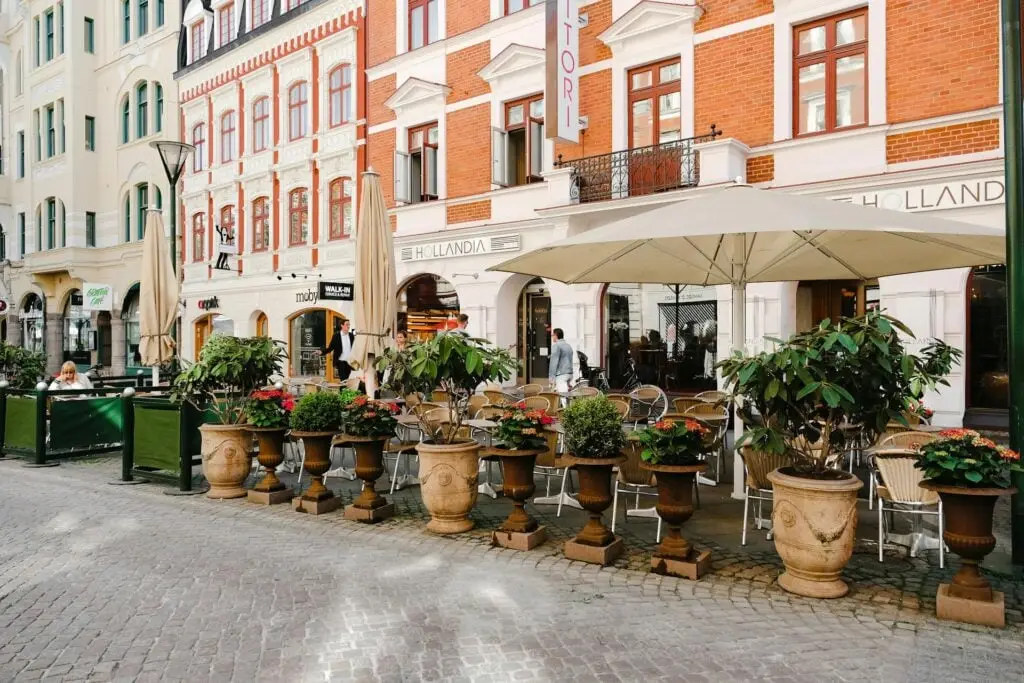
Lilla Torg, just off it, is the one people actually sit in: a small square of half-timbered buildings, now almost entirely bars and restaurants with outdoor heaters. It is touristy and priced accordingly, but on a summer evening it earns its reputation. Gustav Adolfs torg completes the trio and is where the city's markets and events tend to land.
Malmöhus Castle
The castle at the western edge of the old town is the oldest preserved Renaissance castle in Scandinavia, begun under Danish rule in the sixteenth century. It later spent a long stretch as a prison, which explains the thick walls and the general lack of charm from outside.
Inside, it houses the city museum: local history, an aquarium and a natural history collection under one ticket. It is an odd mix, and that is part of the appeal. The surrounding park and moat are free and pleasant to walk.
St Petri Church and the library
St Petri is a fourteenth-century brick Gothic church, plain outside and surprisingly tall inside. The side chapel kept its medieval wall paintings when the rest were whitewashed during the Reformation, which makes it the most interesting corner of the building.
The city library near Kungsparken is worth walking past even if you do not read Swedish. The glass extension by Henning Larsen, opened in 1997, is called the Calendar of Light, and on a grey afternoon it does exactly what the name suggests.
Västra Hamnen and the Turning Torso
The Western Harbour was a shipyard until the 1980s. It is now a low-carbon residential district with a wooden boardwalk along the water where people swim straight off the deck all summer. The Turning Torso, Santiago Calatrava's twisting tower completed in 2005, is the tallest building in Scandinavia. It is residential, so you cannot go up, the point is looking at it from the boardwalk.
Along the same shore, Ribersborg is a long artificial beach, and the Kallbadhus at the end of its pier is an open-air bathhouse from 1898 with saunas and ladders straight into the Öresund. Swedes use it year round. You can too, briefly.
Möllevången, where Malmö actually eats
Ten minutes south of the centre, Möllan is the city's most mixed neighbourhood: Middle Eastern grocers, Balkan bakeries, vinyl shops and cheap kitchens around Möllevångstorget. Malmö is often called Sweden's falafel capital, and this is where that reputation was earned, a falafel roll here costs a fraction of a restaurant lunch.
Folkets Park next door started in 1891 as one of Europe's first workers' parks and still runs as a public park with a small funfair, a dance hall and a flamingo-free reptile house.
Green space and a day trip
Slottsträdgården beside the castle is a working organic garden with a good café. Pildammsparken is the big one, built around old water reservoirs. And Copenhagen is roughly thirty-five minutes away by train across the Öresund Bridge, bring your passport or ID, since border checks on the Swedish side happen from time to time.
Seeing the city as a game
Malmö rewards wandering, which is exactly where a city game fits. You set off in small teams with your phone, solve puzzles attached to real streets and buildings, and end up in corners you would have walked past. There is no guide and no fixed start time: you begin when you are ready and go at your own pace, stopping for coffee whenever it suits.
It works for friends, families and company outings and larger groups. The how it works page explains the whole thing step by step.
Frequently asked questions
How many days do you need in Malmö?
One full day covers the old town, the castle and the Western Harbour. Two days let you add Möllan, the beach and a proper meal or two.
Is Malmö worth visiting from Copenhagen?
Yes. The train takes about thirty-five minutes and Malmö feels genuinely different, smaller, cheaper and less polished.
Do I need ID to cross the bridge?
Bring a passport or national ID card. Identity checks on the Swedish side are applied on and off depending on the period.
What is the best time to visit?
May to September, when the outdoor seating and the swimming make sense. Winter is dark and windy, though the indoor city works fine.
Can you go up the Turning Torso?
No, it is a residential building without a public viewing floor. The best views of it are from the Ribersborg beach path.
Is Malmö expensive?
Cheaper than Copenhagen and Stockholm, especially for food. Möllevången is where you eat well without spending much.
Go and walk it
Malmö is a city best understood on foot, with a few detours. See all the cities where we run games, or read on north to the best museums in Stockholm, or send us a message if you are planning something for a group.