Turin gets a fraction of the visitors that Florence and Venice do, and it has better museums than either for anyone interested in something other than the Renaissance. It was the first capital of unified Italy, the home of Fiat, and the place where vermouth and gianduia chocolate were invented. The museums reflect all of that.
1. Museo Egizio
Turin's Egyptian Museum opened in 1824 and holds what is widely considered the most important collection of Egyptian antiquities outside Cairo. The core of it came from the collection of Bernardino Drovetti, a Piedmontese who served as French consul in Egypt, and from later excavations by Italian archaeologists.
The highlights are the temple of Ellesiya, moved here stone by stone when Lake Nasser was created, and the tomb of the architect Kha and his wife Merit, found undisturbed in 1906 with everything still in it, food, furniture, clothing, cosmetics. Not a royal tomb, which is exactly why it tells you so much.
Book online, allow three hours, and go on a weekday if you can.
2. Museo Nazionale del Cinema
Inside the Mole Antonelliana, the tower that appears on the two-cent coin, the cinema museum is one of the strangest and best museum spaces in Europe. The building was begun in 1863 as a synagogue, designed by Alessandro Antonelli, who kept making it taller until the Jewish community gave up on it and the city took it over.
The museum spirals up the inside on a ramp, past sets, props and early optical devices, with reclining chairs in the central hall where you lie back and watch clips projected on the walls. A glass lift runs up the middle to a viewing platform with the Alps behind the city.
The lift is ticketed separately from the museum, and there is usually a queue for it.
3. The Royal Museums
The Musei Reali complex on Piazza Castello combines the Royal Palace, the Royal Armoury, the Galleria Sabauda picture gallery and the archaeological museum on one ticket. The armoury is one of the best collections of arms and armour anywhere, and the picture gallery holds Van Eyck, Van Dyck and a long run of Piedmontese painting.
Next door, Palazzo Madama is worth going into for the building itself: a medieval castle with a baroque facade and staircase bolted onto the front, which is Turin in one object.
4. Museo Nazionale dell'Automobile
Turin was Italy's car city, and the automobile museum treats that history seriously rather than as a showroom. It runs from the earliest steam vehicles through the Fiat 500 to Formula One, and the design and social history sections are as good as the cars.
It sits south of the centre by the Po; combine it with Lingotto.
5. Pinacoteca Agnelli at Lingotto
The Lingotto was Fiat's enormous factory, built in the 1920s with a test track on the roof, cars were assembled floor by floor as they moved upwards and driven at the top. The factory closed in 1982 and was converted by Renzo Piano into a shopping centre, conference space and gallery.
The Agnelli picture gallery sits in a glass box above the roof, holding a small, very high-quality collection: Matisse, Picasso, Canaletto, Balla. You can walk the old test track, which is the real reason to go.
The Shroud, and what is actually true
Turin Cathedral holds the Shroud of Turin, and visitors often expect to see it. You will not: it is kept sealed and is displayed publicly only rarely, by decision of the Church. Radiocarbon testing of a sample in 1988 dated the linen to roughly 1260–1390, a result that has been disputed ever since on grounds of sampling. The Church has never issued a ruling on its authenticity and presents it as an object of devotion.
The nearby Museo della Sindone covers the history and the science, including the arguments on both sides. That is where to go if the subject interests you.
Practical things
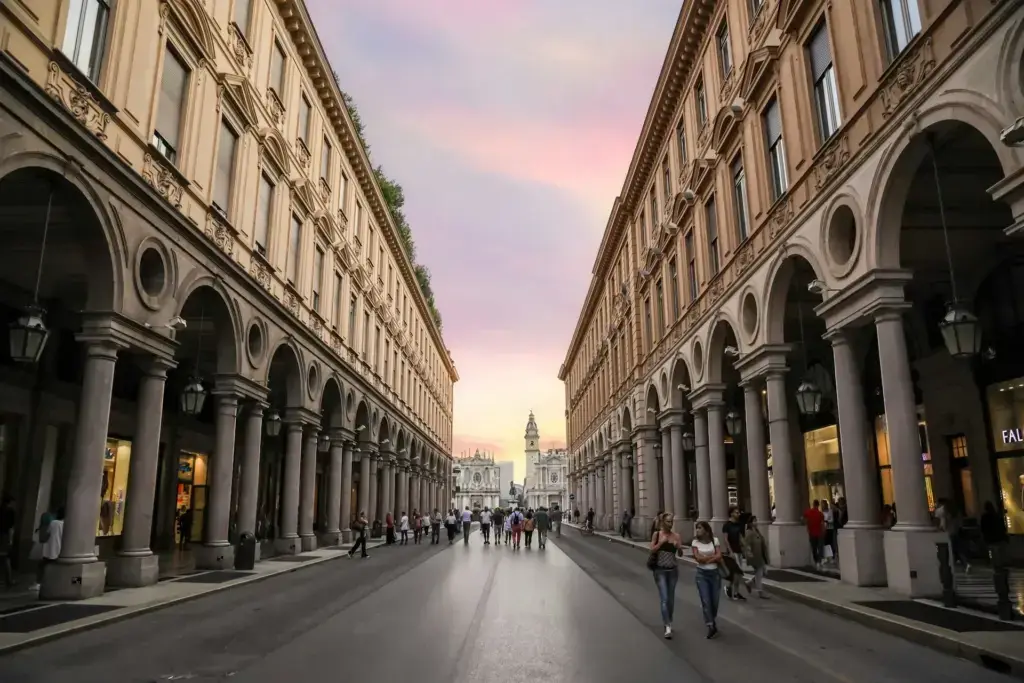
Most Turin museums close on Mondays. The Torino+Piemonte Card covers most of this list and pays off from about the third museum. The centre is compact and connected by eighteen kilometres of arcaded walkways, so you can cross town in the rain without getting wet, a genuinely useful piece of eighteenth-century planning.
See the city between museums
Turin is a grid of arcades, cafés and squares that rewards walking. A city game gives that walking a shape: you explore in small teams with your phone, solve puzzles tied to real streets and buildings, and find corners of the centre most visitors never reach. No guide, no fixed start time, and you stop for a coffee whenever you like.
It works for friends, families and company outings and larger groups. The how it works page explains the format step by step.
Frequently asked questions
Which museum in Turin is the best?
The Egyptian Museum, for the scale and quality of the collection. The cinema museum is the most enjoyable building.
Can you see the Shroud of Turin?
Not normally. It is displayed only on rare occasions announced in advance. The Museo della Sindone tells the story year-round.
How many days do you need in Turin?
Two days for the museums on this list. Three if you want Venaria Reale or Castello di Rivoli as well.
Is the Torino+Piemonte Card worth it?
Usually, if you visit three or more paid sites. Check the current price against the individual tickets you actually want.
Can you go up the Mole Antonelliana?
Yes, by a glass lift, on a separate ticket from the museum. The view takes in the city and the Alps behind it.
Is Turin worth visiting?
Very much so, and it is far quieter than Italy's better-known cities. It is also the best city in Italy for coffee, chocolate and aperitivo.
Go, and start underground in Egypt
Turin is the Italian city that rewards people who ignore the obvious itinerary. See all the cities where we run games, read about the neighbours in Quests in Milan, or get in touch if you are planning something for a group.