Berlin is not one city
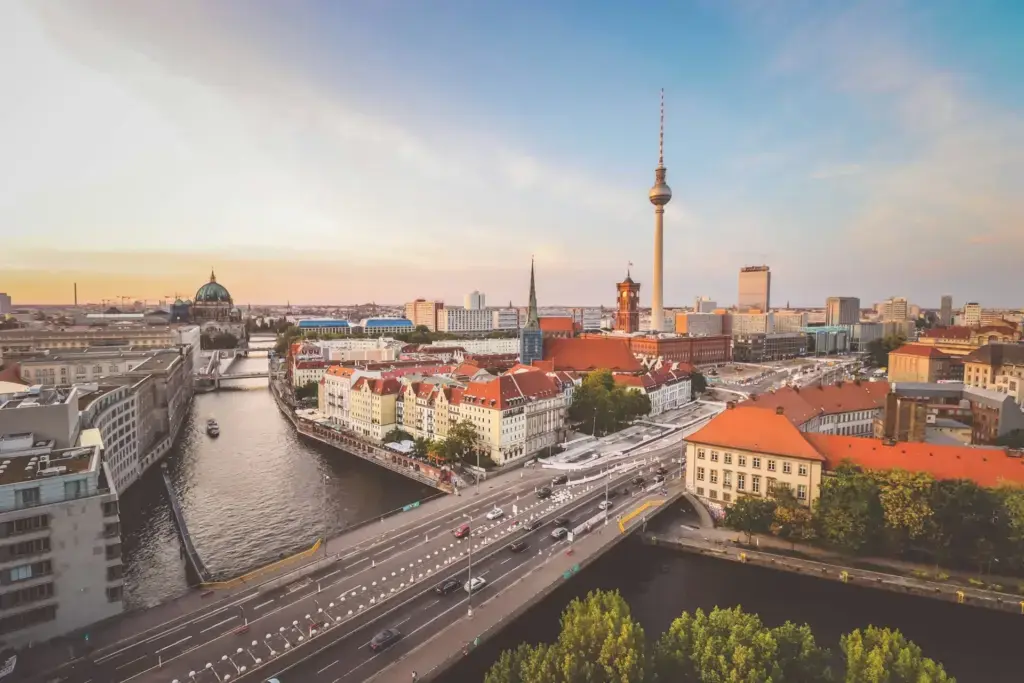
Berlin has no single centre, and that is the first thing to understand. It grew from separate towns, was split in two for twenty-eight years, and then had to stitch itself back together. The result is a set of districts with genuinely different characters, and picking the wrong one for your trip is the most common Berlin mistake.
Here are four that are worth your time, and honestly what each is for.
Mitte: the history you came for
Mitte means middle, and it holds almost everything on a first-time list: the Brandenburg Gate, Unter den Linden, the Reichstag with its glass dome, and Museum Island, a UNESCO World Heritage site with five major museums on one river island.
It also holds the hardest places. The Memorial to the Murdered Jews of Europe is a field of concrete slabs on uneven ground that you walk into rather than look at, and the information centre beneath it is quiet and devastating. Nearby, the Topography of Terror stands on the site of the Gestapo headquarters.
One honest warning: skip Checkpoint Charlie. What is there now is a replica hut with costumed actors and souvenir shops. For the Wall, go instead to the Berlin Wall Memorial on Bernauer Straße, where a preserved section shows the full death strip with the watchtower and the second wall, and explains what the border actually was.
Prenzlauer Berg: the one that changed most
North of Mitte, Prenzlauer Berg was a run-down East Berlin district of nineteenth-century tenements, occupied by artists and dissidents in the 1980s and central to the protests of 1989. Since reunification it has become one of the most expensive and family-heavy parts of the city, and locals argue endlessly about whether that is a success or a loss.
What to do here: the Sunday flea market at Mauerpark, with an open-air karaoke amphitheatre that draws hundreds of people and is much better than it sounds; the cafés around Kollwitzplatz; the Kulturbrauerei, a brewery complex turned cultural centre. The Wall memorial on Bernauer Straße runs along this district's edge.
Friedrichshain: the Wall, the boulevard and the nightlife
Friedrichshain, on the eastern side, holds the East Side Gallery: the longest surviving stretch of the Berlin Wall, painted by artists from around the world in 1990. It is outdoors, free, and busy; go early.
Walk Karl-Marx-Allee too. This vast socialist boulevard of tiled apartment blocks was East Germany's showpiece, built to demonstrate what the state could do for workers, and it is one of the most extraordinary streets in Europe precisely because it is so unlike the rest of the city.
At night, Friedrichshain is where a lot of Berlin's club life happens, around the RAW site and the Spree. Berlin club doors are selective and photography inside is usually forbidden; treat both as house rules rather than a challenge.
Charlottenburg: the West that got quieter
Before the Wall came down, Charlottenburg was the centre of West Berlin, and the Kurfürstendamm was its main street. After reunification the energy moved east, and the district settled into being handsome, comfortable and much calmer.
Go for Schloss Charlottenburg, the baroque palace with formal gardens; the Kaiser Wilhelm Memorial Church, whose bombed tower was deliberately left ruined next to a modern blue-glass church; and the streets around Savignyplatz for eating. The department store KaDeWe has a food floor worth an hour even if you buy nothing.
And if you have a fifth day
Kreuzberg and Neukölln are where a lot of Berlin's food and street life is now, from the Turkish market on the Maybachufer to the courtyards of the Bergmannkiez. The Jewish Museum, in Kreuzberg, is worth a visit for Daniel Libeskind's building as much as for the exhibition.
Seeing Berlin by playing it
Berlin is enormous and much of what matters is invisible unless someone points it out: the double line of cobbles marking where the Wall stood, the Stolpersteine set into pavements, the joins between rebuilt and original. A city game gives you a route with clues through a district, which is a far better way to spend a morning than a coach tour. It works well with a group and with older children.
Frequently asked questions
Where should I stay in Berlin?
Mitte for sightseeing on foot, Prenzlauer Berg for quiet and cafés, Friedrichshain for nightlife, Charlottenburg for calm and space.
How many days do I need?
Three days for one district plus the central sights. Five if you want museums, the Wall memorial and time in the east.
Is Checkpoint Charlie worth it?
Not really. The Bernauer Straße memorial and the East Side Gallery tell the story far better.
How do I get around?
U-Bahn, S-Bahn, trams and buses on one ticket. Distances are long, so buy a day pass rather than single tickets.
Is Berlin expensive?
Cheaper than Munich or Hamburg for food and accommodation, though less so than it used to be. Museums often have combined tickets.
Come and play in Berlin
If you want to read a district rather than pass through it, walk it with a playing route. Here is how it works, and for team outings and larger groups we have formats on this page. Questions about dates, group sizes or routes? Get in touch. An hour south by train, and central to 1989: Leipzig.