
Most cities tidy their history into museums. Berlin leaves it in the street. A double row of cobblestones runs through the middle of roads to mark where the Wall stood. Small brass plates set into the pavement carry the names of people deported from the buildings above them. Bullet scars are still visible on facades that nobody has repaired, on purpose.
That makes Berlin unusually well suited to a quest – a route on your phone, played in teams, where each stop holds a question you can only answer by standing there. The city has already done the hard part of putting the answers outside.
What you are actually looking at
The Wall line. The cobblestone strip crosses streets and squares in the centre, often where you would least expect it. Following it for ten minutes tells you more about the city’s shape than an afternoon in a museum.
Stolpersteine. The brass memorial stones set into pavements outside the last freely chosen homes of victims of Nazi persecution. They are everywhere once you start looking down, which is the point of them.
Two of everything. Forty years of division left Berlin with two centres, two opera houses, two of most civic things. The seams between them are visible in the architecture street by street.
The Ampelmännchen. The East German pedestrian signal survived reunification and is now a city mascot – a small, cheerful example of the same layering.
How a quest runs
You pick the start point and the time. The story loads on one phone per team and sends you to the first location, where the app asks something the place answers: a date on a plaque, the number of columns on a facade, a name on a memorial.
Right answer, next stop unlocks. Wrong answer costs points rather than the game. Two hours later everyone converges on the same finish with a score. The practical detail is on the how it works page.
Where to play
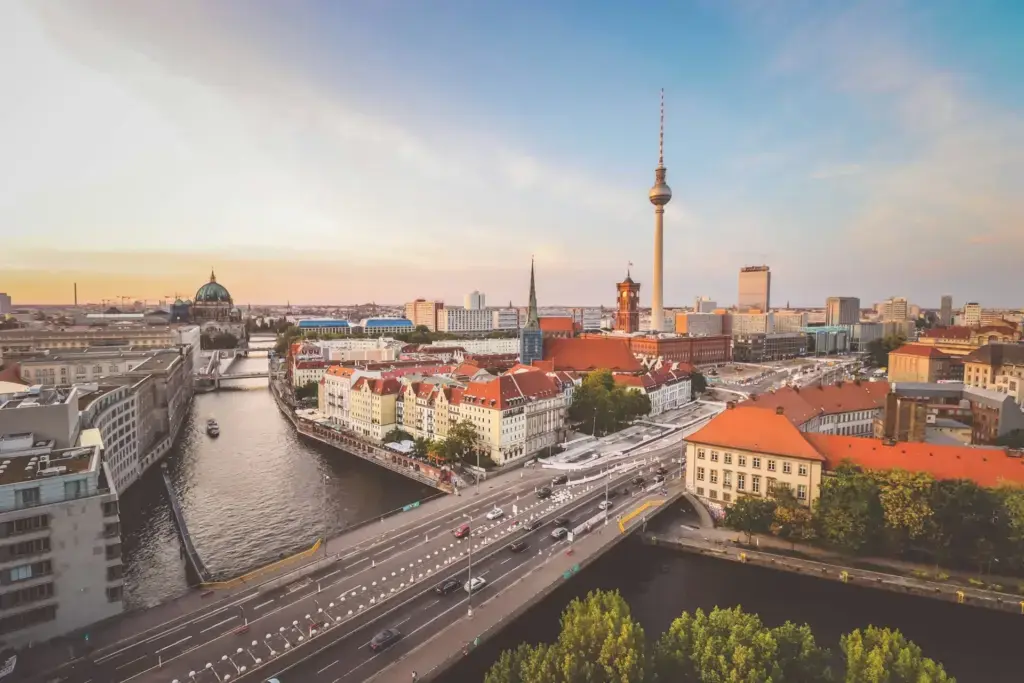
Mitte for the density of history: Museum Island, the Wall line, Bebelplatz, the Nikolaiviertel. Everything within walking distance, and a lot of it easy to miss without a reason to look.
Prenzlauer Berg for nineteenth-century streets that survived the war largely intact, plus courtyards and a completely different pace.
Kreuzberg for a route that is about the last fifty years rather than the last two hundred – street art, migration, the changing city.
Berlin is large and spread out, so pick one district and stay in it. A route that tries to cross the city becomes a day on the U-Bahn.
Practical notes
Distances are longer here than in most European centres, so check the route length before committing a group with limited mobility. Public transport is excellent and worth having on a phone in case a team needs to skip ahead.
Berlin gets genuinely cold from November to March. A two-hour route is comfortable in a coat; four hours is not. Book somewhere warm for the finish.
For a group, split into teams of four to six all playing the same route. Our groups and companies page covers larger bookings, and our piece on group activities has more on picking a format by size – the reasoning carries across cities.
Frequently asked questions
What is a quest in Berlin?
A self-guided route through the city played on a phone in teams, where each location holds a puzzle that must be solved on the spot before the next unlocks. No guide, no fixed departure, and you set the pace.
How long does it take?
Around two hours of play covering two to four kilometres. Allow three hours in total including gathering and a finish.
Do you need to speak German?
No. Games are available in several languages, and Berlin is one of the easiest large cities in Europe to spend a day in with English alone.
Which district is best for a first visit?
Mitte. It has the highest concentration of the things people come to Berlin to see, and the shortest distances between them.
Is it suitable for children?
From about eight years old with an adult in the team. Some of the history a route passes is heavy, which is worth knowing in advance rather than being surprised by.
What about winter?
Playable, but keep it short and end indoors. Between December and February the light goes early and the wind is the deciding factor rather than the temperature.
Playing in Berlin
See what is currently running on our locations page, or tell us about your group through the contact page.