Why there is so much Roman stone here
Trier calls itself the oldest city in Germany, founded as Augusta Treverorum around 16 BC. That alone would not explain what survives. What matters is what happened later: in the late Roman empire Trier became an imperial residence, one of the capitals of the western empire, and emperors build on a different scale from provincial governors.
The result is a cluster of monuments that UNESCO listed together in 1986, all within walking distance in a town small enough to cross in half an hour.
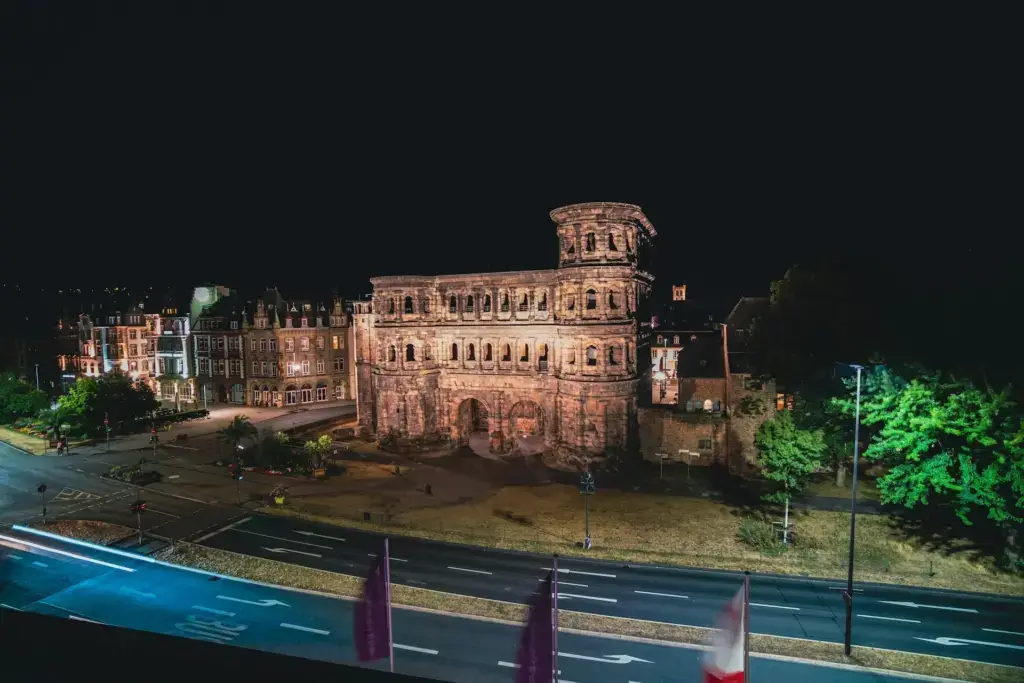
The Porta Nigra
The Porta Nigra is the best-preserved Roman city gate north of the Alps, and it is genuinely startling at first sight: two storeys of arcades in huge sandstone blocks, laid without mortar and held together with iron clamps. The name simply means black gate, from centuries of weathering.
It survived because of an accident of history. A Greek monk named Simeon lived walled inside it in the eleventh century, and after his death the gate was converted into a church, which protected it for seven hundred years. In the early nineteenth century, under Napoleon, the church additions were stripped away and the Roman gate reappeared. You can climb it, and you should.
The imperial baths and the Barbara baths
The Kaiserthermen, the imperial baths, were begun on an enormous scale and never finished as a bathing complex. What makes them worth an hour is underground: a network of service tunnels beneath the floor level, where slaves moved fuel and water out of sight of the bathers. Walking through them tells you more about Roman society than the walls above.
The Barbarathermen, older and once even larger, survive mainly as foundations, viewed from a raised walkway. Go if you want the scale; skip it if you are short of time and do the imperial baths properly instead.
The amphitheatre
The amphitheatre is dug into the hillside at the edge of the old town, and it held thousands. Below the arena floor you can enter the cellar where animals and equipment were raised into the ring. Standing down there, with the seating rising above you, gives you the perspective that no reconstruction drawing does.
The Roman bridge, still carrying cars
This is the one most visitors miss. The stone piers of the Römerbrücke over the Moselle were built in the second century AD, and they are still in use today, carrying a modern road deck and daily traffic. Nearly two thousand years of continuous service is a claim very few structures anywhere can make.
Walk out onto it and look down at the piers. Then look at the traffic going over them.
Constantine's throne hall and the cathedral
The Konstantin-Basilika, the Aula Palatina, was Constantine's throne hall: a single vast brick room with no columns, the largest surviving single-room structure from antiquity. It is a Protestant church now, kept almost bare, and the emptiness is the point. The room was designed to make a person walking towards the emperor feel very small.
Nearby, Trier Cathedral is the oldest in Germany, and parts of its core are fourth-century Roman masonry from a church built under Constantine. Look at the outside wall where the enormous old stones meet the later work; the join is visible.
Beyond the Romans
The Rheinisches Landesmuseum holds the finds, including carved stone from Roman tombs and a famous relief of a wine ship, which is a reminder that this valley has been making wine since the Romans planted it. Trier sits on the Moselle, and the Riesling from these slopes is the other reason to be here.
And Karl Marx was born in Trier in 1818. His birth house is a museum, and it deals with both the man and how he has been used since.
Seeing Trier by playing it
The sites are close together but the connections between them are what make sense of the city, and those are easy to miss. A city game gives you a route through the old town with clues to solve, so you notice the Roman stone reused in medieval walls and the shape of the original street grid under the modern one. It works well with children, who generally prefer the amphitheatre cellar to any museum.
Frequently asked questions
How long do I need in Trier?
One full day covers the Porta Nigra, the imperial baths, the amphitheatre, the basilica and the cathedral. Two days if you want the museum and a Moselle vineyard.
Is there a combined ticket?
Yes, combined tickets covering several Roman sites are usually available and cheaper than separate entries. Ask at the first site you visit.
Is the Roman bridge really Roman?
The piers are, from the second century AD. The road deck on top is modern, and the bridge still carries traffic.
Is Trier good with children?
Yes. Climbing the Porta Nigra and going underground at the baths and the amphitheatre work far better than most historic sites.
How do I get there?
By train from Koblenz or Luxembourg, both of which are short journeys. The old town starts a few minutes from the station.
Come and play in Trier
If you want to read the city rather than tick off five ruins, walk it with a playing route. Here is how it works, and for team outings and larger groups we have formats on this page. Questions about dates, group sizes or routes? Get in touch. Further down the Rhine: Cologne.