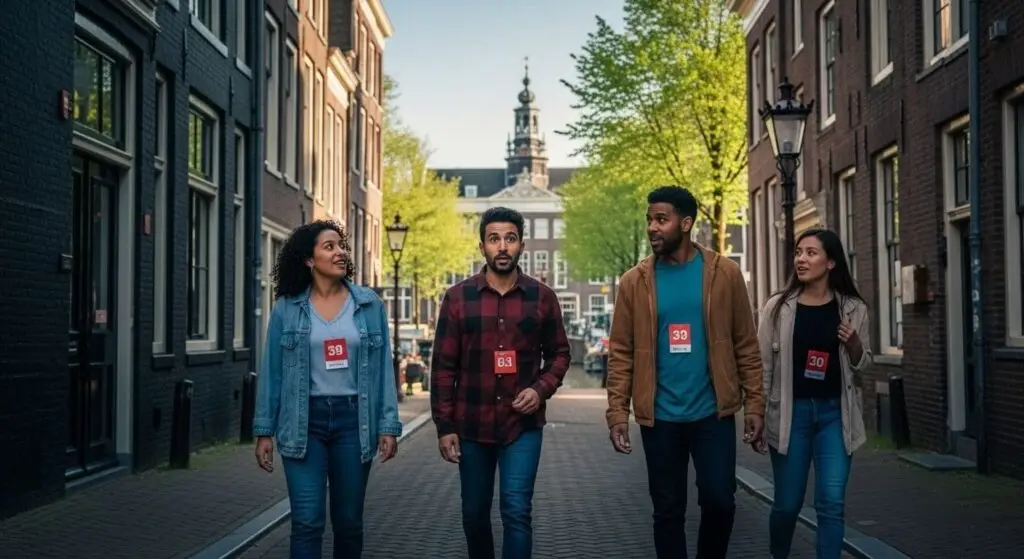
Most colleague outings fail in a specific and predictable way. Everyone shows up, everyone is pleasant, and everyone spends the afternoon with the four people they already sit next to. Nothing goes wrong, and nothing happens either. Three weeks later nobody can remember what you did.
The fix is not a bigger budget or a more impressive venue. It is a structure that makes people talk to someone they do not normally talk to, and gives them a reason to keep talking after. Here is how to build one in Amsterdam.
Decide what the day is for – honestly
There are three legitimate goals, and they need different days.
Reward. The team worked hard and deserves something good. Choose comfort: a boat, a long lunch, somewhere nice. Do not make them do a workshop.
Connection. New joiners, a merged team, remote colleagues who have never met. This is the one that needs structure, because comfort alone will not mix people.
Working through something. A retro, a strategy day. That is a meeting with a nice location, and it should be planned as one, with the social part clearly separate at the end.
Trying to do all three in one day is why so many company days feel exhausting and slightly hollow.
What actually mixes people
Three things reliably get colleagues talking across their usual boundaries: a shared task with a time limit, teams they did not choose, and physical movement. Combine all three and the mixing happens by itself.
An outdoor city game is built on exactly that combination, which is why it is our answer – teams of four to six follow a route through Amsterdam, solving something at each stop, with everyone finishing at the same place. But the principle matters more than the format: a cooking class where teams are assigned works, and a boat where everyone sits with their own department does not.
Mix the teams deliberately. Assign them yourself, before the day. If you let people choose, they will pick their own desk cluster, and you will have spent the budget to reproduce the seating plan.
What to avoid
Activities where one person dominates. Anything requiring a specific skill – sport, karaoke, quizzes with narrow trivia – splits the group into performers and spectators.
Compulsory sharing. Nobody wants to say one interesting fact about themselves to a circle of thirty. Let people talk sideways while doing something, not face-on while doing nothing.
Overrunning. A day that goes past its stated end time costs you the goodwill you spent the day building, especially for anyone with childcare or a long commute. Finish when you said you would and let people stay if they want.
Drinking as the whole plan. It excludes more people than most organisers expect – those not drinking, those driving, those who would simply rather not.
A structure that works in Amsterdam
Meet at half two somewhere easy to reach by tram or from Centraal. Fifteen-minute buffer. Two hours of activity in mixed teams, finishing around five. Then a booked table or bar within ten minutes’ walk of the finish, with a clear end time and no obligation to stay.
That is three hours, fits after a half day of work, does not eat anyone’s evening, and puts the social part where it belongs – after people have something to talk about rather than before. The practical detail of how a route runs is on the how it works page, and the groups and companies page covers invoicing and larger bookings.
The ten minutes that make it worth the money
At the end, before people scatter, ask two questions: what did your team do when you got stuck, and who noticed something the rest missed? Two or three answers is enough. That short conversation converts a nice afternoon into something people reference at work afterwards – and it costs nothing.
If you want the wider comparison of formats by group size and by what they demand of people, our piece on outdoor team building activities for work goes into it properly.
Frequently asked questions
What is a good colleague outing in Amsterdam?
One with a shared task, assigned mixed teams and movement – an outdoor city game, a team cooking class, or a workshop where groups are set in advance. A boat or a meal alone is a reward, not a mixer.
How long should it be?
Three hours including the social part. Longer and attendance becomes an imposition for people with commitments outside work.
How many people can join?
Any number, if the activity splits into parallel teams of four to six. Venue-based options cap out quickly: an escape room takes eight, a small boat twelve.
What if some colleagues do not want to take part?
Make the social part genuinely optional and the activity easy to opt out of without explanation. Enforced participation reliably produces the opposite of what an outing is for.
How do you handle mixed languages in an international team?
Pick a format available in more than one language, or make sure each team has a shared language and say so when you assign the teams rather than leaving people to sort it out on the pavement.
How do you know whether it worked?
Not from a survey. Two weeks later, notice whether people are talking to colleagues they did not talk to before. That is the only measure that means anything.
Planning a day for your team?
See what is running in the city on our locations page, or tell us about your team through the contact page – size, languages, what the day is actually for – and we will tell you honestly whether we fit it.