
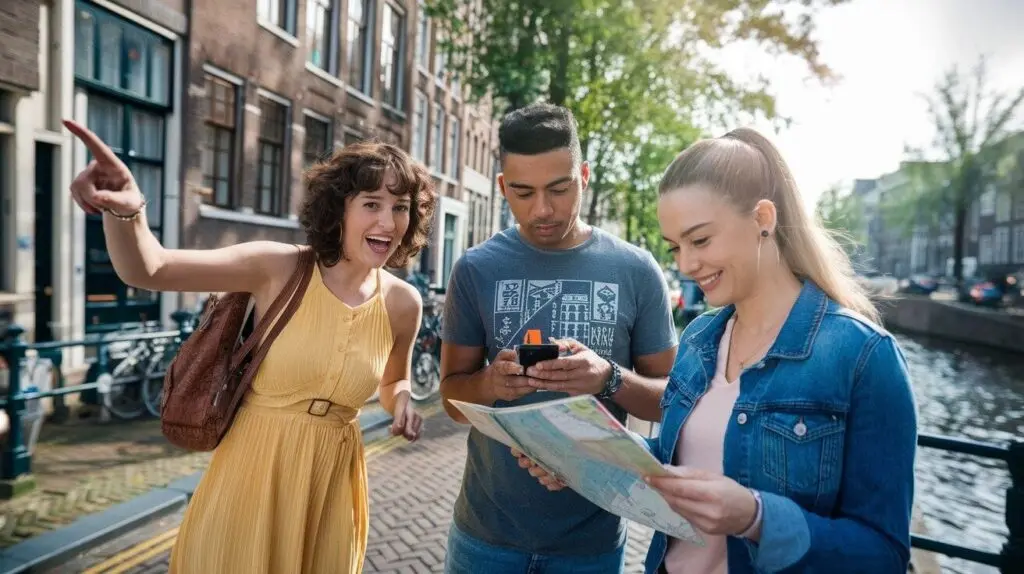
City games get sold to schools as learning disguised as fun. That's half true, and the half that isn't matters, because a trip planned on the wrong expectation disappoints everyone.
Here's an honest account of what a class gets out of a city route, and what it takes to run one with thirty pupils.
What pupils actually learn
Observation. This is the real one. A route trains pupils to look at a building rather than past it - to notice a date, a carving, a change in brickwork where an older wall ends. That's a transferable habit and it's genuinely hard to teach in a classroom.
Orientation. Working out where you are from what's around you, rather than from a blue dot. A surprising number of teenagers have never navigated without turn-by-turn directions.
Working with people they didn't choose. Teams of four to six, assigned rather than self-selected, negotiating an answer under mild time pressure. Most teachers rate this above the content.
Some local history, unevenly. Pupils remember the two or three facts attached to something they physically stood in front of. That's a real effect, but it's two or three facts, not a lesson.
What it doesn't teach
It isn't a curriculum. A two-hour route won't cover a period, build an argument, or give pupils the context that makes a fact mean anything. A guided tour teaches more history; a classroom teaches more of everything else.
The productive way to think about it: the route is where pupils gather impressions and questions. The learning happens in the lesson before and the lesson after.
Making it educational rather than just a day out
Before. Give each team one question the route won't answer, that they'll be able to answer afterwards because of what they saw. "Why is this street so much wider than that one?" is better than a worksheet.
During. Ask pupils to photograph one thing they didn't understand. It's the single most productive instruction, because it collects genuine questions instead of expected answers.
After. Twenty minutes in the next lesson on what they photographed does more than an hour of pre-teaching. The questions are theirs, so the answers land.
The logistics that actually decide it
Supervision ratios. Self-guided teams moving independently through a city is the part that needs thinking about. Most schools work to a ratio set by their own policy and by the pupils' age; check yours before you plan the format, not after. Staff positioned at the halfway point and the end works better than staff walking with one team.
Team size and composition. Four to six, assigned. Mixing pupils deliberately is the whole social benefit; letting them choose gets you the existing friendship groups.
Phones. One per team, charged, and agree in advance whose it is. For schools with a no-phone policy this needs a decision beforehand rather than an argument on the day.
Meeting points. Name a finish point and a time, and a fallback point in case of separation. Every pupil should be able to say both without checking.
Distance and accessibility. Routes run two to four kilometres on flat city streets. Check the stated distance against your group, including any pupil with mobility needs, and ask whether the route can be shortened.
Weather and daylight. Light rain is workable; heavy rain isn't, and in winter the light goes early. Have an indoor fallback for the last hour.
Which ages it suits
Under eight: only with an adult per team reading the clues, and a shortened route.
Eight to twelve: the strongest fit. Pupils read independently, argue productively, and have the stamina.
Teenagers: works well, and the independence is the appeal. The risk is a route pitched too young, which they'll spot immediately.
Sixth form and university groups: better as a social or induction activity than as teaching.
Where to look
You can see which cities have routes and check whether one is within reach of the school. The page on how the game works covers the format, which is usually what a risk assessment needs.
For a class split into several teams, and for invoicing to a school, there's a setup for groups and companies.
Frequently asked questions
What age is a city game suitable for at school?
Eight to twelve is the strongest fit. Younger classes need an adult per team; teenagers do well with more independence.
How long does it take with a class?
Allow two and a half hours for a two-hour route, plus gathering time at both ends.
How many adults do you need?
Follow your school's own ratio policy. Staff at the halfway point and the finish covers more than staff walking with a single team.
Does it fit a curriculum?
Not by itself. It works as the observation stage between a preparation lesson and a follow-up lesson.
What if pupils don't have phones?
One per team is enough, and a school device works. Agree the arrangement before the day rather than on the pavement.
Is it suitable for pupils with additional needs?
Often yes, but ask about distance, steps and whether the route can be shortened. Reading-heavy puzzles are worth checking too.
In short
A city route teaches observation, orientation and cooperation well, and history only in fragments. Plan the lesson afterwards and it becomes educational; skip it and it's a nice afternoon. If you'd rather write your own around a specific topic, we've covered planning a city scavenger hunt.
Planning a trip for a class and want to know whether a route fits? Ask through the contact page.