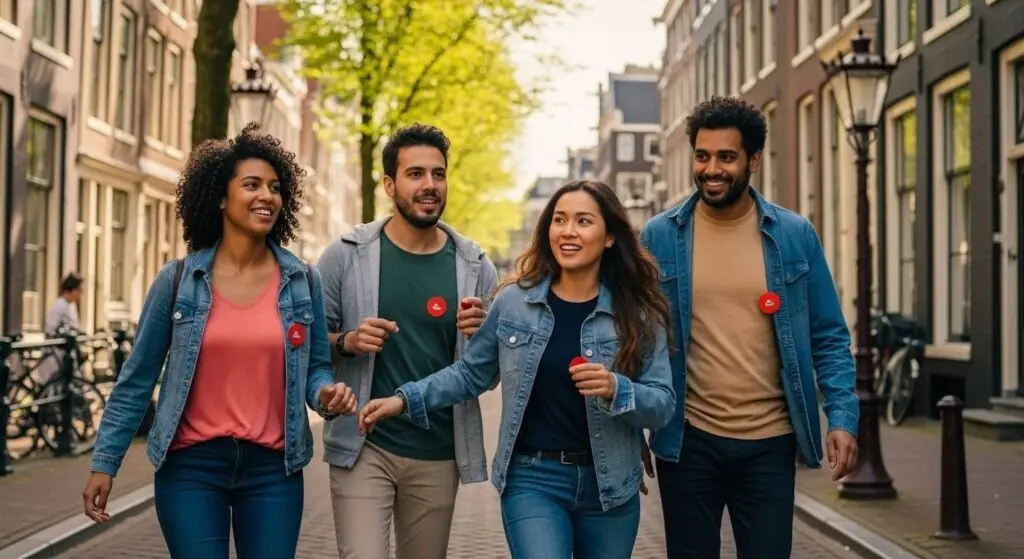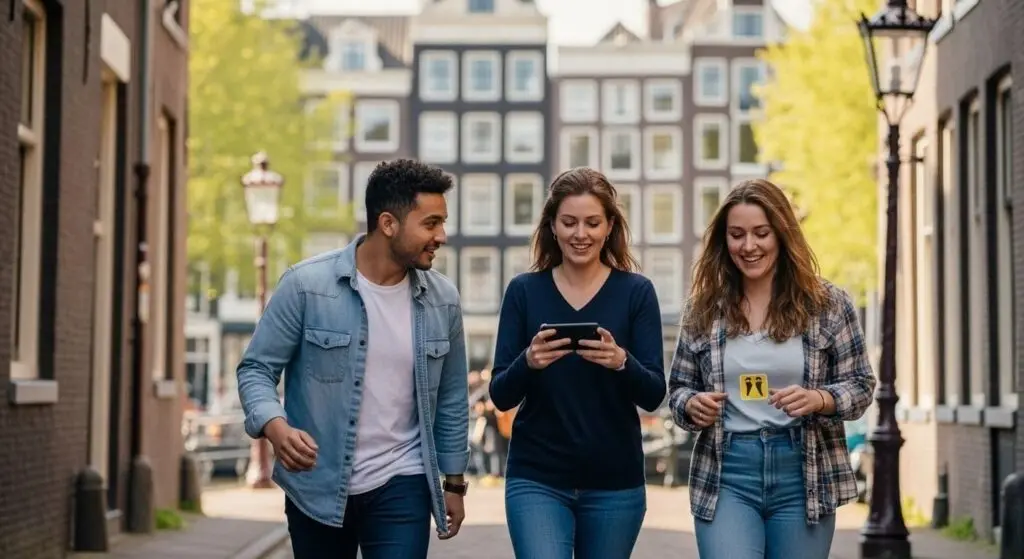
A city scavenger hunt uses a real centre as the board: teams walk between squares, statues, doorways and inscriptions, answering questions that only make sense while standing there. It's the outdoor version of a puzzle game, and the reason it works is simple - people talk more easily while walking than sitting opposite each other.
Whether you write your own or use a ready-made route, the same things decide whether it's a good afternoon or a long walk with complaints.
Choosing the area
The single biggest mistake is spreading a hunt too wide. A route across a whole city becomes a walking race, and the fastest team wins rather than the sharpest one.
A dense historic centre is ideal: a few hundred metres between stops, plenty of detail on the buildings, and cafés to duck into. Two to four kilometres in total is the sweet spot for adults, less with children.
Check the practical things too. A market day can make a square unusable. Building works can hide the exact facade a clue depends on. And an area that's lively at three in the afternoon can be empty and unwelcoming at eight in the evening.
Writing clues that work outdoors
Anchor them to permanent things. Dates carved in stone, the number of columns, the animal on a coat of arms, a name on a plaque. Shop signs and posters change; carvings don't.
Make them unanswerable from home. If a search engine gives the answer from the sofa, the clue isn't doing its job. "How many steps lead up to the door?" is a good clue. "When was this church built?" is a trivia question.
Vary the difficulty. A run of hard clues in a row is where groups give up. Alternate: something quick, something that takes ten minutes of arguing, something quick again.
Give each stop something to look at. The best stops are ones where people say "I've walked past this a hundred times". That reaction is the whole point.
Test the route on foot. Every clue you write from a map has a fifty percent chance of being wrong on the ground. This is the step people skip and regret.
Group size and teams
Four to six per team. Larger groups split into several teams playing the same route, meeting at the end to compare. Twenty people in one group means fifteen of them following.
Mix the teams deliberately. If people pick their own, they'll pick whoever they already talk to, and you've achieved nothing.
Practical planning
Timing. Two hours for adults, two and a half with children. Early afternoon is easiest; check what time it gets dark if you're playing in winter.
Meeting point. Choose the end and book a table there. Fifteen people looking for somewhere to sit at six on a Saturday will not find one.
Phones. One per team, charged. This is the most common practical failure.
Weather. Light rain is fine. For heavy rain, moving the start by an hour is better than cancelling - if your format allows it.
Accessibility. Check whether anyone would struggle with a few kilometres, and whether the route involves steps or cobbles.
Things to leave out
Tasks that require entering private property, taking anything, or approaching strangers who didn't agree to be part of your game. Challenges built around alcohol, which exclude the people not drinking. And anything that singles one person out for embarrassment - it stops being funny for them long before it stops being funny for everyone else.
Writing your own or using a ready-made route
Writing a good city hunt takes a full day of walking and testing, and one broken clue stalls the whole game. That's worth doing if the hunt is personal - a wedding, a milestone birthday, a route past places that mean something to the group.
For everything else, a ready-made route is the sensible option: the clues are already tested against what's actually on the buildings, teams run themselves from a phone, and several teams can play at once.
You can see which cities have routes and pick one near you or where you're travelling. The page on how the game works explains the format in a couple of minutes.
For company outings and larger groups there's a setup for companies and groups.
Frequently asked questions
How long does a city scavenger hunt take?
Around two hours for adults, two and a half with children or a group over ten. Distances are usually two to four kilometres.
How many people can play?
Any number, in teams of four to six. Several teams playing the same route at once works better than one large group.
Do you need to book a time?
Self-guided routes have no time slots, so you start when the group is ready. Hosted hunts usually do need a booking.
What age is it suitable for?
From about eight children play independently, and from five with an adult reading the clues.
How do you stop it becoming a running race?
Keep the area small and score on correct answers rather than finishing time. Speed should never be the deciding factor.
What if a clue turns out to be wrong?
Have a fallback answer or hint ready. In a self-written hunt, one unanswerable clue can stop every team at the same stop.
In short
Keep the area tight, anchor clues to things carved in stone, mix the teams, and test the route on foot before anyone plays it. For the wider view of formats, we've written about scavenger hunts in general.
Planning one for a specific city or group? Ask us through the contact page before you commit.
Secrets of …
Discover the stories behind the facades. For everyone. See the games ›