The town the Romantics could not leave alone
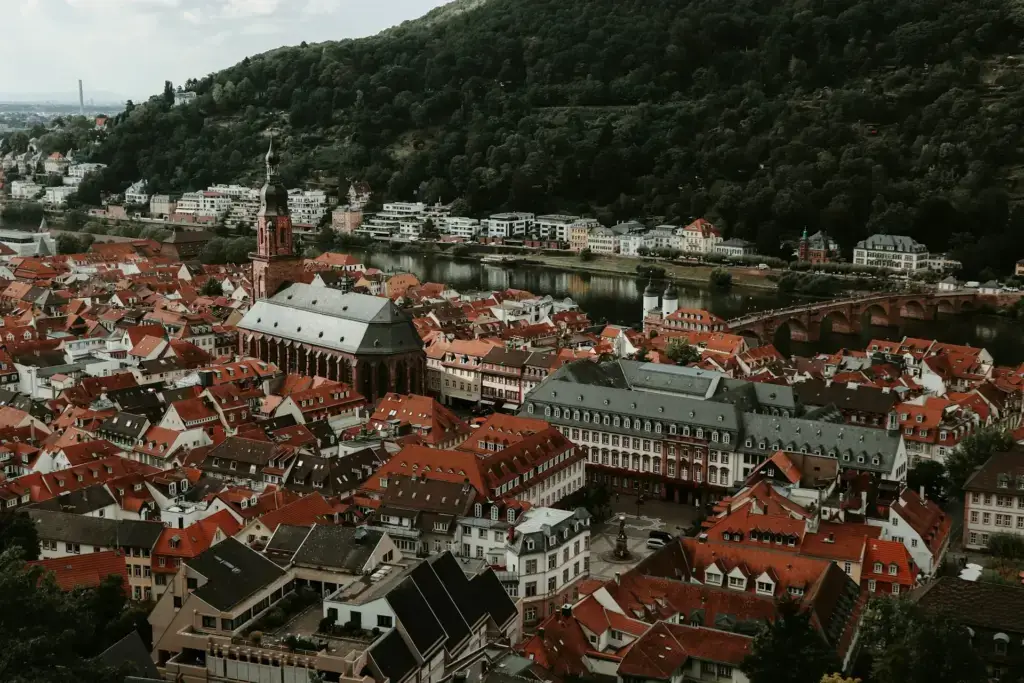
Heidelberg sits where the Neckar comes out of a wooded valley into the Rhine plain, with a red sandstone castle half-collapsed on the hillside above it. In the nineteenth century that combination made it the model romantic German town for poets and painters, and it has been dealing with the consequences ever since.
What saves it from being only a postcard is the university, founded in 1386 and the oldest in Germany. Term time fills the streets with people who live here rather than visit, and it changes the atmosphere completely.
The castle, and why it is a ruin
Heidelberg Castle is not a ruin by neglect. French troops destroyed much of it during the wars of the late seventeenth century, and after a lightning strike in 1764 the decision was taken not to rebuild. By then the ruin had become the point: nineteenth-century travellers preferred it broken and half-swallowed by ivy, and a serious reconstruction was argued about and eventually refused.
Inside, do not miss the Great Vat, a wine barrel in the cellar so large it has a dance floor built on top of it. The terrace gives the view down over the roofs and the river that everybody photographs.
You can walk up in about fifteen steep minutes, or take the funicular from the Kornmarkt.
The Königstuhl
The same funicular line continues above the castle to the Königstuhl, the hill behind the town. The upper section still runs historic wooden carriages, which is worth the ticket on its own, and the top gives a wide view across the Rhine plain rather than the postcard view of the town.
There are walking trails down through the woods if you want to make an afternoon of it. Wear proper shoes; it is steeper than it looks from below.
The old town
Heidelberg escaped serious bombing in the Second World War, so the Altstadt is genuinely old rather than rebuilt. The Hauptstraße running through it is one of the longest pedestrian streets in Europe, which also makes it the most crowded part of town.
Step off it. In the side streets you get the Heiliggeistkirche on the market square, the university quarter, and the Studentenkarzer, the old student prison, where undergraduates were locked up for drinking and duelling and covered the walls with drawings and signatures. It was more of a badge of honour than a punishment, and the walls prove it.
The Philosophers' Way
Cross the river and climb the Philosophenweg on the north bank. This is where the classic view of Heidelberg comes from: castle, old town and bridge together, with the valley behind. The name comes from university professors who walked it to think, and the path is warm and sheltered enough that unusual plants grow along it.
The climb up from the bridge is short and sharp. Go in late afternoon, when the light comes across the castle rather than behind it.
The old bridge and the monkey
The Alte Brücke across the Neckar dates from the eighteenth century and is guarded at the town end by a medieval gate with twin towers. Beside it sits a brass bridge monkey holding a mirror, a modern sculpture recalling a much older one that stood here.
Local custom gives it three functions: touch the mirror for wealth, the outstretched fingers to ensure you return to Heidelberg, and the mice beside it for children. Everyone does at least one.
Seeing Heidelberg by playing it
The old town is small and its best parts are in the side streets, which is exactly the situation where a route helps. A city game sends you solving clues through the lanes, the market squares and the university quarter, so you find the student prison and the odd inscriptions rather than walking the shopping street twice. It works well with a family or a group, and it fills the hours before or after the castle.
Frequently asked questions
How long do I need in Heidelberg?
One full day covers the castle, the old town and the Philosophers' Way. Two days if you want the Königstuhl and the woods as well.
Do I have to walk up to the castle?
No. The funicular runs from the Kornmarkt, and the ticket can be extended to the Königstuhl above.
Is the castle worth the entry fee?
Yes, for the terrace view and the Great Vat. The grounds and courtyard are the main experience rather than furnished rooms.
When is the best time to visit?
Late spring and early autumn. Summer is busy with coach groups, and December has a good Christmas market in the old town squares.
Can I do it as a day trip?
Yes, easily from Frankfurt or Mannheim by train. The station is a tram ride from the old town.
Come and play in Heidelberg
If you want the town and not just the view of it, walk it with a playing route. Here is how it works, and for team outings and larger groups we have formats on this page. Questions about dates, group sizes or routes? Get in touch. An hour north by train: Frankfurt.