
The Culture of Osaka: Food, Comedy and Neon
17. februar 2023
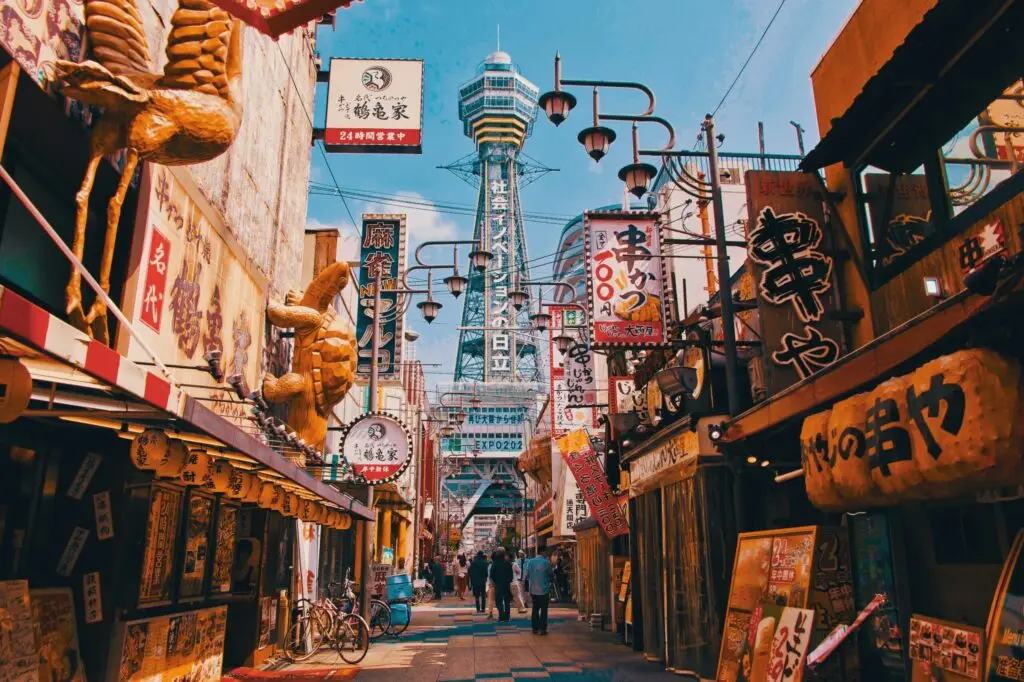
Japan's three big cities have a shorthand that Japanese people use themselves: Tokyo dresses, Kyoto wears kimono, Osaka eats. The word for it is kuidaore — eating yourself into ruin — and Osaka wears it as a compliment.
Osaka is louder, blunter and funnier than the rest of the country expects a Japanese city to be. It has its own dialect, its own comedy tradition, its own attitude to strangers, and food that is designed to be eaten standing up. Here is what that actually means on the ground.
Why Osaka feels different
Osaka was a merchant city, not a court or a government one. For centuries it was the country's commercial hub, where rice was traded and prices were set, and its culture grew out of trade rather than aristocracy or bureaucracy.
You can hear it. Osaka-ben, the local dialect, is faster and more direct than standard Japanese, and the traditional greeting between merchants translates roughly as "are you making money?" Osakans have a reputation across Japan for talking to strangers, haggling, and being funny on purpose. The country's comedy industry is largely based here, built on manzai — a two-person stand-up form with a straight man and a fool.
A small thing that tells you where you are: on escalators, Osaka stands on the right and walks on the left, the opposite of Tokyo. Nobody agrees on why.
The food, properly
Takoyaki
Balls of batter with a piece of octopus inside, cooked in a dimpled iron plate and turned with a skewer, served with sauce, mayonnaise and bonito flakes that move in the heat. They are molten inside. Wait a minute before the first one; everyone burns their mouth anyway.
Okonomiyaki
A savoury pancake of batter, cabbage and whatever else — pork, prawn, cheese. The Osaka style mixes everything into the batter before cooking; Hiroshima layers it instead and adds noodles. Do not tell an Osakan the Hiroshima version is better unless you want a conversation.
Kushikatsu
Skewers of meat, vegetables and odd things like cheese or quail eggs, breaded and deep fried, dipped in a communal pot of thin sauce. The one rule, printed on the wall of every kushikatsu bar: no double dipping. Everyone shares the sauce. Use the cabbage they give you as a scoop if you need more.
Where to eat it
Dotonbori is the famous strip along the canal, lit by enormous signs including the Glico running man, which has been advertising sweets in that spot since the 1930s. It is crowded and slightly ridiculous and worth doing once.
The better eating is a street or two back. Hozenji Yokocho is a narrow stone-paved lane behind Dotonbori with small traditional restaurants and a moss-covered statue that people splash with water for luck. Shinsekai, further south under the Tsutenkaku tower, is the old kushikatsu district, faded and cheerful.
Kuromon Ichiba market is the historic food market, though it has shifted heavily towards visitors and prices have risen accordingly. Go early, and treat it as a place to look rather than the cheapest place to eat.
What to see between meals
Osaka Castle
Impressive from outside, and worth knowing that the tower is a 1931 reconstruction in concrete, with a lift inside and a modern museum. The original was built by Toyotomi Hideyoshi in the 1580s and destroyed twice. The stone walls and moats, however, are original and genuinely enormous — some of the base stones weigh more than a hundred tonnes and were shipped in from other islands.
Sumiyoshi Taisha
One of the oldest shrines in Japan, built in a style that predates Chinese and Buddhist architectural influence: straight roofs, no curves, no vermilion-painted brackets. The steeply arched bridge at the entrance is the image everyone photographs. It is a twenty-minute tram ride south of the centre and almost nobody makes the trip.
Tsutenkaku and Shinsekai
A 1950s tower in a district built in 1912 to look like Paris on one side and Coney Island on the other, then left behind for most of a century. At the top of the tower sits Billiken, an American good-luck figure adopted by Osaka, whose feet you rub for luck.
Umeda Sky Building
Two towers joined at the top by a floating open-air observatory, reached by an escalator that crosses the gap in mid-air. The best view of the city, and the walk up is the point.
Bunraku
Osaka is the home of bunraku, the puppet theatre in which three visible operators work one half-size figure together, with a chanter and a shamisen player telling the story. The National Bunraku Theatre stages it with English audio guides. It is nothing like a puppet show for children.
Walking the city
Osaka rewards walking because the good things are at street level and stacked close together: a shrine, then an arcade, then a kushikatsu bar under a railway bridge. A city game gives you a route with something to solve at each stop, which suits a city best experienced at ground level rather than from a viewing platform.
Frequently asked questions
How many days do I need in Osaka?
Two for the city itself. Most people use it as a base and day-trip to Kyoto (fifteen minutes by fast train), Nara (under an hour) and Kobe (half an hour), which is a sensible plan because Osaka hotels are cheaper.
Is Osaka better than Tokyo?
Different. Tokyo is bigger and more varied; Osaka is more concentrated, cheaper, and easier to talk to people in. For a first trip to Japan, most people do both.
When should I visit?
Spring and autumn. Summer in Osaka is genuinely difficult — hot and very humid — and the city is largely indoors in August.
Do I need Japanese?
No. Signage in the centre is bilingual, restaurants have picture menus, and translation apps work well. A few words go further here than elsewhere in Japan, because people will actually talk back.
Is it expensive?
Less than Tokyo. Street food is cheap, and the standing bars and small restaurants are among the best value in the country.
Does Osaka work for a group?
Yes, especially around food, since almost everything is shared and eaten standing. The transport is dense and reliable. For organised group activities, see what we run for companies and groups.
Plan the day
A shape that works: the castle grounds in the morning, Shinsekai and kushikatsu for lunch, Sumiyoshi Taisha or the Umeda Sky Building in the afternoon, and Dotonbori after dark. If you want the walking to have a route, here is how our games work, and you can get in touch about organising one. Travelling on through Asia? Our guide to the grand palaces of Seoul covers a very different kind of city centre.