
Secrets of Bologna: Our City Game Is Now Live
21. november 2025
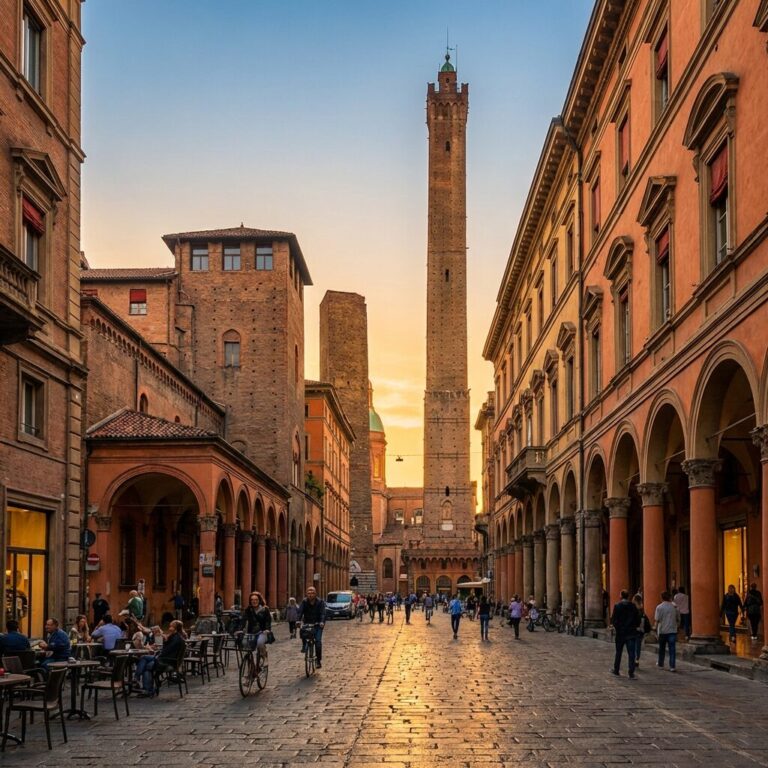
Our city game in Bologna is now live, which gives us a reason to write the thing we actually wanted to write: a proper guide to a city that most people pass through on the way to Florence or Venice and should not.
Bologna has three old nicknames, and between them they explain it. La dotta, the learned, for the university founded in 1088 and generally counted as the oldest in the Western world still running. La grassa, the fat, for the food. La rossa, the red, for the brick and the terracotta roofs, and later for its politics. All three are still true.
The porticoes
The first thing you notice is that you are walking under cover. Bologna has tens of kilometres of porticoes through its centre, built from the Middle Ages onward, originally so that houses could extend their upper floors over the street and take more students. They were added to UNESCO's World Heritage list in 2021.
Practically, they mean you can cross the whole city in rain or full August sun without either touching you. They also change how the city feels: you are always half indoors, the light comes in sideways, and every street has a rhythm of columns.
The extreme version is the Portico di San Luca, which runs from the edge of the centre up the hill to the sanctuary of the Madonna di San Luca: nearly four kilometres of continuous arcade, several hundred arches, climbing steadily. It was built so that the icon could be carried down into the city each spring without getting wet. Walking up takes about an hour and the view from the top is the best in Bologna.
The towers
Bologna once had dozens of tall family towers, built as much for status as defence. Around twenty survive, and two of them stand together at the end of Via Rizzoli: the Asinelli, tall and slender, and the Garisenda, shorter and visibly leaning — Dante used it as an image in the Inferno.
Access here has changed in recent years: the Garisenda has been closed and fenced for stabilisation work, and climbing the Asinelli has been suspended at times as a result. Check the current situation before you build a day around it; from the street the pair are worth seeing whether or not you can go up.
Piazza Maggiore and around
San Petronio
The enormous basilica on the square, with a facade that is marble at the bottom and bare brick above, because the money ran out in the sixteenth century and it was never finished. Inside, set into the floor, is a meridian line laid out by Giovanni Domenico Cassini in 1655, using a hole in the roof to project the sun onto a scale of dates. It is one of the largest instruments of its kind and it still works.
The Neptune fountain
Giambologna's sixteenth-century bronze Neptune stands just off the square, and the locals will tell you where to stand so the statue looks anatomically different from behind. They are not wrong. Take the joke; it is four hundred years old.
The Archiginnasio
The old university building, its walls covered with thousands of painted coats of arms left by students. Upstairs is the Anatomical Theatre, a wood-panelled room where public dissections were held, with two skinned figures carved into the canopy above the lecturer's chair. It was destroyed by bombing in 1944 and rebuilt from the salvaged pieces.
Two things most visitors miss
Santo Stefano
Not one church but a complex of connected buildings, traditionally called the seven churches, layered on top of a Roman temple and built over more than a thousand years. It is quiet, free and the strangest interior in the city.
The canals
Bologna had a working canal network that powered a silk industry, and most of it is now covered over. At a small window on Via Piella you can look down and see one of the surviving stretches running between the houses, which comes as a genuine surprise if nobody has told you.
Eating in Bologna
Some honest corrections first. Spaghetti bolognese is not a Bolognese dish; the local pasta with ragù is tagliatelle, and the ragù recipe is registered with the city's chamber of commerce. Piadina is from Romagna, not Bologna. And tortellini here are properly eaten in broth, not in cream.
What to actually order: tagliatelle al ragù, tortellini in brodo, lasagne verdi, mortadella cut thin, and tigelle or crescentine with cured meats and soft cheese. The Quadrilatero, the grid of narrow streets east of Piazza Maggiore, is the old market quarter and still has butchers, fishmongers and pasta shops among the bars.
What our Bologna game covers
The route stays inside the historic centre and connects the places above: Piazza Maggiore, the porticoes, the towers, the Quadrilatero and the quieter corners around Santo Stefano. You play it on your phone, at your own pace, starting whenever you like — there is no guide to meet and no fixed departure time.
It works because Bologna is a walking city with things worth stopping for every fifty metres, and a route with a reason to stop is more useful here than a list of sights. You can see where else we run games if you are travelling on.
Frequently asked questions
How long does the game take?
Allow two to three hours at a comfortable pace, longer if you stop to eat, which in Bologna you should. You can pause and resume.
Do I need to book a specific time?
No. It is self-guided and starts when you start. Here is how playing works in more detail.
Is Bologna good for a first-time visit to Italy?
Very. It is compact, far less crowded than Florence or Venice, cheaper, and the food is arguably the best in the country. It is also a rail hub, so it works as a base.
When should I visit?
Spring and autumn. Summer is hot and humid, though the porticoes help more than you would expect. Winter is cold and foggy and the food is at its best.
Can I climb the Asinelli tower?
Check locally. Access has been restricted during recent stabilisation work on the neighbouring Garisenda, and the situation has changed more than once.
Does this work for a company outing?
Yes — the centre is flat, compact and sheltered, which makes it unusually reliable for a group. See what we run for companies and groups.
Plan the day
A good shape: the game through the centre in the morning, a long lunch in the Quadrilatero, the Archiginnasio and Santo Stefano in the early afternoon, and the walk up to San Luca before sunset. Questions about running it for a group? Get in touch. Travelling on through Tuscany afterwards? Our guide to things to do in Florence picks up an hour down the line.