
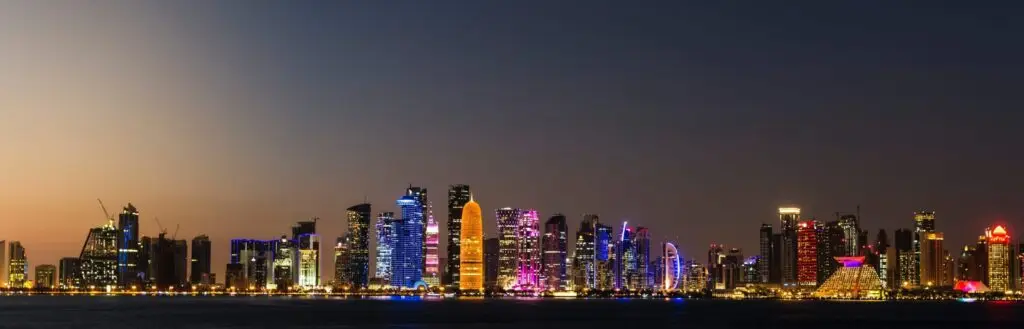
Doha's skyline barely existed at the start of this century. West Bay, the cluster of towers you see on every photograph of Qatar, was largely built in the two decades that followed, and the result is a district where almost every building is trying to be a landmark at once.
Some of them are genuinely good architecture. Here are the ones worth looking at, where to see them from, and what the rest of the city has that the towers do not.
The towers worth your attention
Aspire Tower
The one that looks like a torch, standing alone in Aspire Park south of the centre rather than in West Bay. At around 300 metres it is the tallest building in Qatar, and it was built to hold the flame for the 2006 Asian Games. It is a genuinely strange shape, a slender shaft carrying a bulging capsule, and because it stands by itself it reads as a landmark from most of the city.
Doha Tower
Jean Nouvel's cylinder in West Bay, wrapped in a layered aluminium screen based on the mashrabiya, the traditional carved wooden lattice used across the Gulf to shade windows. The pattern changes density as it climbs, so the amount of light entering varies with the height and the hour. It is the one tower in Doha where the local reference is structural rather than decorative, and it is the best building in the skyline.
Tornado Tower
A hyperboloid, narrower at the middle than at the ends, clad in a diagonal grid of steel that is lit at night in changing colours. The shape does something useful as well as decorative: the profile reduces the wind load on the building.
Burj Qatar and the West Bay cluster
The remaining towers around them make up the skyline you photograph rather than the ones you visit. Most are offices with no public access, which is worth knowing before you plan a day around going up something. Unlike Dubai, Doha has few public observation decks.
Where to see the skyline from
This matters more than the individual buildings, because you cannot get inside most of them.
The Corniche, the long curved promenade along the bay, is the classic view: the towers on one side of the water, the old dhow harbour on the other. Walk it at sunset, when the light is warm and the temperature is survivable.
Better still, take a dhow, the traditional wooden boats moored along the Corniche run short evening trips. Seeing West Bay from the water, from a hundred-year-old boat design, is the single best hour in Doha.
The Museum of Islamic Art sits on its own artificial island at the southern end of the Corniche, and the park behind it gives you the skyline across the bay with the museum in the foreground. The museum, designed by I. M. Pei in his nineties and inspired by a medieval fountain in Cairo, is a better building than anything in West Bay.
What else Doha has built
National Museum of Qatar
Jean Nouvel again, this time a structure of interlocking discs modelled on the desert rose, a crystal formation found in the Gulf sands. It opened in 2019, wraps around the restored palace of the former emir, and tells the country's story from geology to gas.
Msheireb Downtown Doha
An entire district of the old centre rebuilt from scratch in a contemporary Qatari style, low, shaded, walkable, deliberately not a tower cluster. Within it, the Msheireb Museums occupy four restored heritage houses. One of them, Bin Jelmood House, is dedicated to the history of slavery in the Indian Ocean and the Gulf, including Qatar's own. It is unusually direct for a state-funded museum and worth the visit.
Souq Waqif
The old market, largely rebuilt in the 2000s using traditional methods after the original had been modernised badly. It is a reconstruction and it is honest about being one. Go in the evening for the spice alleys, the falcon souq, where hunting birds are sold and treated at a dedicated hospital, and the outdoor cafés.
Lusail
A new city built north of Doha, with the stadium that held the 2022 World Cup final. It is worth seeing as a piece of urban planning being tested in real time; whether it fills up is a question for the next decade.
Practicalities
The heat is the planning constraint. From May to September daytime temperatures regularly pass 45°C and outdoor walking in the afternoon is not realistic. November to March is the season; even then, plan the outdoors for early morning and evening.
The metro, opened in 2019, is fast, cheap and air-conditioned, and it reaches West Bay, Msheireb, Souq Waqif and the airport. Dress modestly in public, shoulders and knees covered is the general expectation. Alcohol is served only in licensed hotel venues.
Seeing the city on foot
Doha is not a walking city everywhere, but Msheireb, Souq Waqif and the Corniche form a connected stretch that is genuinely walkable in the cooler months. A city game gives you a route through it with something to solve at each stop, which works well in a place where the distances between interesting things are otherwise awkward.
Frequently asked questions
Can you go up any of the towers?
Very few. Most West Bay towers are private offices. Some hotels have high bars and restaurants with views, which is the usual workaround.
How long do I need in Doha?
Two to three days covers the museums, the souq, the Corniche and the skyline properly, with time for a desert trip.
When should I go?
November to March. Anything from May onwards is extremely hot, and outdoor plans have to be built around dawn and dusk.
Is Doha expensive?
Hotels and alcohol, yes. Transport, taxis and food outside hotels are reasonable, and the major museums are inexpensive or free.
What should I wear?
Modest dress in public spaces: shoulders and knees covered for everyone. Beachwear is for hotel pools and private beaches only.
Does Doha work for a group?
Yes, particularly in the cooler months, and the metro makes moving a group around straightforward. For organised group activities, see what we run for companies and groups.
Plan the day
A shape that works with the climate: the Museum of Islamic Art or the National Museum during the hot hours, Msheireb in the late afternoon, the Corniche and a dhow trip at sunset, and Souq Waqif after dark. If you want the walking to have a route, here is how our games work, and you can get in touch about organising one. Travelling on through Asia? Our guide to the best things to do in Singapore covers another city built fast and on purpose.
