Almost everything you see in central Lisbon is either older than 1755 and survived, or newer than 1755 and replaced what did not. The earthquake and tsunami of that November destroyed most of the lower city, and understanding which side of that line a building falls on makes the whole place easier to read.
These five are the ones to see, with the reasons that matter.
1. Jerónimos Monastery
Begun in 1501 in Belém, near the point from which Vasco da Gama sailed for India, the monastery was funded largely by the tax on spices arriving from the East. It is the finest surviving example of Manueline architecture, the Portuguese Gothic style covered in ropes, knots, corals and armillary spheres, the ornament of a country that had just staked everything on the sea.
The church is free to enter; the cloister is ticketed and is the part worth paying for. Vasco da Gama and the poet Luís de Camões lie in tombs by the church door, although whether the remains are genuinely theirs has never been fully settled.
It has been on the UNESCO World Heritage list since 1983, together with the Belém Tower.
2. Belém Tower
Built between 1514 and 1520 as a fortress guarding the mouth of the Tagus, the tower is small, ornate and, in photographs, deceptively grand. Inside, it is a series of low stone rooms up a narrow spiral staircase with one-way traffic control, which is why the queue moves so slowly.
Look for the stone rhinoceros on the north-western bastion, carved after an Indian rhinoceros was shipped to Lisbon in 1515, probably the first depiction of one in European stonework, and the same animal that inspired Dürer's famous woodcut.
The tower originally stood on an island in the river; the shoreline moved after the earthquake, which is why it now sits at the water's edge.
3. São Jorge Castle
The hilltop was fortified by the Moors, taken by Portuguese and crusader forces in 1147, and used as a royal palace until the sixteenth century. The earthquake wrecked it and much of what stands today is a twentieth-century reconstruction, which is worth knowing before you attribute every stone to the twelfth century.
You come for the walls and the view over the tiled roofs to the river, not for interiors. Buy tickets in advance and go early or late; the middle of the day is the queue.
4. Carmo Convent
The best monument in Lisbon is a ruin. The Carmo church collapsed during the earthquake, which struck on All Saints' Day while the building was full of worshippers, and it was deliberately never rebuilt. What remains is a roofless Gothic nave, open to the sky, with a small archaeological museum in the apse.
It is quieter than everything else on this list and says more about what happened to the city than any plaque.
5. Santa Justa Lift
The iron lift connecting the lower town to the Carmo ruins opened in 1902. It is very often credited to Gustave Eiffel; it was not his. The designer was Raoul Mesnier du Ponsard, a Portuguese engineer, and the resemblance to Eiffel's work is a matter of period and material rather than authorship.
Riding it costs money and involves a long queue for a very short journey. The viewing platform at the top can be reached on foot from Largo do Carmo for a small fee, which is what most people should do.
One more, and an honest note
The Monument to the Discoveries on the Belém waterfront looks centuries old and dates from 1960, built under the Salazar dictatorship for an exhibition marking the death of Henry the Navigator. It celebrates the voyages without mentioning what they enabled, Portugal was the first European power to trade enslaved Africans by sea and one of the last to abolish it. The monument is worth seeing precisely because it is a piece of twentieth-century politics rather than a piece of the fifteenth century.
Practical things
Belém is a short train or tram ride west of the centre; do the monastery, the tower and the waterfront in one trip. Most major sites close one day a week, usually Monday. Trams 15 and 28 are useful and are also where the city's pickpockets work, so keep bags in front of you. Lisbon is steep, the hills are not decorative.
See the city between the monuments
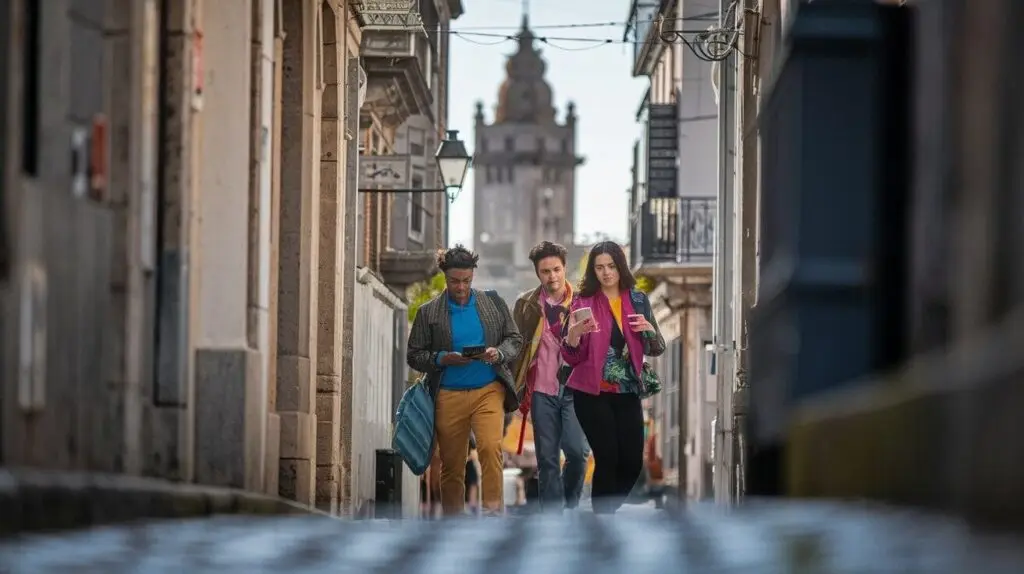
Monuments are the frame; the streets between them are the city. A city game makes those streets the point: you explore in small teams with your phone, solve puzzles tied to real squares, staircases and churches, and end up in parts of Alfama and Mouraria you would not have found. No guide, no fixed start time, and you stop for a coffee whenever you like.
It works for friends, families and company outings and larger groups. The how it works page explains the format step by step.
Frequently asked questions
What is Lisbon's most important monument?
Jerónimos Monastery, both for the architecture and for what it represents. It shares its UNESCO listing with the Belém Tower.
Do you need to book in advance?
For Jerónimos, Belém Tower and São Jorge Castle, yes in high season. Timed tickets save an hour of standing.
How long do you need in Belém?
Half a day covers the monastery, the tower and the waterfront, with time for a custard tart in between.
Was the Santa Justa Lift built by Eiffel?
No. It was designed by Raoul Mesnier du Ponsard and completed in 1902. The Eiffel attribution is a persistent error.
What did the 1755 earthquake destroy?
Most of the lower city, followed by a tsunami and fires. The grid-planned downtown was rebuilt afterwards; Carmo was left as a ruin.
Is Lisbon walkable?
Yes, but it is genuinely hilly. Use the trams and funiculars for the climbs and walk the descents.
Go and climb something
Lisbon rewards the effort of getting uphill, every time. See all the cities where we run games, read about the north in Quests in Porto, or get in touch if you are planning something for a group.