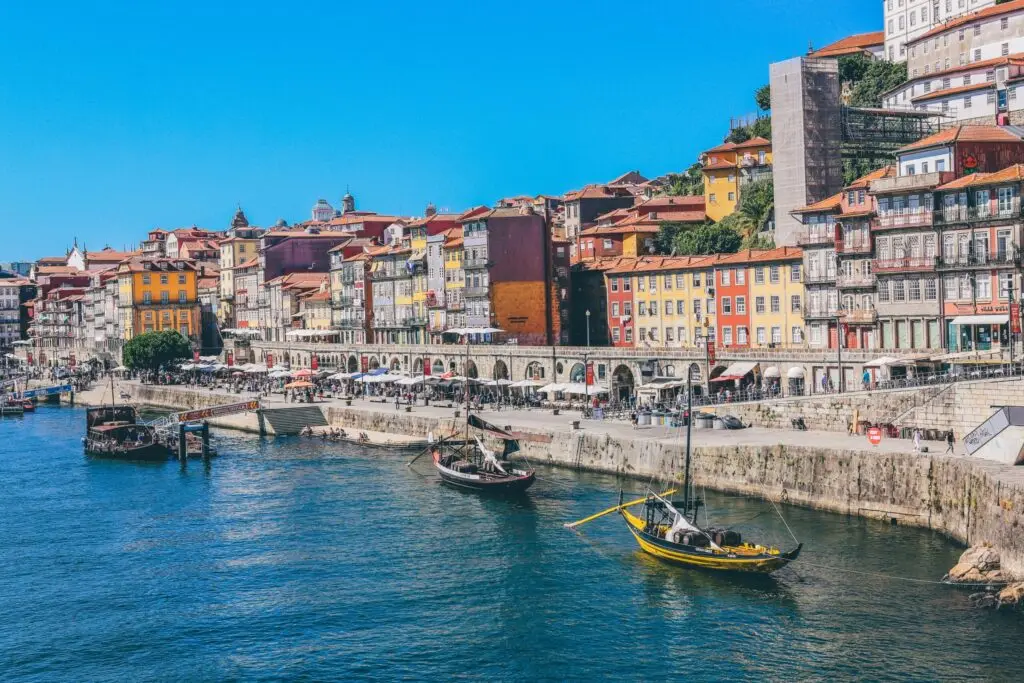
A city built on a hill above a river
Porto is steep. Almost everything worth seeing sits between the cathedral at the top and the Ribeira waterfront at the bottom, and the walk between them is all staircases and alleys. Wear shoes that grip, take the funicular when your legs complain, and accept that you will be going up and down all day.
These four places are the ones to build a first visit around, with the practical detail each one needs.
Livraria Lello
The Lello bookshop opened in 1906 and has a carved wooden staircase curving through the middle of it, a stained-glass ceiling and shelves running to the roof. It is genuinely beautiful and genuinely crowded.
Two practical things. Entry is ticketed, and the ticket price can usually be set against the cost of a book, so buy something and the visit costs you little. And book a time slot in advance; turning up on the day in summer means a long queue on the pavement.
One myth to let go of: you will be told this shop inspired Hogwarts. J.K. Rowling did live in Porto in the early 1990s, but she has said publicly that she does not remember the shop and that it did not inspire her books. Go for the staircase, not the story.
The Clérigos Tower
The Torre dos Clérigos is the baroque bell tower attached to the church of the same name, and for a long time it was the tallest structure in the city. You climb a narrow spiral stair to the top, and the reward is the best overview of Porto there is: the red roofs falling away downhill, the river, the bridge and Gaia on the far bank.
The stair is tight and two-way, so it is slow at busy times. Go at opening or in the last hour.
Jardim do Morro, for the sunset
Cross the top deck of the Dom Luís I bridge on foot to Vila Nova de Gaia, and you arrive at the Jardim do Morro, a small terraced garden on the slope. This is where the city goes at the end of the day: the sun sets behind Porto, the whole old town is laid out in front of you, and people sit on the grass with a bottle.
Get there half an hour before sunset for a spot. The walk across the upper deck is worth doing in itself, though it is high and open, so bear that in mind if heights bother you.
While you are on this side: the port wine cellars are all here, not in Porto. Port is grown in the Douro valley upriver and aged in Gaia; the city gave the drink its name but has never made it.
Where to eat a francesinha
Porto's own dish is the francesinha: a sandwich of steak, sausage and ham, covered in melted cheese and drowned in a hot beer-and-tomato sauce, usually with chips. It is enormous and it is not delicate.
Rather than sending you to one address that may change, here is how to choose. Look for a place where locals are eating them at lunchtime, where the sauce is made in-house rather than poured from a tub, and where you are asked whether you want an egg on top. Order one between two people the first time.
The rest of a good two days
São Bento station has an entrance hall lined with thousands of blue and white azulejo tiles showing scenes from Portuguese history. It costs nothing and takes ten minutes.
The Ribeira, the waterfront under the bridge, is UNESCO-listed and lovely in the early morning before the restaurants put their boards out. And tram 1, an old wooden car, runs along the river out to Foz where the Douro meets the Atlantic, which is the best cheap ride in the city.
A correction worth having: the Dom Luís I bridge was designed by Théophile Seyrig, a former partner of Gustave Eiffel, not by Eiffel himself. Eiffel built the older railway bridge upstream, the Maria Pia. Guides conflate the two constantly.
Seeing Porto by playing it
Porto is a city of small streets, tiled façades and sudden views, and the interesting parts are between the sights rather than at them. A city game gives you a route with clues through the old town, which is a much better way to handle the hills than wandering and hoping. It works well with friends and with a group.
Frequently asked questions
How many days do I need in Porto?
Two full days covers the old town, the tower, the bookshop and a port cellar. Three if you want the beach at Foz or a Douro valley trip.
Do I have to pay to enter Livraria Lello?
Yes, and you should book a slot ahead. The ticket can usually be put towards a book, so buy one.
Is port wine made in Porto?
No. The grapes grow in the Douro valley and the wine is aged in the cellars of Vila Nova de Gaia, across the river.
Is Porto very hilly?
Yes, steeply. There is a funicular from the Ribeira up to the bridge, and taxis are cheap when you have had enough.
When is the best time to visit?
May, June and September. July and August are hot and busy; winter is mild but wet, and Porto gets a lot of rain.
Come and play in Porto
If you want the streets between the sights, walk them with a playing route. Here is how it works, and for team outings and larger groups we have formats on this page. Questions about dates, group sizes or routes? Get in touch. More on playing here: quests in Porto.