Theatres and Stages in Hamburg: From Musicals to Kampnagel
By Martijn · 3 November 2022
A city that has always paid for its stages
Hamburg is a merchant city, and merchants funded culture here long before the state did. Germany's first public opera house opened at the Gänsemarkt in 1678, meaning ordinary paying audiences rather than a court. That habit never stopped: today the city carries major repertory theatres, an opera house, an experimental venue in a factory, a concert hall that became a landmark, and one of the biggest musical scenes in Europe.
Most performances are in German. The musicals and the concert halls are the exceptions, and they are where to start if you do not speak the language.
Theater im Hafen: the musical across the water
On the south bank of the Elbe, directly opposite the city, the Theater im Hafen is a purpose-built musical house that has hosted long-running productions for years. What makes it worth doing even if musicals are not usually your thing is the journey: your ticket includes a ferry across the harbour, and you arrive at the theatre by boat with the cranes and the skyline behind you.
Go early enough to stand outside on the terrace before the performance. That view is half the evening.
Deutsches Schauspielhaus
Near the main station, the Schauspielhaus is one of the largest German-language playhouses, with a gilded horseshoe auditorium from around 1900 that is worth seeing on its own. The programme is serious repertory: classics, new writing, and productions that get argued about nationally.
If your German is decent, this is the most rewarding ticket in the city. Some productions offer surtitles in English, so check the listing before you assume.
Staatsoper Hamburg
The Staatsoper is the descendant of that 1678 opera house, and its ballet company has an international reputation built over decades. Opera and ballet both travel well across the language barrier, which makes this the easiest classical night out for visitors.
Tickets range widely. Standing places and upper-tier seats are often released cheaply, and the acoustics up there are usually better than the price suggests.
Thalia Theater
The Thalia is the Schauspielhaus's counterpart and rival, with a sharper, more contemporary edge and a strong ensemble. It runs two houses, the main theatre in the centre and a second stage in the Gaußstraße in Altona, where the more experimental work usually goes.
Kampnagel
Kampnagel is a former crane factory in Winterhude that became one of Germany's most important venues for international performance: dance, theatre, live art and work that does not fit a conventional stage. The halls are raw industrial spaces, the bar is part of the experience, and a lot of the programme is either wordless or in English.
If you want to see something you could not see at home, look here first.
The Elbphilharmonie
No list of Hamburg stages is complete without the Elbphilharmonie, the concert hall that opened in 2017 on top of an old brick warehouse in the harbour, with a glass wave for a roof. It went years over schedule and enormously over budget, and the city has largely forgiven it.
Concert tickets are hard to get and sell out months ahead. The Plaza, the open viewing level between the brick base and the glass, needs only a cheap timed ticket and gives you a 360-degree view over the port. Book that in advance too, especially at weekends.
The rest of the night
Hamburg's other stage tradition is on the Reeperbahn in St. Pauli, where the Beatles played long residencies in small clubs in the early 1960s before anyone knew who they were. The street today is a mixture of music venues, theatres, bars and the red-light district, and it works best if you go with a plan rather than drifting.
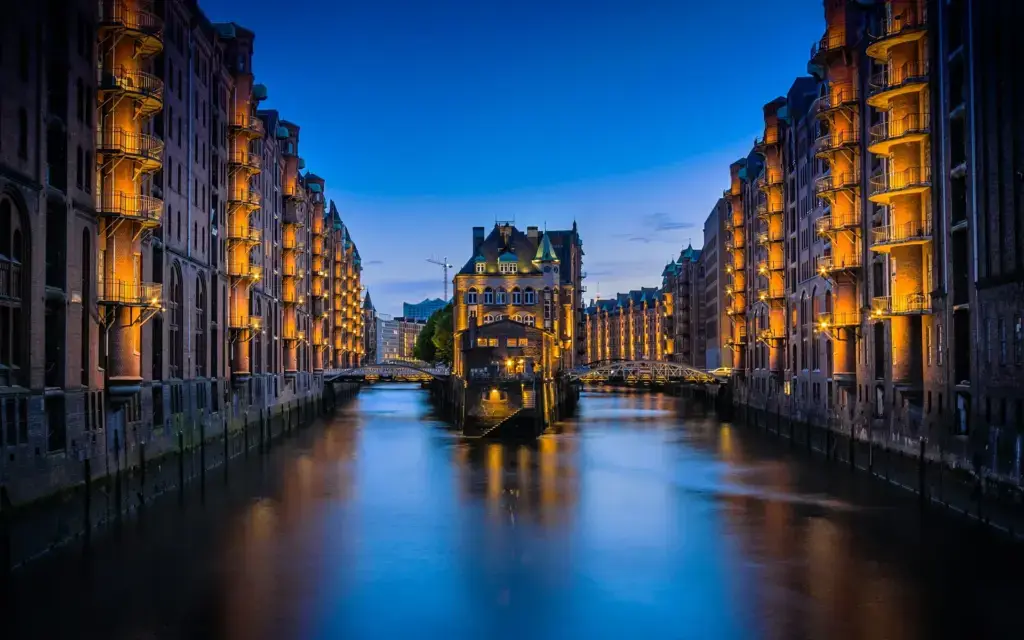
Before or after a show, walk the Speicherstadt, the UNESCO-listed warehouse district on its canals. At night, lit from below, it is the best free thing in the city.
Seeing Hamburg by playing it
Between the harbour, the Speicherstadt, the lakes and St. Pauli, Hamburg is spread out and full of things that need pointing out. A city game gives you a route with clues to solve, which is the best way to fill the afternoon before an evening performance. It works well with a group and with children.
Frequently asked questions
Are performances in English?
Mostly not. Musicals are in German, opera and ballet cross the language barrier easily, and Kampnagel programmes a lot of English-language and non-verbal work.
How far ahead should I book?
Months for the Elbphilharmonie and popular musicals, weeks for theatre. Last-minute returns do appear at the box office.
How do I get to the harbour theatre?
By ferry from the Landungsbrücken; the crossing is included with the ticket.
Can I visit the Elbphilharmonie without a concert?
Yes. The Plaza viewing level has its own cheap timed ticket and is worth going up for.
Is Hamburg easy to get around at night?
Yes. The U-Bahn and S-Bahn run late, and on weekend nights many lines run through the night.
Come and play in Hamburg
If you want the city as well as the show, walk it with a playing route. Here is how it works, and for team outings and larger groups we have formats on this page. Questions about dates, group sizes or routes? Get in touch. An hour down the road: Bremen.