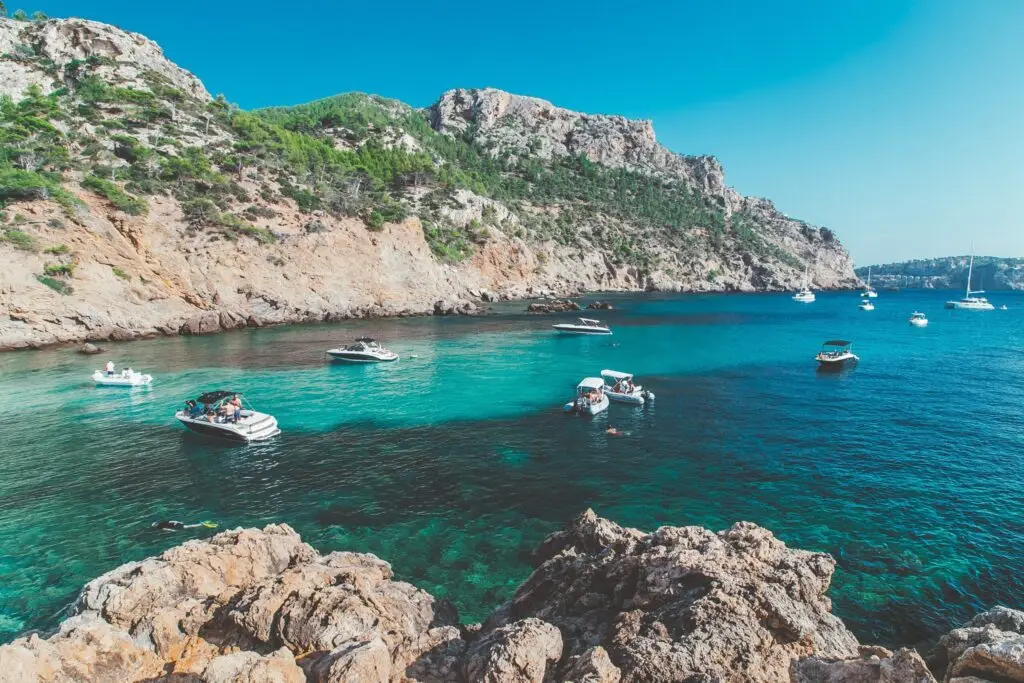
Mallorca has hundreds of calas, small coves cut into limestone, usually with a strip of pale sand and water that turns an implausible green over the seagrass beds. The good ones are not near Palma; they are between forty minutes and an hour and a half away, and the drive is the price of admission.
One honest note before the list. Mallorca receives a very large number of visitors for its size, and some coves are now visited by thousands of people a day for a beach the size of a tennis court. Residents have been vocal about it, and several municipalities have asked people to stop promoting the smallest ones. The practical answer is simple: go early, park where you are allowed to, take everything away with you, and spread out rather than all going to the same photograph.
1. Portals Vells: the closest good one
Twenty-five minutes from Palma on the south-western tip, Portals Vells is a set of three sheltered coves with pine trees down to the sand and calm, shallow water. It is the easiest real cove to reach from the city, and the one to choose if you are not planning a whole day out.
At the far end is the Cova de la Mare de Déu, a cave cut into the cliff where stone was quarried, later used as a chapel by sailors. You can walk into it from the rocks.
2. Cala Mondragó and s'Amarador
An hour east, inside the Mondragó natural park, two coves sit a fifteen-minute walk apart along a marked coastal path. Because the area is protected, there is no development behind the beach: pines, dunes and a footpath, which is exactly what most of the island's coast used to look like.
Parking is paid and limited, and it fills by mid-morning in summer. This is the best family option on the list, shallow, sandy, with facilities.
3. Cala Varques: the one you walk to
On the east coast, Cala Varques has no road access, no bar, no sunbeds and no bins. You park on the main road and walk about twenty minutes through a gate and along a track. That filter is what keeps it good.
Bring water and shade, and carry your rubbish out. There are caves and cliffs to swim around at the edges, and it is the closest thing on this list to what people imagine Mallorca was fifty years ago.
4. Sa Calobra and Cala Tuent
In the north, in the Serra de Tramuntana mountains, a UNESCO World Heritage landscape, the road down to Sa Calobra is a famous engineering curiosity, thirteen kilometres of hairpins including a full 270-degree spiral where the road crosses under itself. It is spectacular and it is not fun in a hire car in August.
From the car park a walkway through tunnels leads to the mouth of the Torrent de Pareis, a gorge that comes out at a pebble beach between enormous cliffs. Neighbouring Cala Tuent is far quieter and worth choosing instead. Boats run from Port de Sóller and are the calmer way to arrive.
5. Cala Deià
A small rocky cove below the village of Deià on the north-west coast, with a couple of long-standing beach restaurants on the rocks. It is not a sandy beach and it is not for lounging: you swim, you eat fish, you look at the mountains coming straight down into the sea.
The village above it has been a writers' and artists' place since Robert Graves settled there in the 1930s, and his house is now a museum.
The famous one, honestly
Caló des Moro, near Santanyí, is the cove in every photograph of Mallorca. It is roughly the size of a small swimming pool, reached down a rocky scramble, and on a summer day several thousand people try to visit it. The local council has publicly asked people to stop advertising it.
If you must go, go at seven in the morning or in October. Otherwise go to Cala Llombards or Cala s'Almunia nearby, which look much the same and are not being loved to death.
Practical things
Most coves need a car and most car parks fill before ten in summer. Bring water shoes for rocky entries, and shade, because many calas have none after midday. Sea urchins live on the rocks, look before you put a foot down. September and early October have warm water and a fraction of the crowds.
Palma itself, between beaches
Do not treat Palma as an airport with a city attached. The cathedral, the old town, the Arab baths and the Bellver castle are worth a full day, and a city game is a good way to do it: small teams, a phone, puzzles tied to real streets and squares, no guide and no fixed start time. It fills the day when the beach car parks are already full.
It works for friends, families and company outings and larger groups. The how it works page explains it step by step.
Frequently asked questions
Which cove is closest to Palma?
Portals Vells, about twenty-five minutes away on the south-west coast. Most of the famous calas are an hour or more.
Do you need a car?
For most coves, yes. Buses reach some larger beaches, and boats run to Sa Calobra from Port de Sóller and to several coves from Palma.
When should you arrive?
Before nine in summer, or after five. Car parks at the popular coves are full by mid-morning from June to September.
Is Caló des Moro worth it?
Only very early or out of season. It is tiny, badly overcrowded, and the local council has asked visitors to consider other coves.
Are there facilities?
At Mondragó and Portals Vells, yes. At Cala Varques and most walk-in coves, nothing at all, bring water and take your rubbish home.
When is the best time of year?
Late May, June, September and early October. The sea is warmest in September and the island is far calmer than in August.
Go early, go quietly
The best cove is almost always the one you had to walk to. See all the cities where we run games, read about the mainland in Quests in Barcelona, or get in touch if you are planning something for a group.