Seville is a city of squares, and of shade
Seville lives outdoors, but not at every hour. From June to September the afternoon is genuinely dangerous heat, regularly over forty degrees, and the city empties between two and six. Plan around that: squares in the morning, indoors or a long lunch in the middle, squares again from seven until late.
Here are the ones worth your time, and what each is actually good for.
Plaza de España
This is the one people come for, and it lives up to it. It was built for the 1929 Ibero-American Exposition by Aníbal González: a vast semicircle of brick and tile with a canal running around it, four bridges representing the old kingdoms of Spain, and a tiled alcove for every Spanish province, each with a map and a scene from its history.
Find your province, or someone else's, and read the tiles. You can hire a rowing boat on the canal, which is more fun than it sounds. Film crews have used it repeatedly, most famously as an alien city in a Star Wars film.
Go early. By eleven the arcade is full and the reflections in the canal are gone.
Plaza de América
At the other end of the Parque de María Luisa, and by the same architect, this is the quiet counterpart to the big one: three pavilions from the same exhibition, now holding the archaeological museum and the museum of arts and traditions, around a formal garden thick with pigeons and doves.
Walk to it through the park rather than around it. The Parque de María Luisa is the best shade in Seville, with tiled benches, fountains and orange trees, and it is where you should be at two in the afternoon in July.
Plaza de la Encarnación and the Setas
The Setas de Sevilla, the mushrooms, is a huge timber lattice structure that opened in 2011 and gave the city its biggest architectural argument in decades. People either love it or think it does not belong. Either way it works: there is a walkway across the top with a view over the old town, best at sunset.
Underneath is the part most visitors skip. When they dug the foundations they found Roman remains, and rather than remove them the city built a museum around them in the basement. You can walk over the mosaics on glass floors. It is small, cheap and much better than expected.
Plaza del Duque and Plaza de la Campana
These two, joined by Calle Sierpes and Calle Tetuán, are the commercial heart of Seville: pedestrian shopping streets, awnings strung between the buildings in summer, and the place the city goes about its ordinary business.
They are not beautiful in the way the others are, and that is the point of including them. This is where you buy things, get a coffee standing at a bar, and see Seville working rather than performing.
The square you should not miss
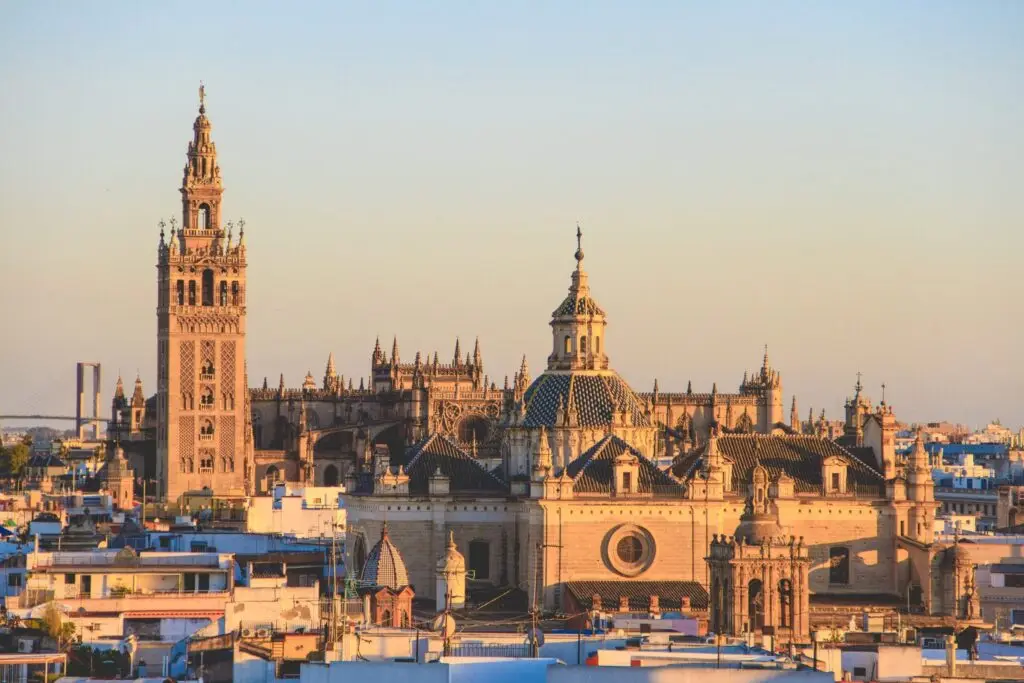
One more, because it is remarkable: Plaza del Triunfo. Standing in it you are surrounded by three UNESCO World Heritage sites at once, the Cathedral with the Giralda tower, once a mosque minaret; the Real Alcázar, the Mudéjar palace still used by the royal family; and the Archivo de Indias, which holds the documents of the Spanish empire in the Americas.
Book the Alcázar in advance. It sells out, and the gardens alone justify the visit.
Two things about Seville worth knowing
The orange trees lining the streets are beautiful and the fruit is inedible. They are bitter Seville oranges, and much of the crop is collected and exported to be made into marmalade. Do not pick one and eat it; people do, once.
And if you come during Semana Santa or the Feria de Abril, know what you are getting. Semana Santa fills the streets with processions and moving through the centre becomes difficult. The Feria is spectacular but most of the casetas, the tents, are private and belong to families and associations; as a visitor you can walk the avenues and enter the public ones, and that is a different experience from what the photographs suggest.
Seeing Seville by playing it
The squares are linked by the narrow lanes of Santa Cruz and the old town, and those lanes are the best part of the city. A city game gives you a route with clues between them, which keeps you in the shade and shows you the courtyards and tilework you would otherwise walk past. It works well with family and with a group.
Frequently asked questions
Is Plaza de España free?
Yes, it is a public square and open to walk through. The rowing boats on the canal are paid.
When is the best time to visit Seville?
March to May and October to November. July and August are extremely hot, with afternoons above forty degrees.
Do I need to book the Alcázar?
Yes, in advance. It has timed entry and sells out, especially in spring.
Are the Setas worth going up?
Yes, particularly at sunset, and the Roman museum underneath is worth the extra few minutes.
Can I eat the oranges from the trees?
You can, once. They are bitter Seville oranges, grown for marmalade rather than eating.
Come and play in Seville
If you want the lanes between the squares, walk them with a playing route. Here is how it works, and for team outings and larger groups we have formats on this page. Questions about dates, group sizes or routes? Get in touch. Two hours east: Granada.