Vigo is not a postcard city and it does not try to be. It is the largest city in Galicia and one of the busiest fishing ports in Europe, built up a steep hillside above a long sea inlet, with cranes and container ships in the middle of the view. That is exactly why it is worth visiting: it is a real place doing real work, and the food that comes off those boats is the best reason to be in northwest Spain.
Here are the places that actually matter, and how to string them together in a day or two.
The old town and the oyster street
Casco Vello
The old quarter climbs from the waterfront in narrow granite streets. It was neglected for decades and has been steadily restored, so you get scaffolding next to beautifully rebuilt squares. Praza da Constitución is the centre of it, with arcades and terraces, and the Colegiata de Santa María sits just below.
Rúa Pescadería
Better known as the oyster street. A short row where women shuck oysters at stone tables in the open air and sell them by the dozen, to be eaten standing up with a glass of white wine from a bar behind. The oysters come from the ría, they are sold fresh and cheap, and the whole transaction takes about four minutes. It is the single most Vigo thing you can do.
The Berbés and the fish market
The old fishermen's quarter next to the port, with the arcaded houses that appear in every historic photograph of the city. The commercial fish auction nearby handles an enormous share of Spain's catch. The auction itself runs at night and access is restricted, but the area around it is where the port becomes visible as an industry rather than a view.
The city above the water
Monte do Castro
The hill in the middle of the city, with the remains of a 17th-century fortress and the excavated foundations of a Celtic-era settlement, a castro, which is where the name comes from. Walk up for the view: the whole ría, the Rande bridge, the Cíes islands closing off the mouth of the inlet, and the city stepping down to the water. Go at the end of the afternoon.
Calle del Príncipe
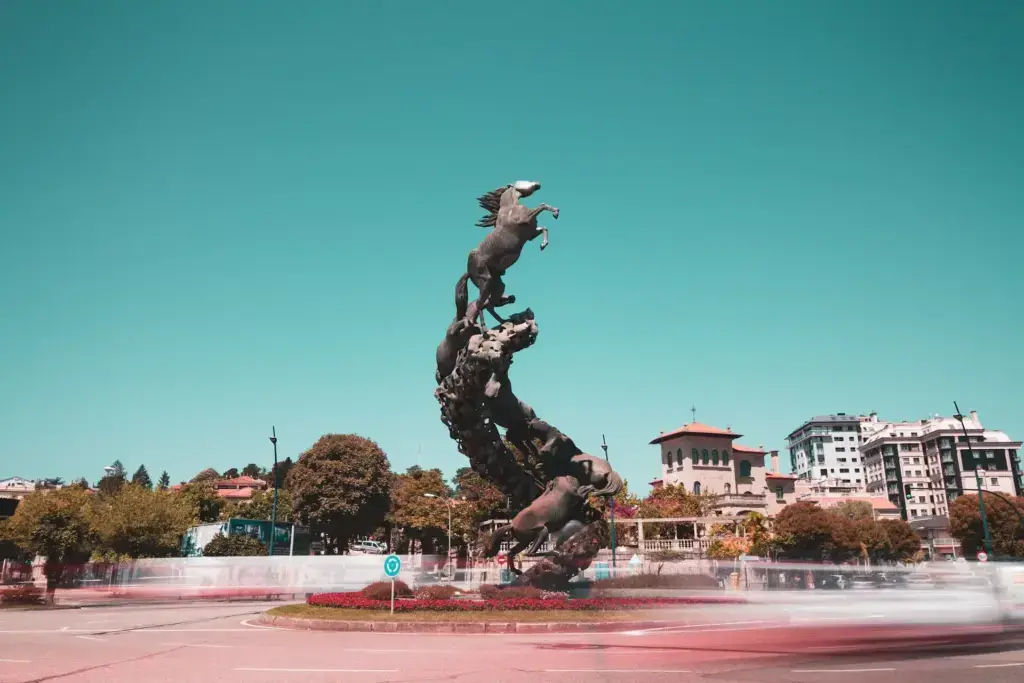
The main pedestrian shopping street, and where the city walks in the evening. The bronze figure standing on its head halfway along is O Sireno, a merman sculpture by Francisco Leiro that Vigo has been arguing about since it went up in the 1990s. Everyone meets there anyway.
Bouzas
A former fishing village absorbed by the city, west along the shore. Low white houses, a small harbour, and a strip of seafood restaurants that locals rate above anything in the centre. Twenty minutes by bus and worth the trip for lunch.
The bridge and the bay
The Rande bridge crosses the narrowest point of the ría, a long cable-stayed span opened in 1978 and widened since. Below it, in 1702, a Spanish treasure fleet and its French escort were destroyed by an Anglo-Dutch force in the Battle of Rande. The story that a fortune in silver still lies on the seabed has been chased by salvage expeditions for three centuries and turns up in Jules Verne's Twenty Thousand Leagues Under the Sea, which is why Vigo has a statue of Verne sitting on a giant squid near the waterfront.
The Cíes Islands
Three islands at the mouth of the ría, part of the Atlantic Islands of Galicia National Park, with a beach, Rodas, that regularly appears on lists of the best in Europe. No cars, no hotels, one campsite, a couple of cafés.
The practical part matters: in the high season visitor numbers are capped and you need an authorisation from the regional government before you can buy a ferry ticket. Do that first, then book the boat. The crossing takes about 45 minutes from the port. Bring water and lunch; the island is not set up to feed everyone who arrives.
Beaches closer in
Samil is the city beach, a long stretch with a promenade, pools and restaurants, busy in summer and easy to reach by bus. Further out towards the mouth of the ría the beaches get quieter and colder. This is the Atlantic, not the Mediterranean; the water is bracing in August.
Eating in Vigo
Order what came off the boat. Oysters on Pescadería, percebes (goose barnacles) if they are in and you are feeling brave about the price, pulpo á feira, razor clams, and whatever white fish the board says arrived that morning. Drink albariño from the Rías Baixas, which is grown twenty minutes south. Galician portions are large and sharing is normal.
Walking the city
Vigo is steep and it rains, which sounds like a warning but mostly means you should plan a route rather than wander. A city game gives you one through the Casco Vello and down to the waterfront, with something to work out at each stop, which is a good way to see a city that does not hand its highlights to you in a straight line.
Frequently asked questions
How many days do I need in Vigo?
One full day covers the old town, the oyster street, Monte do Castro and Bouzas. Add a second if you want the Cíes islands, which take most of a day on their own.
Do I need a permit for the Cíes?
In the busy season, yes. Numbers are limited and you request authorisation from the Galician regional government before buying the ferry ticket. Check the current rules before you plan the day, because they change between seasons.
When is the best time to go?
June to September for the islands and the beaches. Spring and autumn are green, quiet and often wet. Vigo also does an unusually large Christmas lights display, which has become a reason people visit in December.
Is Galician spoken here?
Yes, alongside Spanish, and you will see it on all the signs. Place names are usually given in Galician, which is why you will see both Casco Vello and Casco Viejo depending on the map.
Is Vigo good for a group?
Yes, particularly for food-led trips: the seafood is excellent, sharing plates is the norm and the old town is compact. For organised group activities, see what we run for companies and groups.
Can I get to Santiago de Compostela from here?
Easily. Fast trains run north in about an hour and a half, and Pontevedra is half an hour away, so Vigo works well as a base for the region.
Plan a day in Vigo
The best version of the day: Casco Vello in the morning, oysters and lunch around Pescadería, Monte do Castro in the late afternoon for the view, and dinner in Bouzas. If you want the morning to have a route, here is how our games work, and you can get in touch about running one for a group. Heading down the coast afterwards? Our guide to the most typical things of Valencia covers a very different Spanish waterfront.