Rotterdam does not look like the rest of the Netherlands, and there is one reason for that. On 14 May 1940 the medieval centre was bombed and burned, and what stood there was gone. Everything you look at now was a decision taken afterwards. That is what makes it the most interesting city in the country to walk around with your head up.
Start with the fire boundary
Set into the pavement across the city is a line of light strips marking the brandgrens, the edge of the area destroyed in 1940. Cross it in one direction and the buildings are pre-war; cross it in the other and everything is later. Once you have noticed the line, the whole city becomes readable. It is the single most useful thing to know here, and almost no visitor knows it.
The Cube Houses
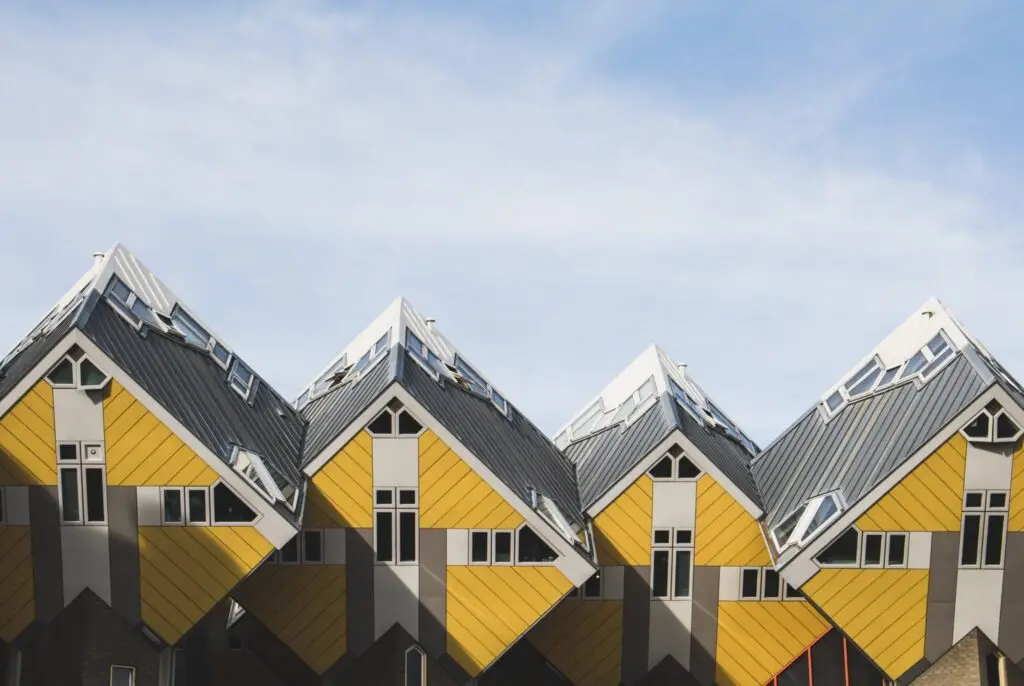
Piet Blom's cube houses from the 1980s are tilted forty-five degrees and set on hexagonal pillars. Blom described them as trees, and the block as a forest, an attempt to put a village on top of a busy road. One cube is open as a show home, so you can find out what living inside a tipped-over box actually does to your furniture. Next to them stands his pencil-shaped tower, which locals simply call the Pencil.
The Markthal
A horseshoe of apartments arched over a covered food market, finished in 2014. The residents live in the curve; the ceiling above the stalls is covered by an enormous digital artwork of fruit, flowers and insects. Look up before you look at the food. Yes, it is touristy, and it is still worth twenty minutes.
The waterfront
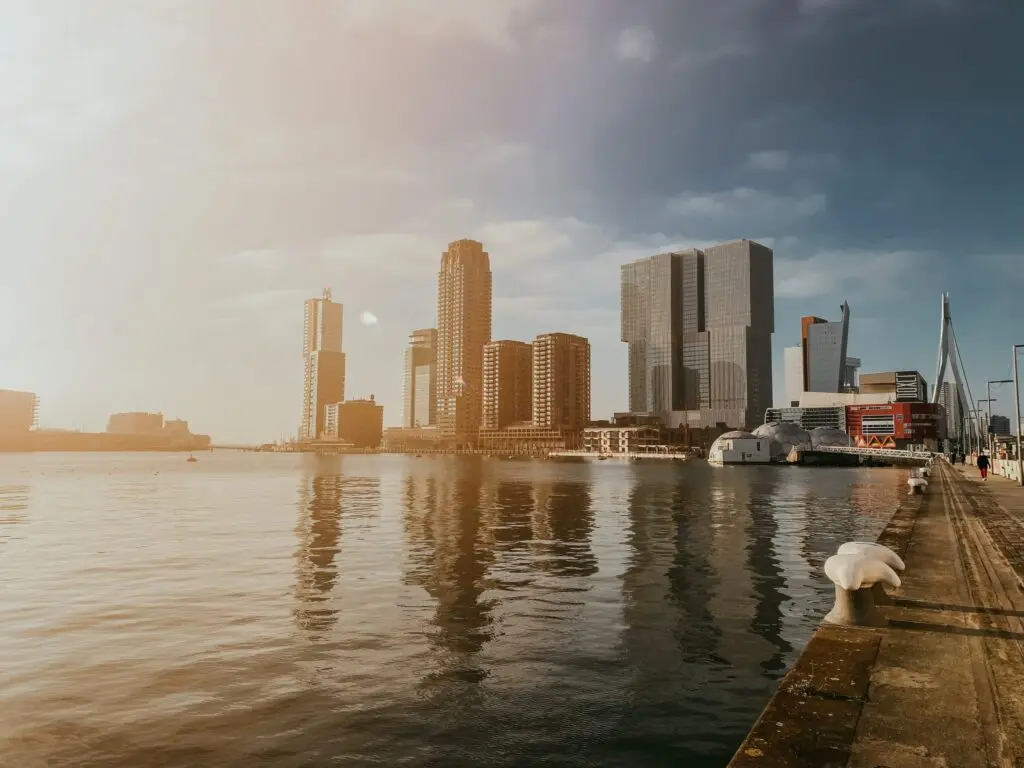
The Erasmus Bridge, finished in 1996, has a single angled pylon that gave it the nickname the Swan, and crossing it on foot is the best free thing to do in the city. On the far side is the Kop van Zuid, where the tall stuff is: De Rotterdam, three shifted towers designed as a vertical city, and Hotel New York in the former head office of the Holland America Line, the building from which enormous numbers of emigrants left for America. Have a coffee there and read the room.
The Euromast dates from 1960 and was extended a decade later with a rotating lift that carries you up the mast. On a clear day the view explains the port better than any map.
The Van Nelle Factory
A little outside the centre, this 1931 factory of steel, glass and daylight is on the UNESCO World Heritage list, and deservedly. It was built on the idea that a workplace could be healthy and light rather than dark and grim, and it still reads as modern nearly a century on. It is now offices, so access is by tour, book ahead.
The Depot
The mirrored bowl next to the Museumpark is the storage building of the Boijmans Van Beuningen collection, and the first art depot anywhere that lets the public in to see how a collection is actually kept. The museum beside it has been shut for a long renovation, so check what is open before you plan around it. The Depot's roof terrace is worth the climb on its own.
What survived
Two places show you the city that was lost. The White House near the Oude Haven came through the bombing and was once advertised as Europe's first high-rise office block. And Delfshaven, west of the centre, was outside the fire boundary altogether: canal houses, a working harbour, and the church from which the Pilgrims sailed in 1620. It is twenty minutes from the cube houses and four hundred years away.
Seeing it on foot
Rotterdam is spread out, and the buildings mean much more when you know why each one is there. A city game gives you a route with puzzles that links the centre, the market hall and the waterfront, and tells you the story at each stop rather than leaving you to look things up afterwards.
Not sure what it involves? Read how to play first.
Frequently asked questions
Why does Rotterdam look so modern?
Because the historic centre was destroyed by bombing in May 1940 and rebuilt from scratch. The city chose to build forwards rather than reconstruct what had been lost.
What is the best architecture to see in one day?
The cube houses and the Markthal in the morning, the Erasmus Bridge and the Kop van Zuid in the afternoon, and Delfshaven if you have an hour left.
Can you go inside the cube houses?
Yes. One cube is fitted out as a show home and open to visitors; another operates as a hostel.
Is the Van Nelle Factory open to the public?
It is a working office building, so visits are by guided tour on set dates. Book in advance rather than turning up.
How long do I need in Rotterdam?
A full day covers the highlights comfortably. Two days lets you add the Van Nelle Factory, the Depot and Delfshaven without rushing.
Does Rotterdam work for a company outing?
Very well, the scale of the place gives a group something to talk about, and there is plenty of space on the waterfront. See the options for companies and groups.
Walk a city with its decisions on show
Find the fire boundary, follow it, and let the buildings on either side tell you the rest. Want help choosing the right game for your group? Get in touch. Our guide to a city game in Rotterdam covers the route in more detail.