Rome has more to see than any reasonable trip can absorb, and almost all of it is in one walkable centre. The failure mode is not missing things; it is spending your days in queues and eating badly two hundred metres from somewhere excellent.
This guide is organised around that: what must be booked, what you can walk into, what has changed recently, and how to plan a day that works.
What you must book in advance
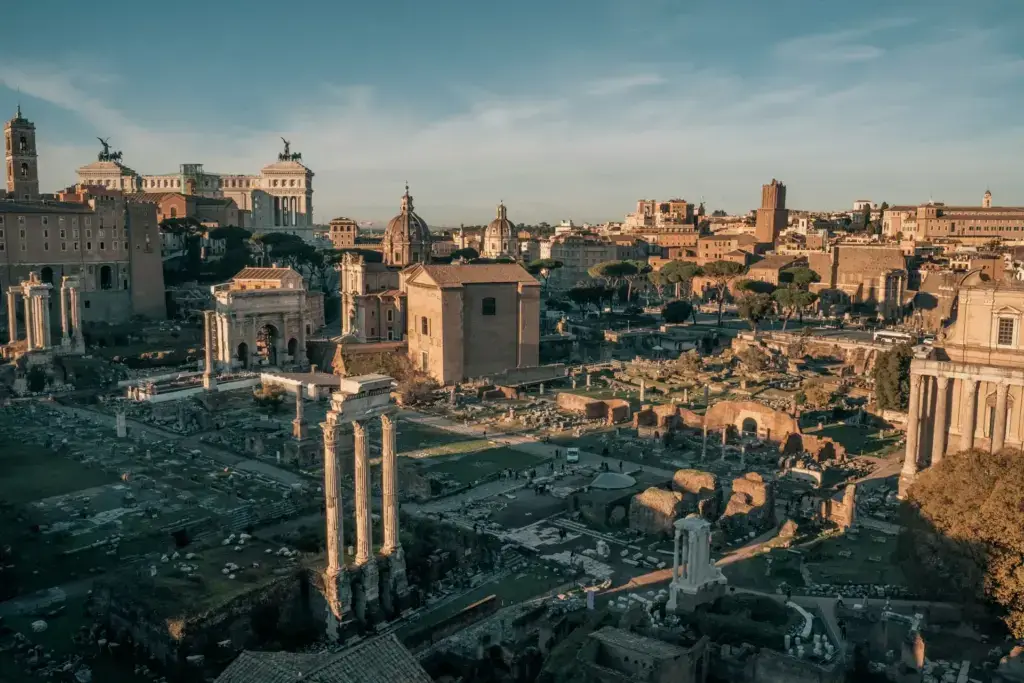
The Colosseum, Forum and Palatine
One combined ticket covers all three, valid across consecutive days, and it is timed for the Colosseum. Slots sell out days ahead in season. Book on the official site rather than through resellers.
A detail worth knowing: the name has nothing to do with its size. It was the Flavian Amphitheatre, and it took the name Colosseum from the Colossus of Nero, an enormous bronze statue that stood beside it and has since vanished entirely.
The Forum is the part most people underestimate. Go there with some idea of what you are looking at or hire a guide, because without context it is a field of broken columns.
The Vatican Museums
Separate country, separate ticket, and unmissable queues without one. The route through the museums ends at the Sistine Chapel, and it is a long walk, around seven kilometres of galleries if you follow everything. Book the earliest slot you can.
St Peter's Basilica itself is free to enter, with a security queue rather than a ticket queue. The dome climb is ticketed separately and worth it. There is a dress code for both: shoulders and knees covered, enforced at the door.
The Borghese Gallery
The best small museum in Rome, holding Bernini's sculptures, including the Apollo and Daphne, where marble becomes leaves, and several Caravaggios. Entry is by two-hour timed slot with a hard limit on numbers, and it must be booked, often weeks ahead. It is worth arranging your trip around.
What you can simply walk into
The Pantheon
The best-preserved building from ancient Rome, standing because it was converted into a church in the seventh century. Its dome is still the largest unreinforced concrete dome in the world, nearly two thousand years after it was built, and the oculus in the middle is open to the sky, when it rains, it rains inside, and the floor is subtly domed with drains.
Note that entry now carries a small charge on most days, introduced in 2023 after centuries of free access. Check the current arrangement; it has changed once and may change again.
The Trevi Fountain
Free, permanently crowded, and best at seven in the morning or after midnight. The coins thrown in are collected daily and go to a Catholic charity that runs services for people in need in the city.
The Spanish Steps
Also free, and here is the rule that catches people out: sitting on them has been prohibited since 2019, and the fines are real and enforced. Walk up, take the photograph, and sit somewhere else.
Churches
Rome's churches are its best free museums. San Luigi dei Francesi has three Caravaggios in a side chapel; bring a coin for the light. Santa Maria della Vittoria has Bernini's Ecstasy of Saint Teresa. San Clemente is three buildings stacked vertically, a twelfth-century church over a fourth-century one over a Roman house with a Mithraic temple in it, and that one is ticketed but cheap.
Neighbourhoods worth your evening
Trastevere
Across the river, narrow and ivy-covered, and where most visitors are sent for dinner. It is busy and increasingly priced for that, but the streets away from the main squares still work.
Testaccio
The old slaughterhouse district south of the centre, and where Romans actually eat. The market is excellent and cheap. Monte Testaccio, the hill at its edge, is made entirely of the broken remains of an estimated fifty million Roman amphorae, a rubbish tip that became a landmark.
The Appian Way
The old road south, closed to most traffic on Sundays, with catacombs, ruins and umbrella pines along it. Rent a bike and get out of the city for an afternoon.
Eating in Rome
Roman cooking is specific and unfussy: cacio e pepe, carbonara, amatriciana and gricia are four variations on the same short list of ingredients, and every restaurant serves all four. Add carciofi alla giudia, deep-fried artichokes from the Jewish quarter, and supplì, the fried rice balls sold at pizza-by-the-slice counters.
The practical rules: avoid restaurants with photographs on the menu, with someone outside inviting you in, or within direct sight of a major monument. A coperto, a small per-person cover charge, is normal and legal. And the free drinking water from the nasoni, the small cast-iron street fountains all over the city, is clean, cold and endless, bring a bottle.
Walking the city
The centre is compact and the connections between things are where Rome actually happens: a temple in a wall, an obelisk in a square, a fountain from a Roman aqueduct still running. A city game gives you a route with something to solve at each stop, which is a good way to fill the gaps between timed tickets.
Frequently asked questions
How many days does Rome need?
Four as a minimum: one for ancient Rome, one for the Vatican, one for the centre and its churches, one for Trastevere, Testaccio or the Appian Way.
When should I visit?
April, May, September and October. July and August are very hot and the queues are worst. Winter is quiet, cool and the light is good.
Can I sit on the Spanish Steps?
No. It has been prohibited since 2019 and is enforced with fines.
Is the Pantheon still free?
Not on most days. A charge was introduced in 2023. Check before you go, and note that residents and some categories still enter free.
Do I need to dress a certain way?
For St Peter's and most churches, yes: shoulders and knees covered, for everyone. Carry a light scarf in summer.
Does Rome work for a group?
Yes, but timed tickets have to be booked as a block well ahead, and large groups are often split across slots. The walking parts handle groups easily. For organised group activities, see what we run for companies and groups.
Plan the day
A shape that works: the Colosseum at opening, the Forum and Palatine afterwards, lunch in Monti, the Pantheon and the centre in the afternoon, and Trastevere or Testaccio for dinner. If you want the walking between them to have a route, here is how our games work, and you can get in touch about organising one. Already playing here? Our post on quests in Rome covers what a game day looks like.