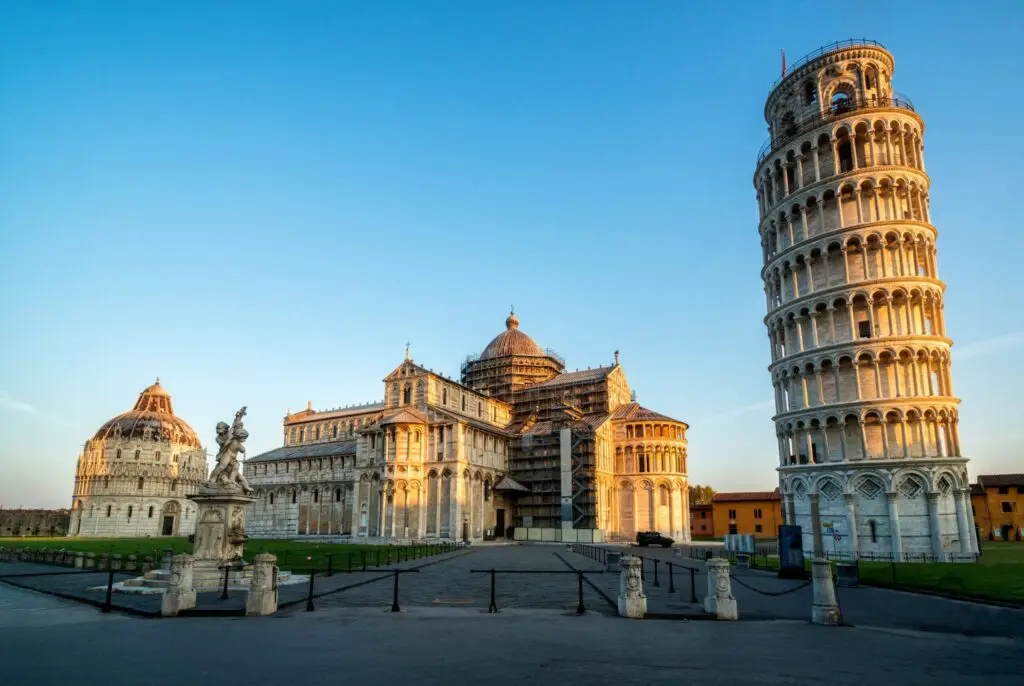
Most people give Pisa ninety minutes: off the bus, photograph the tower, back on the bus. That is a shame, because the square the tower stands on is one of the great architectural ensembles in Europe and the city behind it is a real Tuscan university town with almost nobody in it.
Here is how to do the tower properly, what else is worth your ticket, and what to do with the rest of the day.
Why the tower leans
It was built as the cathedral bell tower, begun in 1173, and it started tilting before the third storey was finished. The ground underneath is soft: clay, sand and shells left by an old estuary, and it compressed unevenly.
What saved it was war. Construction stopped twice for decades at a time, which let the soil settle and consolidate between phases. The builders also tried to correct the lean as they went, which is why the upper floors are subtly curved, the tower is banana-shaped, not straight and tilted.
By the late twentieth century the lean had become dangerous and the tower was closed to visitors for over a decade while engineers removed soil from the high side. It reopened in 2001, straightened by a small but decisive amount, and it is monitored constantly. It is safe, and it will still be leaning long after all of us.
Climbing it
You can go up, and you should. It is just under three hundred steps up a spiral staircase inside the wall, and the strange part is not the height but the tilt: the stairs feel steeper on one side of the spiral and shallower on the other, and your balance keeps quietly disagreeing with your eyes.
The practical rules matter here:
Tickets are timed and slots sell out, particularly in summer. Book online in advance. Children under eight are not allowed up at all, and older children must be with an adult. No bags of any kind are permitted inside; there are free lockers nearby but the queue for them is part of your time slot, so arrive early. The whole visit lasts around half an hour, most of which is climbing.
The rest of the square
The Piazza dei Miracoli is a UNESCO World Heritage site and the tower is the least interesting building on it.
The cathedral
Begun in 1063, and the building that set the pattern for the whole Pisan Romanesque style: striped marble, tiers of small columns, a bronze door and a coffered ceiling. Entry is included with any ticket for the square, but you still need to collect a timed voucher.
The Baptistery
The largest baptistery in Italy, round, and acoustically extraordinary. Every half hour a custodian stands in the middle and sings a few notes, and the building holds them and folds them over each other for several seconds. It is the single best thing on the square and most visitors miss it because they are outside doing the photograph.
The Camposanto
The monumental cemetery along the northern side, a long marble cloister built around soil said to have been brought back from Golgotha during the Crusades. Its frescoes were badly damaged when the roof burned during an Allied bombardment in 1944; the surviving work, including the enormous Triumph of Death, has been restored and returned to the walls.
The museums
The Museo dell'Opera del Duomo holds the sculpture and treasury taken off the buildings, including work by Giovanni Pisano, and has a courtyard with the best framed view of the tower. The Museo delle Sinopie shows the preparatory drawings uncovered under the burned Camposanto frescoes, which is more interesting than it sounds.
Beyond the square
Walk south for ten minutes and the crowds vanish completely.
Piazza dei Cavalieri
Redesigned by Giorgio Vasari in the sixteenth century, with a facade covered in scratched geometric decoration. The palace is now the Scuola Normale Superiore, one of Italy's most selective universities, so the square is full of students rather than tour groups.
The Lungarni
The embankments along the Arno, lined with pastel palazzi. On the southern bank stands Santa Maria della Spina, a tiny Gothic church covered in spires and statues, built to house a thorn from the crown of thorns and moved brick by brick to higher ground in the nineteenth century.
Tuttomondo
On the back wall of a church near the station is a large mural Keith Haring painted in 1989, one of his last public works and one of the few that survives intact. It is a five-minute detour and a complete change of register.
Eating in Pisa
The local street food is cecina, a thin baked chickpea flatbread sold by the slice, hot, with pepper. Eat it standing up. Beyond that, Pisa is a student city, so the food is cheaper and less curated than in Florence, and the places away from the square are the ones worth sitting down in.
Seeing the city on foot
The walk from the square to the river takes fifteen minutes and passes almost everything above. A city game gives you a route through it with something to solve at each stop, which is the difference between seeing Pisa and seeing the tower.
Frequently asked questions
Do I need to book tickets for the tower?
Yes, in practice. Slots are timed and limited, and in high season same-day tickets are usually gone by mid-morning.
Is it safe to climb?
Yes. The stabilisation work in the 1990s reduced the lean and the structure is monitored continuously. The staircase is narrow and uneven, so it is more a question of mobility than of safety.
Can children go up?
Not under eight. Between eight and eighteen they must be accompanied by an adult.
How long should I spend in Pisa?
Half a day for the square done properly, including the baptistery and one museum. A full day if you want the Lungarni, Piazza dei Cavalieri and a proper lunch.
When is the best time to go?
Spring and autumn. Summer on that square is very hot and there is almost no shade. If you can, come on 16 June for the Luminara, when the buildings along the river are outlined in thousands of candles.
Does Pisa work for a group?
Yes, though tower tickets have to be booked as individual timed slots, so a large group will be split across several. The rest of the city handles groups easily. For organised group activities, see what we run for companies and groups.
Make a day of it
The version of Pisa that is worth the trip: the square early, the baptistery at a singing demonstration, lunch away from the tourist strip, then the Arno and the Keith Haring in the afternoon. If you want the walk to have a route, here is how our games work, and you can get in touch about organising one. Travelling on through Italy? Our guide to four famous landmarks in Milan covers a very different Italian city.