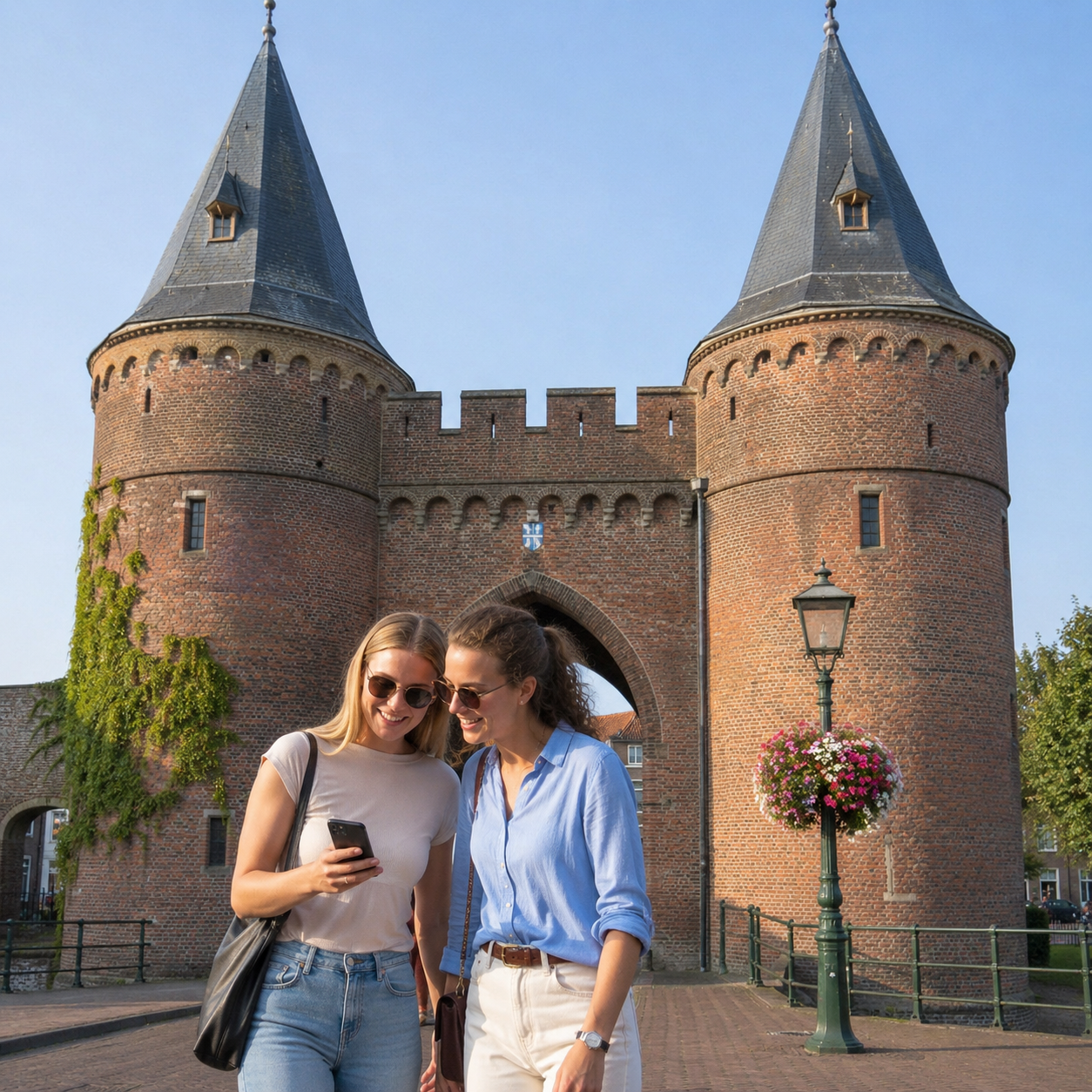
An outdoor escape hunt is what you get when you take the mechanics of an escape room and stop putting them in a room. Instead of one set with hidden compartments, you get a route: a sequence of locations in a real city, each holding a puzzle that can only be solved by standing there and looking at what is actually in front of you.
It is a hybrid of two older things – the escape room and the scavenger hunt – and it borrows the better half of each. From the escape room it takes the story, the clock and puzzles with real answers. From the scavenger hunt it takes movement, open air and the fact that a hundred people can play at once.
How the format actually works
You start at a fixed point. The story loads on one phone per team, sets up a reason to be walking around this particular city, and gives you the first location. You walk there. At the location the app asks something that requires the place itself: a number carved into a facade, the order of figures on a monument, something you can only count by looking up.
Answer correctly and the next stop unlocks. Answer wrong and you lose time or points rather than the whole game – the design assumes you will be wrong sometimes. Between stops there is walking, which is where the conversation happens and, for most groups, where the day is actually enjoyed.
The hunt ends at a fixed finish, usually two hours and two to four kilometres later, with a score you can compare against the other teams.
Why the puzzles have to be tied to the place
This is the part that separates a good outdoor hunt from a bad one. A weak hunt gives you riddles that could be solved anywhere – you sit on a bench, one person does a crossword on their phone, and the city is just scenery you walk through between questions.
A good hunt cannot be solved from the bench. The answer is on the building. That single constraint does three things: it forces the group to look up, it makes local knowledge worthless so visitors and residents start equal, and it means the route itself teaches you something. You end the game knowing why a street has that name.
Who it works for
Large groups. This is the main practical reason to choose it. Twenty, fifty or a hundred players split into teams of four to six, all playing the same route at the same time. Nothing about the format cares how many teams there are. Our groups and companies page covers what changes above about twenty-five players.
Mixed ages. Because puzzles are physical and observational rather than purely verbal, a twelve-year-old and a sixty-year-old are useful in different ways on the same team.
Visitors. If you are in a city for two days, a hunt gets you further into it than a walking tour, because you are looking for things rather than being shown them.
Colleagues who need a reason to talk. Two hours of walking with a shared task does what a seated lunch does not.
Running one well: five practical notes
Teams of four to six. Fewer and the walking gets quiet; more and someone drifts to the back on their phone.
One charged phone per team, and agree who is carrying it before you start. A dead battery at stop seven is the only real failure mode.
Build in a fifteen-minute buffer. Someone will be late, and starting on the hour is not worth the stress.
Book the finish before you start. Where you go afterwards is the difference between a game and a day out.
Check the weather the evening before, not the morning of. If you need to move it, you can – you set your own start time. The how it works page covers the rest of the practicalities.
What it costs you in time
Budget three hours door to door: fifteen minutes gathering, roughly two hours of play, and half an hour at the end for scores and the walk to wherever you are eating. That is shorter than most team events and longer than an escape room, which is usually the right amount for a group that has to get home afterwards. If you are still weighing formats, our comparison of the five outdoor escape game formats sets them side by side.
Frequently asked questions
What is an outdoor escape hunt?
A puzzle route through a real city, played on a phone in teams, where each location holds a challenge that must be solved on the spot before the next one unlocks. It combines an escape room’s story and clock with the movement of a scavenger hunt.
How is it different from an escape room?
No room, no host, no upper limit on players, and you choose the start time. You trade physical props and set design for scale, fresh air and flexibility.
How long does it take?
Around two hours of play covering two to four kilometres, at your own pace. Allow three hours in total including gathering and the finish.
Do you need to know the city?
No, and knowing it does not help much either – the answers are things you look at rather than things you remember. Visitors and residents finish about equally often.
Can children join?
From about eight years old with an adult on the team, and from twelve without. Younger children enjoy the walking but not the reading.
What happens in bad weather?
Light rain is fine and most routes pass plenty of shelter. In heavy rain, move the date – there is no fixed slot to lose.
Find a route
See which cities currently have hunts on our locations page, or tell us the size and shape of your group through the contact page and we will tell you honestly whether an outdoor hunt is the right call for it.
The Syndicate
Solve puzzles and crack codes across the city. See the games ›