Bruges is one of the best preserved medieval cities in Europe and, between about eleven and five, one of the most crowded. The good news is that this is a scheduling problem rather than a permanent condition. Almost everyone here is on a day trip, and they all leave at the same time.
The timing trick, first
Stay the night. That is the whole secret. By six in the evening the coaches have gone, the main streets empty out, and the city you came to see is simply there, lit and quiet, with locals walking their dogs across the Markt. Early morning does the same in reverse, before nine, the Rozenhoedkaai is yours.
If you can only come for the day, go against the flow: do the centre first thing, take the middle of the day somewhere out of it, and come back in the late afternoon as the numbers drop.
The Minnewater
South of the centre, the Minnewater, the Lake of Love, is a broad, still stretch of water with swans, a stone bridge and a park along one side. The name comes from a legend about a woman named Minna, though it more prosaically derives from an old word for common water. Either way, it is the one place near the middle of Bruges where you can sit on grass and hear nothing.
The beguinage
Right next to the Minnewater, behind a gate, is the Begijnhof: a walled courtyard of white houses around a lawn that fills with daffodils in spring. Benedictine sisters live here now, and silence is requested rather than suggested. Walk through slowly and do not talk. It is the calmest place inside the city and it is fifty metres from the crowds.
The eastern ramparts
The old defensive line on the east side of the city is now a long green walk with four surviving windmills standing along it. Almost no day visitor goes here, because it does not appear on the standard route. You get the canal on one side, grass on the other, and Bruges as a place where people live rather than a place people photograph.
The Bonifacius bridge
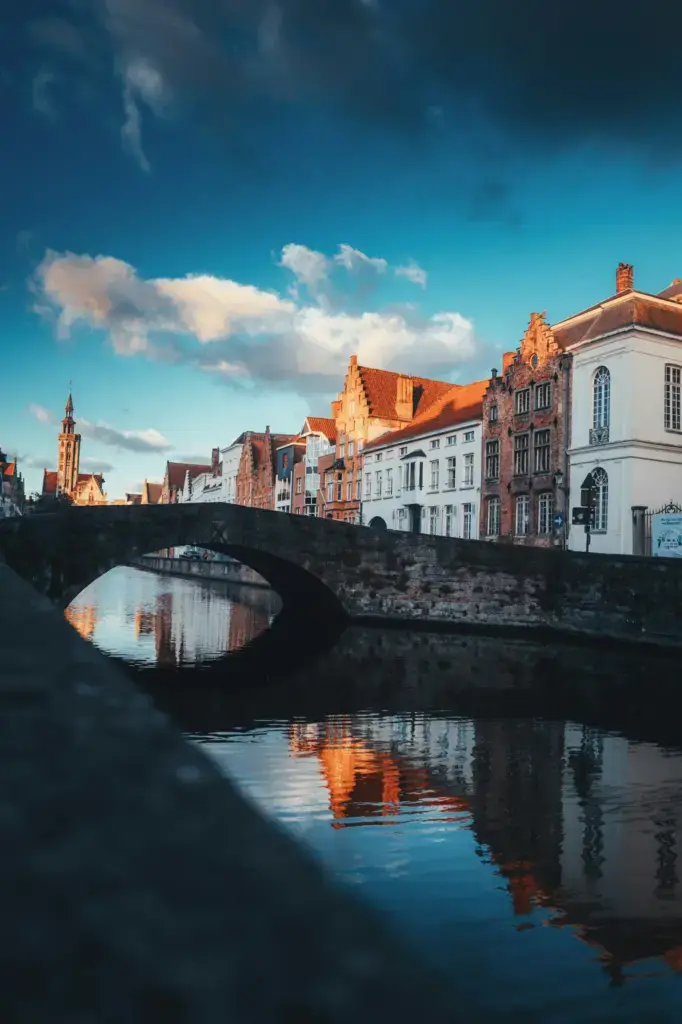
The small stone bridge behind the Church of Our Lady is the most photographed corner in Bruges after the Rozenhoedkaai, and it is worth knowing that it is not medieval, it was built in the early twentieth century, in a medieval style, on a spot that never had a bridge. It is beautiful, the setting is genuine, and the bridge itself is a hundred years old rather than six hundred. Bruges is honest about this; the guidebooks often are not.
What is worth queueing for
Two things. The Groeningemuseum, for the Flemish Primitives, Van Eyck and Memling painted here, and seeing that work in the city it was made in is different from seeing it anywhere else. And the Church of Our Lady, which holds a marble Madonna and Child by Michelangelo, the only sculpture of his to leave Italy during his lifetime.
The belfry on the Markt is 366 steps, narrow, and worth it if you are up for the climb. Book a slot if you can.
About the chocolate
There is a very large number of chocolate shops in Bruges and the quality varies enormously. A useful rule: look for shops where the making happens on the premises rather than shops selling boxes made elsewhere. The good ones will tell you what is in it and where the cocoa came from.
Seeing the city on foot
Bruges rewards knowing where you are, and the quiet parts are exactly the parts nobody points you to. A city game gives you a route of puzzles that keeps you off the main drag and explains each stop as you reach it, a much better way to spend a busy afternoon than following the crowd from the Markt to the Burg and back.
Not sure how it works? Read how to play first.
Frequently asked questions
Is Bruges too crowded to enjoy?
Not if you time it. The crowds are concentrated in the middle of the day; before nine and after six the city is calm.
How long do I need in Bruges?
One night is the minimum that makes sense. A day trip shows you the busiest version of the city and none of the good hours.
Is the Bonifacius bridge medieval?
No. It was built in the early twentieth century in a medieval style. The surroundings are genuinely old; the bridge is not.
Can you climb the belfry?
Yes, 366 steps up a narrow spiral, with a limit on how many people can be at the top. Book ahead in high season.
Where is the quietest place in Bruges?
The beguinage, and the eastern ramparts. Both are within fifteen minutes of the Markt and both are almost empty.
Does Bruges work for a group outing?
It does, with planning, the streets are narrow and a large group moves slowly, so a route that avoids the main axis works far better. See the options for companies and groups.
Stay until the coaches leave
Do the museums in the middle of the day and the streets in the evening. Want help planning something for a group? Get in touch. Seeing more of Flanders? Our guide to coffee and streets in Leuven makes a good contrast.