Antwerp is a port city that has spent five centuries being richer and more worldly than its size suggests. It has Rubens, diamonds, one of Europe's largest ports, a fashion school that changed the industry, and a railway station people travel to see. It is also compact enough to cross on foot in half an hour.
Start at the station
Antwerp Central, finished in 1905, is one of the very few railway stations that is a destination in itself. A stone hall with a glass and iron train shed behind it, four levels of platforms stacked underground, marble, gilt and a dome. Arrive by train if you can; walking up out of it is the best introduction to the city there is.
The cathedral and the Rubens paintings
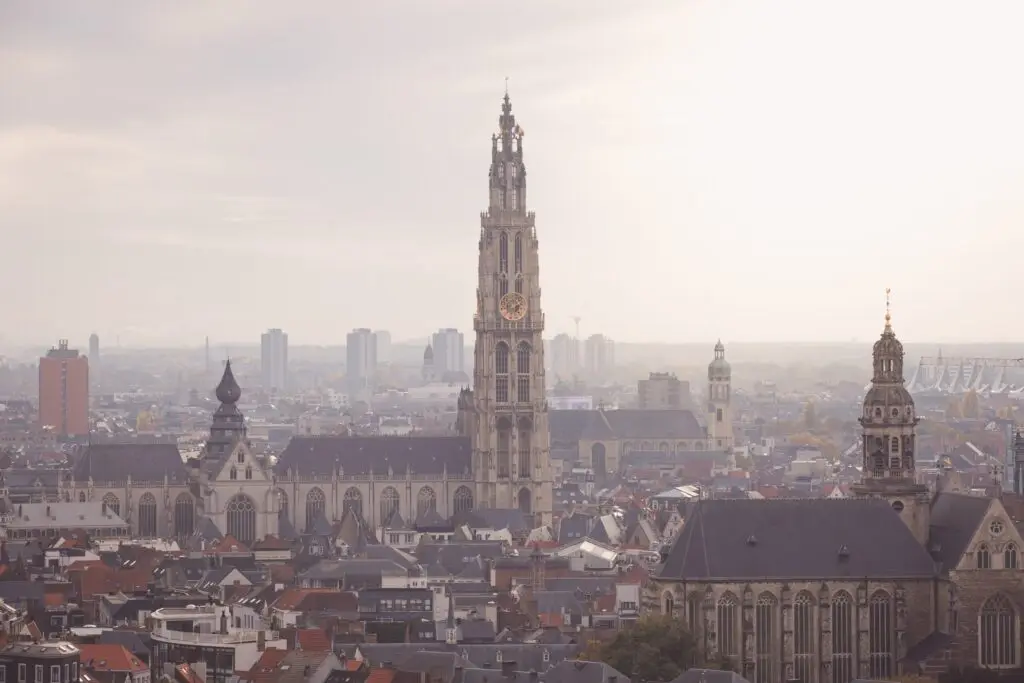
The Cathedral of Our Lady has the tallest church tower in the Low Countries and, inside, four major works by Rubens, including the Descent from the Cross, hanging where they were meant to hang rather than in a museum. Seeing them in a working church, in the light they were painted for, is completely different from seeing them under gallery lighting.
Rubens' own house and studio is a museum. It has been undergoing major renovation work, so check whether it is open before you build a day around it.
The Grote Markt and the hand
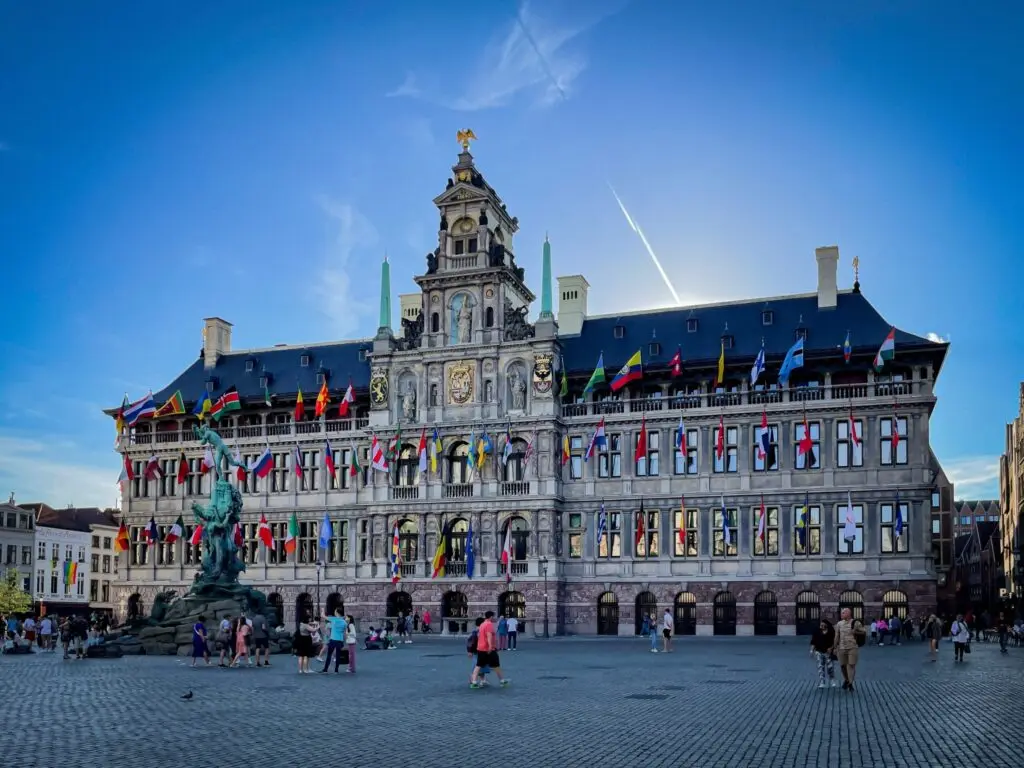
The market square is ringed with tall guild houses and has, at its centre, a fountain of a figure throwing a severed hand. The legend says a giant demanded tolls from ships on the Scheldt and cut off the hands of those who refused, until a Roman soldier named Brabo killed him and threw his hand into the river, hand werpen, hence Antwerpen. The etymology is almost certainly not true, but the city has never let that get in the way, and hand-shaped biscuits and chocolates are sold everywhere.
The MAS
The Museum aan de Stroom is a tower of red sandstone and curved glass on the old docks. The museum inside is good; the reason to go is that an escalator route runs up the outside of the building to a rooftop terrace, it is free, and it gives you the whole city, the river and the port from above. Go at the end of the day.
Plantin-Moretus
A printing works and family home, preserved with its presses, type, library and courtyard garden intact, and the only museum in the world on the UNESCO World Heritage list. Two of the presses are among the oldest surviving anywhere. If you have any interest in books, type or how information became cheap, this is the best thing in Antwerp.
Diamonds and fashion
The quarter behind the station has been one of the world's main centres of the diamond trade for centuries, and it still is. It is a working business district rather than a sight, there is a museum, but the streets themselves are offices and security doors.
Antwerp's fashion academy produced a group of designers in the 1980s who changed how the industry saw Belgium, and the fashion museum in the centre traces that. The shopping streets in Het Zuid and around Kammenstraat still reflect it.
Two things almost nobody does
The Sint-Anna pedestrian tunnel runs under the Scheldt, and you reach it by wooden escalators installed in the 1930s that are still running. Walk to the far side for the view back at the skyline, which is the one photograph of Antwerp worth taking.
And Zurenborg, twenty minutes from the centre, is a district of belle époque houses where the architects were apparently competing: Egyptian, Greek, art nouveau and mock-medieval, sometimes on the same street corner. Cogels-Osylei is the street to find.
Seeing the city on foot
Antwerp's centre is walkable and full of things that need explaining, the guild houses, the hand, the docks, the printing works. A city game gives you a route of puzzles that connects them and tells you the story at each stop, which suits a group better than a guided tour and leaves room to stop for a drink.
Not sure how it works? Read how to play first.
Frequently asked questions
How long do I need in Antwerp?
A day covers the station, the cathedral, the Grote Markt and the MAS. Two days lets you add Plantin-Moretus, Zurenborg and the river properly.
What is Antwerp best known for?
Its port, its diamond trade, Rubens, and its fashion designers. And, increasingly, its railway station.
Can you see Rubens paintings for free?
The cathedral charges admission outside services, and it is modest. The works inside are worth it.
Is the MAS rooftop free?
Yes. The escalator route to the roof terrace is free to use; only the museum floors are ticketed.
Is Antwerp good for a night out?
Very. Het Zuid and the streets around the Grote Markt both work, and the city stays up late without the crowds of Brussels.
Does Antwerp work for a company outing?
Well. It is compact, well connected, and has enough variety that a group with different interests all get something. See the options for companies and groups.
Arrive by train and walk out
Start at the station, work down to the cathedral and the river, and end on the MAS roof. Want help choosing the right game for your group? Get in touch. Pairing it with the coast? Our guide to the quiet corners of Bruges covers the other half of Flanders.