A city with a reputation, and a good answer to it
Charleroi spent years being called the ugliest city in Belgium, mostly by people who saw it from the ring road. It grew on coal and glass, both industries collapsed, and it was left with the scale of a big city and the tax base of a shrinking one. What makes it interesting now is that it stopped pretending otherwise. Instead of hiding the industrial past it turned the mine sites into museums, the slag heaps into walking hills and the empty buildings into galleries.
You do not come here for pretty. You come for something with more grip than pretty.
Bois du Cazier
Start here, because everything else in Charleroi makes more sense afterwards. Bois du Cazier in Marcinelle is a former coal mine and a UNESCO World Heritage site. On 8 August 1956 a fire underground killed 262 miners, a large share of them Italians who had come to Belgium under a labour agreement that traded workers for coal. The site keeps the headframes, the pit-top buildings and a memorial, and it tells the story without softening it.
Behind the buildings, the old slag heaps are now wooded hills you can climb. From the top you look across a landscape that is entirely man-made.
The belfry and the Art Deco centre
Charleroi's belfry is not medieval like the others on the UNESCO list of Belgian and French belfries. It was built in the 1930s in Art Deco, attached to the town hall, and that makes it the odd one out in the best way. Look around the upper town while you are there: the 1930s left a lot of good brick and geometry here that most visitors walk straight past.
Saint-Christophe and its mosaic
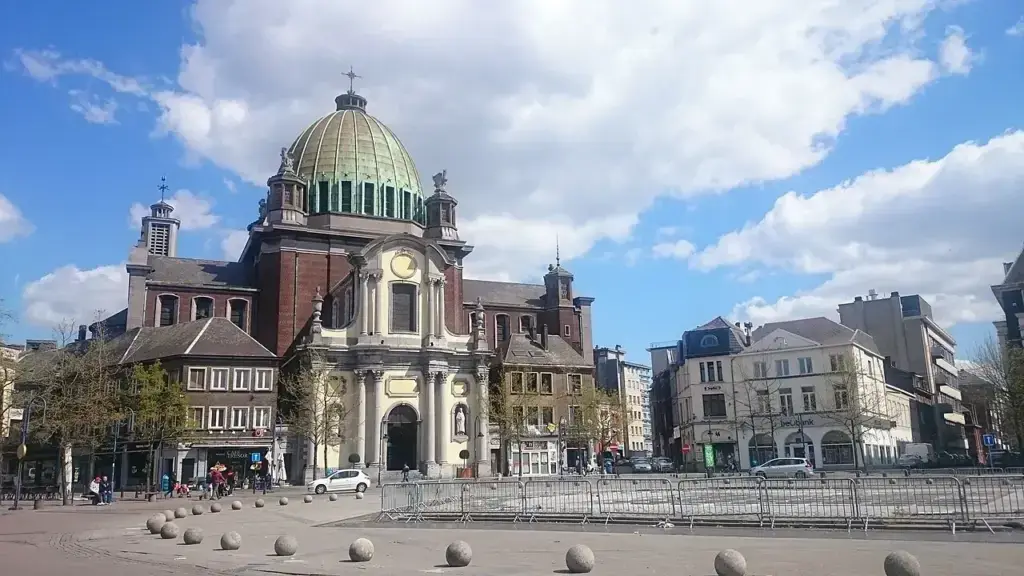
The church of Saint-Christophe hides something you would not guess from outside: an enormous mosaic, made in the twentieth century in a Byzantine-inspired style, covering the vault above the choir. It is worth stepping in for ten minutes purely for the contrast between the modest exterior and the gold inside.
The Photography Museum
The Musée de la Photographie is one of the largest photography museums in Europe and it sits in a former neo-Gothic Carmelite convent, with a modern extension attached. Cloister corridors turn into exhibition rooms, which is a strange and very effective setting for photographs. It runs a serious programme of temporary shows alongside its permanent collection, so check what is on. If you only have time for one museum in Charleroi, most people should make it this one.
Glass, contemporary art and the metro
The Musée du Verre covers the other industry that built this city. Charleroi glass went around the world, and the museum handles both the technique and the working lives behind it.
BPS22, in a glass and steel hall from 1911, shows contemporary art with a social edge, which suits the building and the city.
And the metro is a story in itself: a network planned for a population that never arrived, leaving stations and viaducts that were built and then barely used. Some have since been brought into service. It is a favourite subject for photographers and a fair symbol of Charleroi's twentieth century.
Seeing Charleroi by playing it
Charleroi is not a city that hands itself to you, which makes it perfect for exploring with a purpose. A city game gives you a route and clues through the upper and lower town, so instead of judging the place from a main road you end up reading its facades, its industrial traces and its 1930s details up close. It works with friends, with family and particularly well with a work group, because the city surprises people.
Frequently asked questions
Is Charleroi worth visiting?
Yes, if you want industrial heritage, strong museums and a city with a real story rather than a picture-book centre. One day is enough for the highlights.
What is Charleroi best known for?
Its coal and glass past, the Bois du Cazier UNESCO site, the photography museum and an Art Deco belfry that stands out among Belgium's medieval ones.
Is Charleroi safe for visitors?
The areas described here are ordinary city districts and the usual city sense applies: stay aware around the station at night, keep valuables out of sight, and you will be fine.
How do I get around?
The centre is walkable and the metro and buses cover the rest. Bois du Cazier is reachable by bus or a short drive.
Is it good for children?
Bois du Cazier and the slag-heap walk work well for older children. The photography and glass museums suit teenagers more than small kids.
Come and play in Charleroi
If you want to see past the reputation, walk the city with a route that makes you look. Here is how it works, and for team days and larger groups we have formats on this page. Questions about dates, group sizes or routes? Get in touch. Staying in Wallonia? Tournai makes a good contrast.