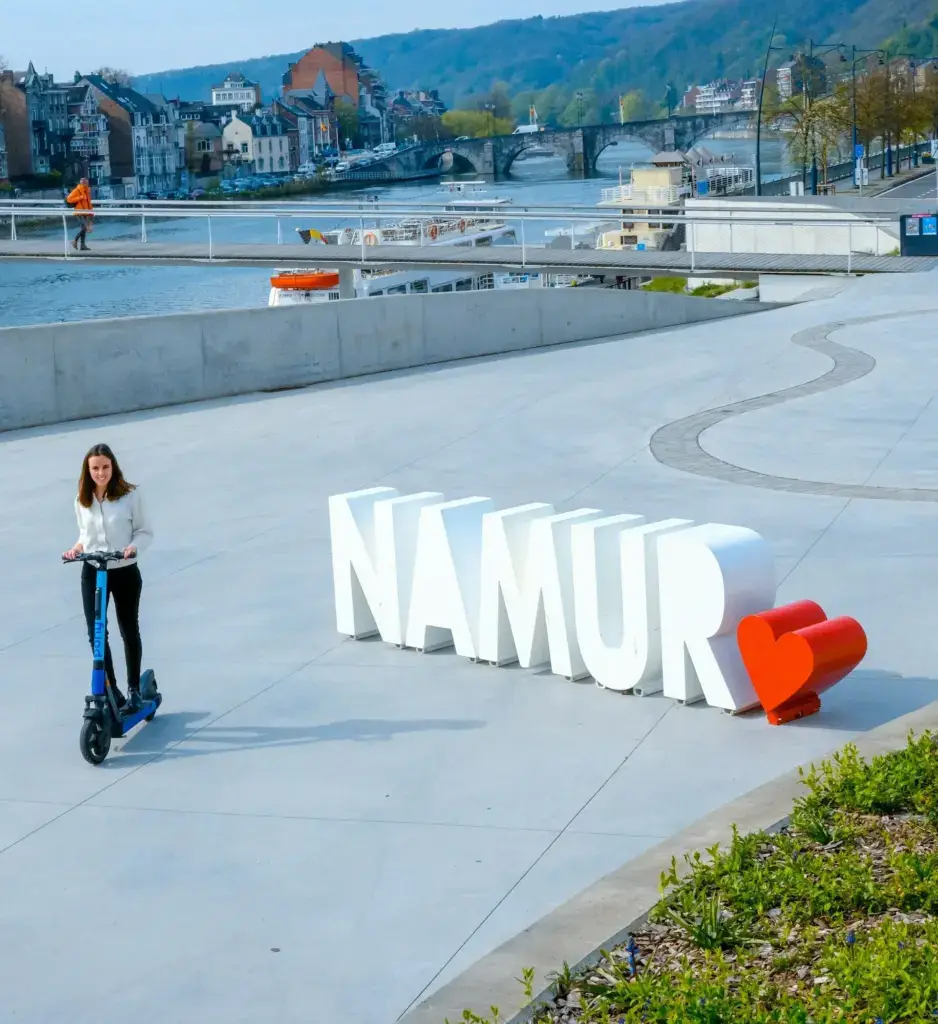
Namur is the capital of Wallonia and sits where the Sambre runs into the Meuse, with an enormous fortress on the rock above the junction. It is French-speaking, considerably quieter than the Flemish cities, and built around one very obvious feature that most visitors climb on the first afternoon.
The citadel
The rock above the confluence has been fortified for around two thousand years, and what stands there now is the accumulated result: medieval walls, seventeenth-century bastions, Dutch and Prussian additions, and tunnels cut through the rock beneath all of it. It is among the largest fortresses in Europe and it takes half a day if you do it properly.
Go up by cable car from the city if it is running, and walk down. The underground galleries are visited on a guided tour and are the part people remember, cold, narrow and genuinely disorienting.
The Grognon
The spit of land at the exact point where the two rivers meet is called the Grognon, and it is where Namur began. Stand on it and you have the Sambre on one side, the Meuse on the other, and the citadel directly above. There is not much built on it, which is the point, this is a place to look from rather than at.
The belfry
The Saint-Jacques tower in the centre is one of the belfries of Belgium and France on the UNESCO list. Like the others, it was a civic tower rather than a church one: proof that the town governed itself. It is easy to walk past, so look for it.
The Oignies treasure
Namur holds one of the great pieces of medieval European goldsmithing: a group of reliquaries and liturgical objects made in the thirteenth century by Hugo d'Oignies, worked in gold, silver and enamel at a level of detail that is hard to believe was done by hand. It is displayed in the city's museum of early art. If you see one thing indoors in Namur, see this.
The Rops museum
Félicien Rops was born here in 1833 and became one of the most provocative graphic artists in Europe, dark, satirical and frequently censored. The museum in his birth city does not soften him. It is small, it is strange, and it is a useful corrective to the idea that Namur is a sleepy provincial capital.
The stilt jousters
Namur has a tradition of stilt jousting that goes back to the fifteenth century: two teams on tall wooden stilts try to knock each other over in the market square, without using hands. It is still done, it is taken seriously, and it was added to the UNESCO list of intangible cultural heritage. If you can time a visit to a match, do.
The valleys
Namur is the gateway to the Meuse valley and the Ardennes. Dinant, half an hour upstream, has a citadel on a cliff, a church with an onion dome and the birthplace of the man who invented the saxophone. The Lesse valley beyond it is limestone, caves and river, and there are gardens, abbeys and rock formations within an easy drive.
If you have a car and two days, the second day belongs outside the city.
Seeing the city on foot
The old centre between the citadel and the station is small and full of things that need pointing out, the belfry, the courtyards, the line of the old walls. A city game gives you a route of puzzles through it and explains each stop as you reach it, which works well before or after the climb up to the fortress.
Not sure how it works? Read how to play first.
Frequently asked questions
Is Namur worth visiting?
Yes, for the citadel and the setting. It is a calmer, cheaper and more French-speaking side of Belgium than the Flemish cities, and it is the best base for the Meuse valley.
How long do I need in Namur?
A day for the citadel and the centre. Two if you want the museums or a trip up the Meuse to Dinant.
How do you get up to the citadel?
By cable car from the riverside, on foot up the paths, or by road. The walk down is easier than the walk up.
What language is spoken in Namur?
French. Namur is the capital of Wallonia and the seat of the Walloon Parliament.
What is stilt jousting?
A Namur tradition dating from the fifteenth century in which teams on tall stilts fight to unbalance each other, recognised by UNESCO as intangible cultural heritage.
Does Namur work for a group outing?
It does, the citadel gives a group a shared objective, the centre is compact, and it is well connected to Brussels. See the options for companies and groups.
Go up first, then walk the town
Take the citadel in the morning while you have the legs, then come down into the centre. Want help planning something for a group? Get in touch. Comparing the two halves of Belgium? Our guide to what to do in Antwerp is the Flemish counterpart.