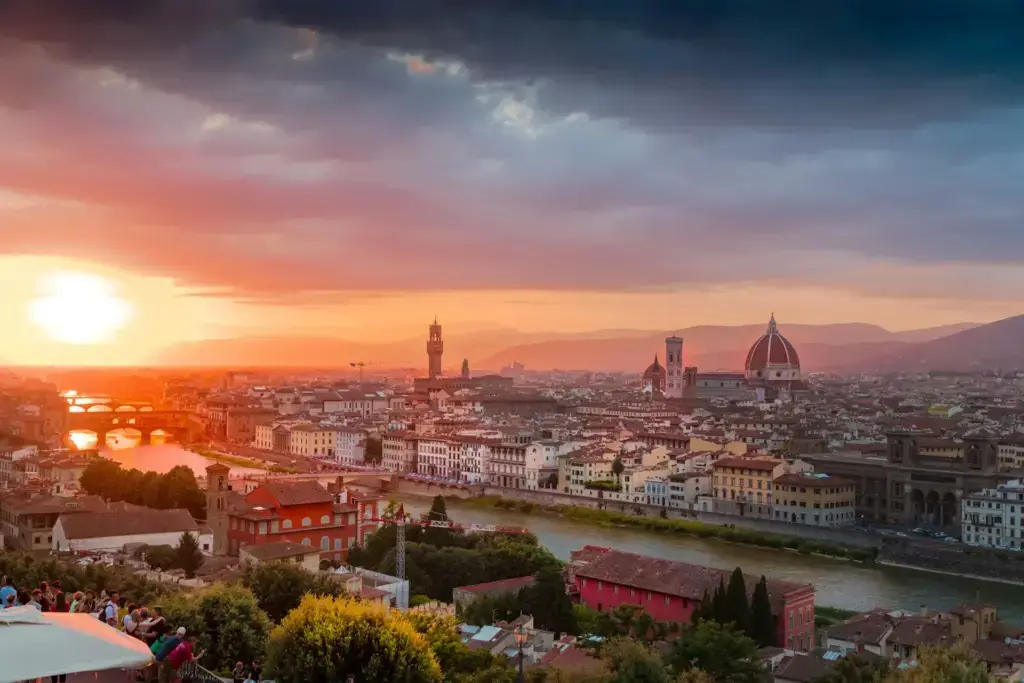
Florence is a small city carrying an enormous amount of art, and that mismatch is the whole experience. The historic centre is walkable end to end in half an hour, and inside that half hour are the works that most people mean when they say the Renaissance. It is also, for the same reason, extremely crowded.
This guide is arranged around that problem: what to book ahead, what you can walk into, what is a copy, and how to build a day that is not spent in queues.
The Duomo complex
Brunelleschi's dome
The cathedral dome was built between 1420 and 1436 without the wooden scaffolding structure that everyone assumed such a span required. Brunelleschi built it as two shells with a herringbone brick pattern that made each ring self-supporting as it went up. Nobody had done it since antiquity and nobody was certain it would stand.
You can climb it, a little over 450 steps, ending between the two shells and then out onto the lantern. Reservation is compulsory and slots go quickly; book as soon as you have dates. It is narrow, warm and not for anyone uneasy in tight spaces.
Giotto's campanile
The bell tower next door is a similar climb with one advantage: from the top you can see the dome, which you cannot do from the dome. If you only climb one thing, and you want the photograph, climb this.
The Baptistery
The oldest building on the square, with Ghiberti's bronze doors that Michelangelo is said to have called the Gates of Paradise. Note that the panels on the building are copies; the originals are in the Museo dell'Opera del Duomo across the square, along with Michelangelo's late unfinished Pietà and Donatello's Mary Magdalene. That museum is the least crowded part of the complex and one of the best in the city.
The two big museums
The Uffizi
The Medici collection, in the building Vasari designed as government offices, which is what uffizi means. Botticelli's Birth of Venus and Primavera are here, along with Leonardo, Caravaggio, Titian and a corridor of Roman sculpture.
Book a timed entry, go at opening or in the last two hours, and accept that you will not see it all. A focused two hours beats a defeated four.
The Accademia
People queue for one thing: Michelangelo's David, which stands at the end of a hall lined with his unfinished Prisoners, figures still half-buried in their blocks. The Prisoners are the reason to go even if you have seen the David in photographs a hundred times. Book ahead here too.
A useful thing to know: the David in Piazza della Signoria is a copy, placed there in 1873 when the original was moved indoors. So is the one at Piazzale Michelangelo.
What you can just walk into
Florence rewards the person who knows what is free.
The Loggia dei Lanzi on Piazza della Signoria is an open-air sculpture gallery you walk straight into, with Cellini's Perseus and Giambologna's Rape of the Sabine Women standing in the weather. Piazza della Signoria itself is free, and Palazzo Vecchio's courtyard can be entered without a ticket.
Santo Spirito, Brunelleschi's last church, is usually quiet. San Miniato al Monte, up the hill beyond Piazzale Michelangelo, is the finest Romanesque church in Tuscany and the monks sing vespers in the crypt in the late afternoon; it is free, it is a real service, and it is the best hour in Florence.
The river
The Ponte Vecchio has carried shops since the Middle Ages. They were butchers until 1593, when the Medici, who had built a private corridor over the top of the bridge, decided the smell was unacceptable and replaced them with goldsmiths. The jewellers are still there. The corridor above, the Vasari Corridor, running from the Uffizi to Palazzo Pitti, has been restored and opened to visitors; check current arrangements before counting on it.
Cross to the Oltrarno, the south bank. Palazzo Pitti and the Boboli Gardens are here, and so are the workshops, gilders, restorers, leatherworkers, that still make Florence a working craft city rather than only a museum one.
Santa Croce, and who is actually buried there
The Franciscan church east of the centre holds the tombs of Michelangelo, Galileo and Machiavelli, among others. Dante has a monument here but is not in it: he died in exile in Ravenna in 1321 and Ravenna has declined to give him back ever since. The cloister next door contains Brunelleschi's Pazzi Chapel, a small perfect room that is worth the ticket on its own.
An invention you would not expect
The piano was invented in Florence. Bartolomeo Cristofori, keeper of instruments for the Medici, built the first gravicembalo col piano e forte, a harpsichord that could play soft and loud, around 1700. Some of his surviving instruments and a broader collection are held in the musical instruments department attached to the Accademia.
Eating
Lampredotto, a sandwich of slow-cooked tripe sold from carts, is the genuine Florentine street food and costs almost nothing. Schiacciata is the flat salted bread everything gets stuffed into. Bistecca alla fiorentina is a very large T-bone, served rare, priced by weight and meant for two or more, if a restaurant offers you a small one cooked through, you are in the wrong restaurant.
Eat across the river or in the streets north of the market. The places directly around the Duomo and the Signoria are priced for people who will only eat there once.
Walking the city
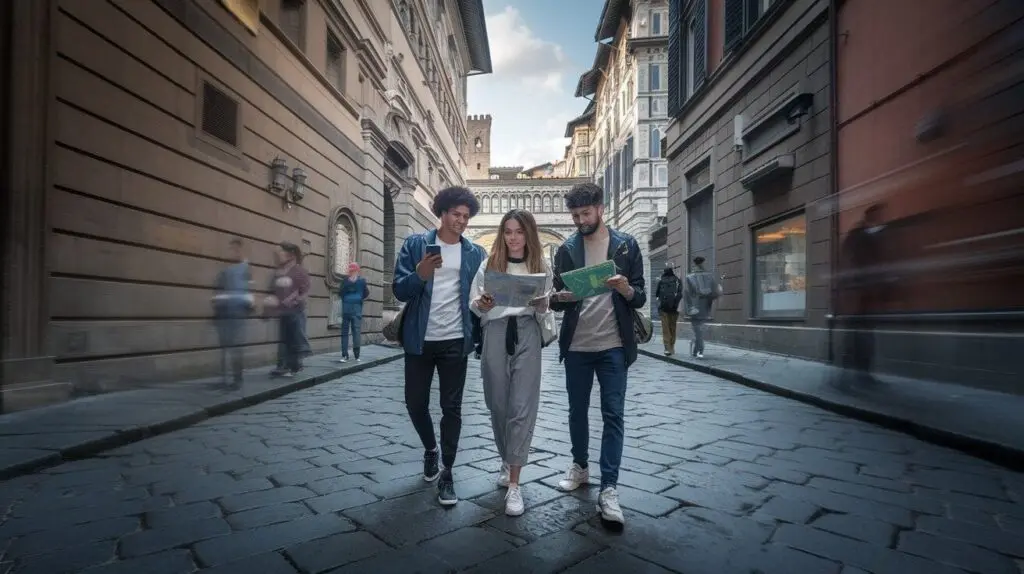
Everything above sits inside a compact centre, and the walking between things is where Florence actually happens: the sudden gaps between buildings, the street shrines, the courtyards. A city game gives you a route through it with something to solve at each stop, which is a good way to fill the hours between timed museum slots.
Frequently asked questions
What do I absolutely need to book in advance?
The dome climb, the Uffizi and the Accademia. Everything else can be handled on the day, though the Duomo complex needs a combined ticket even for the free-entry cathedral.
How many days does Florence need?
Three is comfortable: one for the Duomo complex, one for the Uffizi and the centre, one for the Oltrarno and San Miniato. Two is possible if you book everything.
When should I visit?
Late autumn to early spring. Summer is hot, and the centre is genuinely uncomfortable in July and August. April, May, September and October are pleasant but busy.
Is the David in the square the real one?
No. The original has been in the Accademia since 1873. The copies are in Piazza della Signoria and at Piazzale Michelangelo.
Is Florence too crowded to enjoy?
Not if you plan around it. Early mornings, late afternoons, the Oltrarno, and the churches and smaller museums are all comparatively calm. The crush is concentrated in about six streets between the Duomo and the Ponte Vecchio.
Does Florence work for a group?
Yes, though timed museum tickets need booking as a block well in advance. The walkable centre makes everything else straightforward. For organised group activities, see what we run for companies and groups.
Plan the day
A shape that works: the Duomo complex at opening, the streets and Loggia dei Lanzi late morning, lunch in the Oltrarno, an afternoon museum slot, and San Miniato at vespers. If you want the walking between those to have a route, here is how our games work, and you can get in touch about organising one. Already playing here? Our post on quests in Florence goes into what a game day in the city looks like.