
Look at Zwolle on a map and the first thing you notice is the shape: the old centre sits inside a moat that zigzags around it in points, like a star. Those are seventeenth-century bastions, and Zwolle kept its outline when most Dutch cities filled theirs in. Walking that ring is the simplest way to understand the place, and it takes about forty minutes.
The Sassenpoort
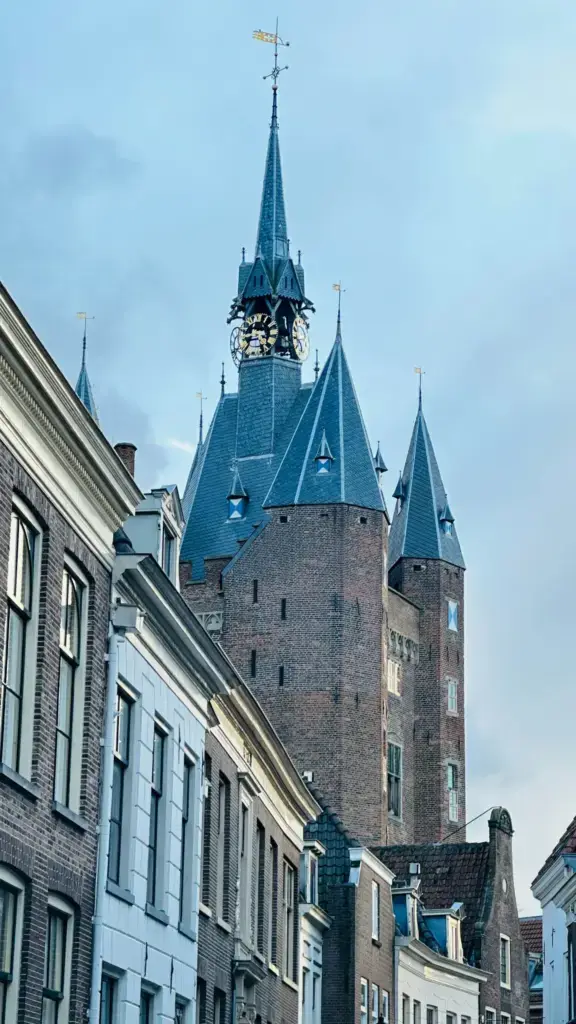
One city gate survives, and it is a good one: a tall brick gatehouse from around 1408 with four slim corner turrets, standing at the point where the main street meets the moat. It looks exactly like the gate a child would draw. Go through it on foot rather than round it.
The church with no tower
The Grote or Sint-Michaëlskerk dominates the market square and has no steeple. It did once, the tower was struck by lightning and collapsed, was rebuilt, and collapsed again. After the second or third attempt the city gave up and left the church as it was. Inside is a large seventeenth-century Schnitger organ, and the building is used for concerts and events as much as for services.
A bookshop in a church
The Broerenkerk, a former monastery church a few streets away, is now a bookshop. Not a shop with some books in an old building, the shelving climbs three storeys up the nave, the vaulting is untouched above it, and there is a café where the choir used to be. Whatever you think of the idea, it has kept a large medieval building open and in daily use, and it is worth twenty minutes even if you buy nothing.
Museum de Fundatie
A neoclassical building on the Blijmarkt with an enormous tiled ellipse sitting on its roof, added in 2013. The city calls it the cloud, or the eye, depending on who you ask. Inside is a good art collection with changing exhibitions, and the interior of the ellipse, an oval white room with windows at each end, is worth the ticket by itself.
The Peperbus
The tower of the Onze-Lieve-Vrouwebasiliek is nicknamed the Pepper Pot for its shape. It can be climbed in season, and the reward is the star-shaped moat seen from above, which makes the whole layout of the city suddenly obvious.
Blue fingers and sweets
People from Zwolle are called blauwvingers, blue fingers. The story goes that Zwolle bought Kampen's church bells, paid in small coin, and counted so much of it that their fingers turned blue. Kampen tells the story differently. The rivalry is several centuries old and still good for an argument.
The local sweet is the Zwolse balletje, a hard boiled sweet still made by hand in a small shop in the centre. Buy a bag; they last.
Out of the centre
North-east of town is the Agnietenberg, where Thomas à Kempis spent most of his life in a monastery and wrote The Imitation of Christ, one of the most widely read books in the Christian tradition, written in a low hill outside a small Dutch city. The monastery is gone; the hill and a memorial are still there.
Seeing the centre on foot
Zwolle is compact, and the interesting parts are the details: the gate, the moat, the courtyards, the gable stones, the line where the old wall used to run. A city game gives you a route of puzzles that links them and explains each stop as you reach it, better for a group than a guided tour, and it gives children a reason to keep walking.
Never played one? Read how to play first.
Frequently asked questions
Is Zwolle worth visiting?
Yes, especially if you like a compact historic centre without crowds. It is also the easiest rail hub in the north-east, so it fits neatly into a longer trip.
How long do I need in Zwolle?
Half a day covers the moat walk, the Sassenpoort and the market square. A full day adds Museum de Fundatie, the Broerenkerk and the tower.
Why does the big church have no tower?
Because it kept falling down. After repeated collapses the city stopped rebuilding it, and the church has stood without one ever since.
Can you walk the old fortifications?
Yes. The moat and its bastions form a continuous green ring around the centre, and the full circuit takes under an hour at an easy pace.
What are Zwolle people called?
Blauwvingers, blue fingers, from a centuries-old story about counting coins paid to Kampen for its church bells.
Does Zwolle work for a group outing?
Well. The centre is small enough that nobody gets lost, and the market square has terraces to finish on. See the options for companies and groups.
Walk the star first
Do the moat circuit before anything else, the shape of the city explains everything inside it. Want help choosing the right game for your group? Get in touch. Continuing along the IJssel? Our guide to things to do in Deventer is the next stop down the river.