For a few centuries around the year 1000, Córdoba was one of the largest and most learned cities in the world, the capital of a caliphate that ran most of the Iberian peninsula. Almost everything worth seeing today dates from then or from what came immediately after, and it fits into a single walkable centre.
The Mosque-Cathedral
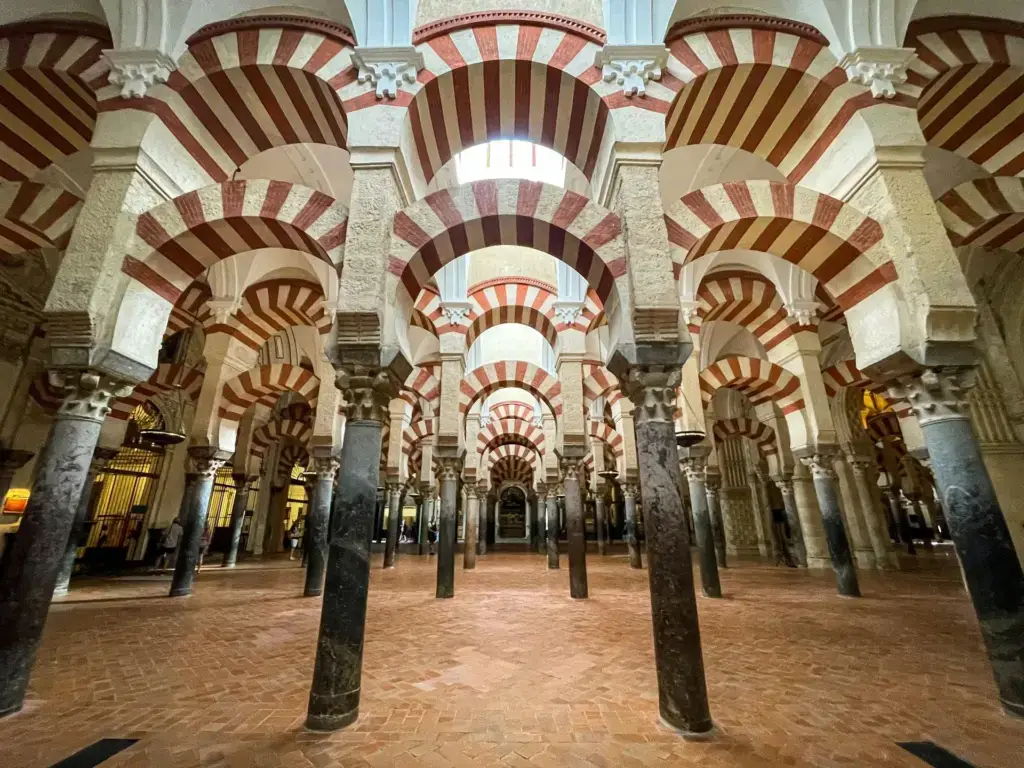
Building began in 785 under Abd al-Rahman I, on a site that had held a Visigothic church, and it was enlarged three times over the following two centuries. The result is the forest of red-and-white double arches on 850-odd columns that everyone comes for, and it still does something no photograph manages: it makes a very large building feel infinite in every direction.
After Córdoba was taken by Castile in 1236 the mosque became a cathedral, and in the 1520s a full Renaissance nave was built into the middle of it. The story that Charles V regretted authorising it, telling the builders they had destroyed something unique to build something ordinary, is widely repeated and impossible to verify. The two buildings inside one another are the point of the place.
Practical notes: it is officially a cathedral and functions as one, so Muslim prayer is not permitted inside, a restriction that has been the subject of long-running public debate. Entry is free in the early morning for a limited window on most days, but that slot excludes guided access and gets busy. The bell tower, the former minaret, is a separate ticket.
The Jewish quarter and the synagogue
The Judería is the tangle of whitewashed lanes north of the mosque. Its synagogue, built in 1315, is one of only three medieval synagogues surviving in Spain and the only one in Andalusia. It is very small and takes ten minutes, and the Hebrew inscriptions on the walls are worth the visit.
The Calleja de las Flores nearby is a narrow alley framing the bell tower and is photographed constantly. Go early or accept the queue for the shot.
The Roman bridge
The bridge over the Guadalquivir has Roman foundations, though what you walk on has been rebuilt repeatedly over two thousand years. It is best at either end of the day, with the mosque on one side and the Calahorra tower on the other. Walk to the far bank and look back; that is the classic view of the city.
The Alcázar and its gardens
The Alcázar de los Reyes Cristianos is a fortress-palace with long water gardens that are the coolest place in Córdoba on a hot afternoon. Isabella and Ferdinand received Columbus here before his first voyage.
It also served for centuries as the seat of the local tribunal of the Inquisition, which the site acknowledges. Both facts belong to the same building.
Medina Azahara
Eight kilometres west of the city, Medina Azahara was a palace-city begun in 936 by Abd al-Rahman III as a new seat of government, administration, mint, mosque, gardens, the whole apparatus of a caliphate on one terraced hillside. It was sacked and abandoned within about seventy-five years of being built, and lay buried until the twentieth century.
It became a UNESCO World Heritage Site in 2018. A shuttle bus runs from the city; the museum below the site is excellent and explains what you are about to walk through. Allow half a day.
The patios
Córdoba's courtyard tradition, private patios filled with pot plants, kept cool by shade and water, is on UNESCO's intangible cultural heritage list. During the Fiesta de los Patios in early May, dozens of private courtyards open to the public for free and the city fills up entirely.
Outside the festival, several patios stay open year-round for a small fee, and the Palacio de Viana has twelve of them in one building, which is the reliable option if your dates do not line up.
The heat, honestly
Córdoba is one of the hottest cities in Europe. July and August regularly pass 40°C and the streets empty between two and six in the afternoon for a reason. April, May, October and November are far better months. If you do come in summer, do the outdoor things before ten in the morning.
See it as a game
The old centre is a maze of lanes designed to give shade rather than direction, which makes it perfect for a city game: small teams, a phone, puzzles tied to real courtyards, gates and squares, and no guide or fixed start time. You find the corners of the Judería that the tour groups walk past, and you stop for a cold drink whenever you want.
It works for friends, families and company outings and larger groups. The how it works page explains it step by step.
Frequently asked questions
How many days do you need in Córdoba?
One full day covers the mosque, the Judería, the bridge and the Alcázar. Two days let you add Medina Azahara properly.
Do you need to book the Mosque-Cathedral?
Booking a timed ticket online saves queueing, especially in spring. There is a free early-morning window most days, with restrictions.
Can you pray in the Mosque-Cathedral?
It is a working Catholic cathedral and Muslim prayer is not permitted. This has been the subject of long public debate.
When is the patio festival?
Early May, usually for around two weeks. Accommodation books out months ahead for it.
How do you get to Medina Azahara?
By shuttle bus from the city centre, which is the simplest option since private cars cannot reach the site directly.
Is Córdoba worth visiting from Seville?
Yes. The high-speed train takes about forty-five minutes, which makes a day trip genuinely easy.
Go in spring
Córdoba in May, with the patios open and the temperature still bearable, is one of the best few days in Spain. See all the cities where we run games, read about the neighbours in the best flamenco tablaos in Granada, or get in touch if you are planning something for a group.