For four nights around 8 December, Lyon turns its buildings, squares, parks and riverbanks into a free open-air exhibition of light. Artists project onto cathedral facades, fill parks with installations you walk through, and light the hills above the city. It is one of the largest events of its kind in Europe and it costs nothing to attend.
Here is where to go, in what order, and what nobody tells you about the crowds.
Why 8 December
The date comes from a vow. In 1643, with plague in the region, the city authorities placed Lyon under the protection of the Virgin Mary and promised an annual tribute.
The candles in windows came later. In 1852 a new statue of the Virgin was to be unveiled on the Fourvière hill on 8 September; flooding delayed it to 8 December, and on that evening a storm looked set to cancel the ceremony. The weather cleared in the early evening, and people put lit candles on their windowsills. They have done it every year since.
Those small candles in glass jars are called lumignons and they are still the heart of the thing. The large-scale artistic festival was built around them from 1999 onwards, but if you want the original version, look up at the windows on the residential streets rather than at the projections.
Where the big installations are
Place des Terreaux
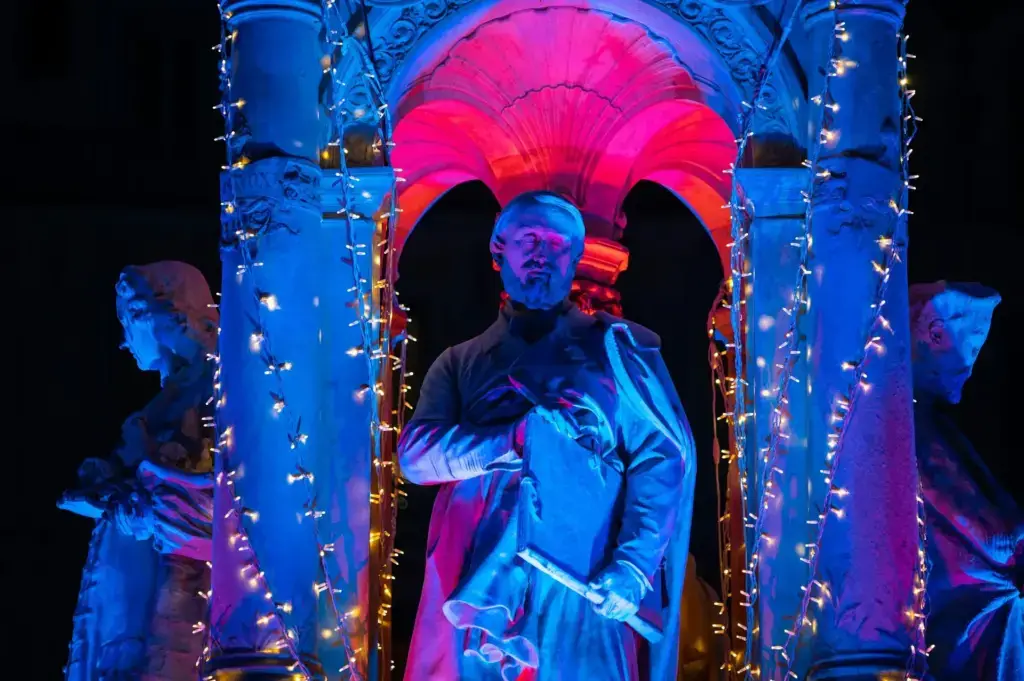
The main square, and traditionally the site of the largest projection of the festival, mapped onto the facade of the Hôtel de Ville and the Musée des Beaux-Arts. Bartholdi's fountain, by the sculptor who made the Statue of Liberty, sits in the middle. This is the most crowded spot in the city on those nights; go early or very late.
Fourvière and the cathedral
The basilica on the hill is floodlit, and the walk or funicular up gives you the whole city laid out and glowing. Below it, the facade of Saint-Jean cathedral in Vieux Lyon usually carries one of the most ambitious projections of the festival, played to a crowd standing in a small square, which makes it far more intimate than the Terreaux.
Place Bellecour
One of the largest open squares in Europe, with the equestrian statue of Louis XIV in the middle. It usually holds a large-scale piece that can be seen from a distance, which is useful when everything else has a queue.
Parc de la Tête d'Or
The big park north-east of the centre, which in recent years has hosted walk-through installations along the lake. Further from the crush, and the best option if you have children.
The riverbanks
Both the Rhône and the Saône quays are used, and walking between the two rivers is often better than standing still at any single installation. The bridges give you reflections and distance.
How to actually do it
Some honest practicalities. Hundreds of thousands of people attend, the centre is closed to traffic, and the metro is packed from about 6pm. Walk rather than trying to travel; the whole festival area is walkable and the distances are shorter than they look on a map.
Go against the flow. Most people move from Bellecour north to Terreaux early in the evening, so doing that route in reverse, or starting in Vieux Lyon, saves you a great deal of standing still.
Dress for December in a river valley: it is cold, often damp, and you will be outdoors for four or five hours. Book accommodation months ahead, because the city sells out. And check the official programme before you go, the sites change every year and so do the start and end times.
Lyon when the lights are off
If you come for the festival, stay a day longer. Lyon is one of the most underrated large cities in France.
Vieux Lyon
One of the largest Renaissance quarters in Europe, and part of a UNESCO World Heritage listing. Running through it are the traboules, covered passageways cutting between streets through courtyards and stairwells. They were used to move silk through the city without exposing it to rain. Some are open to visitors; look for the small plaques on the doors.
Croix-Rousse
The hill north of the centre where the silk weavers, the canuts, lived and worked in tall rooms built to fit their looms. It has its own traboules, its own market, and a very large mural celebrating the trade.
Fourvière's Roman city
Lyon was Lugdunum, capital of Roman Gaul. Two theatres are cut into the hill below the basilica, still used for summer concerts, with a museum built into the slope beside them.
Eating
Lyon takes food more seriously than almost anywhere. A bouchon is a traditional Lyonnais restaurant serving quenelles, andouillette, salade lyonnaise and pralines tart, heavy, offal-friendly, and not for everyone. The covered market named after Paul Bocuse is a good place to graze if you want the produce without the full sit-down commitment.
Seeing the city by day
The daytime version of Lyon, the traboules, the two hills, the two rivers, rewards a route rather than a wander, because the interesting things are hidden behind doors. A city game gives you one with something to solve at each stop, which fits a city that keeps its best parts out of sight.
Frequently asked questions
When exactly is the Festival of Lights?
Four nights built around 8 December, usually starting the evening of the 5th, 6th or 7th depending on the year. Check the official dates before booking.
Is it free?
Yes. All the installations in public space are free to see. Some indoor or ticketed side events are not.
How crowded does it get?
Very. Central squares are shoulder to shoulder between about 7pm and 10pm. The later hours and the outer sites are far more comfortable.
Is it suitable for children?
The park installations, yes. The central squares with small children, no. Go early, stay in the outer sites and avoid Terreaux at peak time.
Do I need to book anything?
Only accommodation and restaurants, and both need booking well in advance. The festival itself needs no ticket.
Can we come as a group?
Yes, with a plan: agree a meeting point in advance, because phone networks struggle in the crowds. For organised group activities in Lyon, see what we run for companies and groups.
Plan the visit
The best version: arrive a day early, walk Vieux Lyon and Croix-Rousse in daylight, eat properly, then start the festival in Vieux Lyon at dusk and work north, ending at Terreaux late when the crowd has thinned. If you want the daytime walk to have a route, here is how our games work, and you can get in touch about running one for a group. Heading south afterwards? Our guide to quests in Nice covers the Mediterranean end of France.