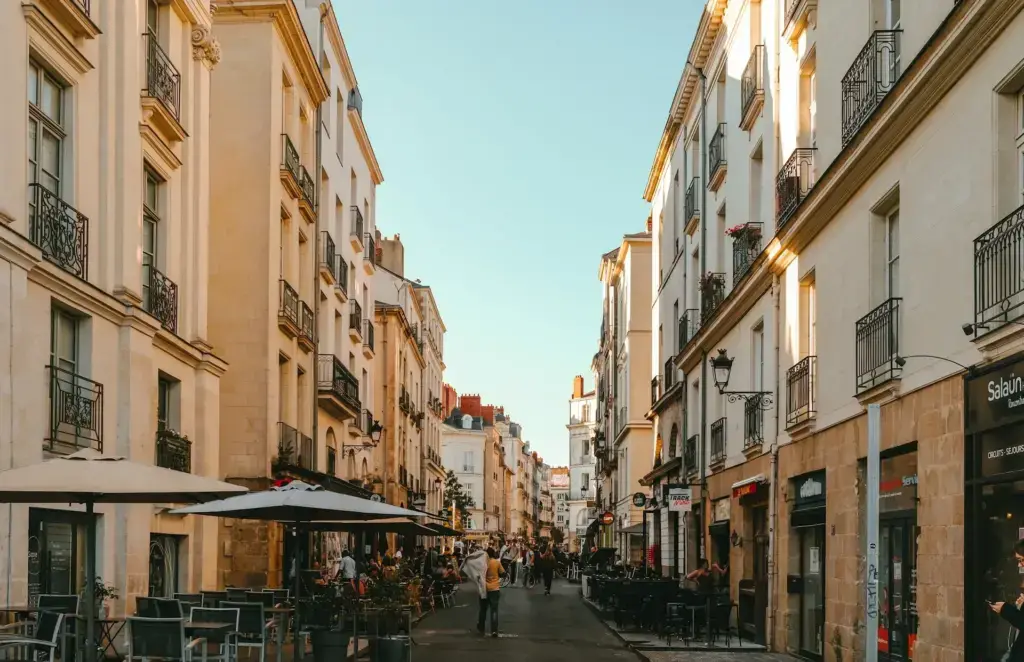
Nantes is the French city that decided art should be the thing you trip over on the way to work. There is a giant mechanical elephant that walks along the riverfront carrying passengers, a green line painted on the pavement that leads you past dozens of artworks, and a castle in the middle of it all. It is one of the more surprising cities in France, and small enough to see properly in two days.
Les Machines de l'île
On the island in the Loire, in the sheds of a closed shipyard, a workshop builds enormous mechanical animals inspired by Jules Verne and Leonardo da Vinci. The Grand Éléphant is twelve metres tall, carries around fifty people at a time and sprays water at bystanders. The Carrousel des Mondes Marins next door is a three-storey merry-go-round of sea creatures you operate yourself.
Tickets for the elephant ride sell out on busy days, so book ahead in summer. If you only do one thing in Nantes, this is it, and it is a rare attraction that adults enjoy as much as children.
Château des ducs de Bretagne
The castle in the centre was the seat of the Dukes of Brittany and later a royal residence. Walking the ramparts and the courtyard is free, which alone makes it worth an hour. Inside, the Nantes history museum tells the city's story across more than thirty rooms.
That story includes something many cities would soften: Nantes was France's largest slave-trading port in the eighteenth century. The museum addresses it directly, and the Mémorial de l'abolition de l'esclavage on the Quai de la Fosse, an underground passage of engraved planks along the river, is one of the most affecting places in the city. It is free and always open.
Passage Pommeraye
A shopping arcade from 1843 built on three levels connected by a grand staircase, with statues looking down from the balustrades. It is still full of shops, and it takes about ten minutes to walk. Go anyway, there is nothing quite like it in France.
The cathedral, still recovering
Saint-Pierre-et-Saint-Paul is a Gothic cathedral built over more than four centuries, with a strikingly white stone interior. A fire in July 2020 destroyed the great organ and damaged the building badly; restoration has been running ever since. Access varies as work progresses, so check before you go.
Le Lieu Unique and the LU tower
The old LU biscuit factory, yes, those biscuits, is now an arts centre with a bar, a bookshop and a hammam, under a restored tower you can climb for a view over the city. It is the kind of building that tells you what Nantes did with its industrial past: kept it, and put something else inside.
Gardens and the river
The Jardin des Plantes, next to the station, is a botanical garden of about seven hectares with enormous magnolias and playful sculptures scattered through it. Free, and the best place in the city to do nothing.
Take the small ferry across the Loire to Trentemoult, a former fishing village of brightly painted houses now full of restaurants. Or walk the Erdre north out of the centre, which is greener than you expect this close to a city.
Follow the green line
A green line is painted on the pavement through the centre of Nantes, and following it takes you past the main sights and a trail of permanent and temporary artworks. In summer, the Voyage à Nantes festival adds new installations along the same route. It is the simplest self-guided walk in the city and it costs nothing.
Or turn the walk into a game
If a painted line is not enough of a challenge, a city game gives you a reason to look harder. You set off in small teams with your phone, solve puzzles tied to real streets and buildings, and end up noticing details you would otherwise pass. No guide, no fixed start time: you begin when you like and stop for a coffee whenever you feel like it.
It works for friends, families and company outings and larger groups alike. The how it works page explains the format step by step.
Frequently asked questions
How many days do you need in Nantes?
Two days is comfortable: one for the island and the machines, one for the castle, the arcade and the gardens.
Is Nantes in Brittany?
Historically yes, it was the seat of the Dukes of Brittany. Administratively it now sits in the Pays de la Loire region, which remains a live local debate.
Do you need to book the elephant?
In summer and school holidays, yes. Rides are timed and sell out; the workshop and gallery can usually be visited without booking.
Is Nantes walkable?
Very. The centre, the castle and the island are all within about thirty minutes on foot, and the tram covers anything further.
When is the best time to visit?
May to September for the weather, and July and August for the Voyage à Nantes art trail, which is also when the city is busiest.
What is Nantes known for?
Jules Verne, who was born here in 1828, the mechanical machines his books inspired, the LU biscuit factory, and Muscadet wine from the surrounding vineyards.
Go and follow the line
Nantes is a city that hides very little and rewards curiosity. See all the cities where we run games, read about our routes through the capital in Quests in Paris, or get in touch if you are organising something for a group.