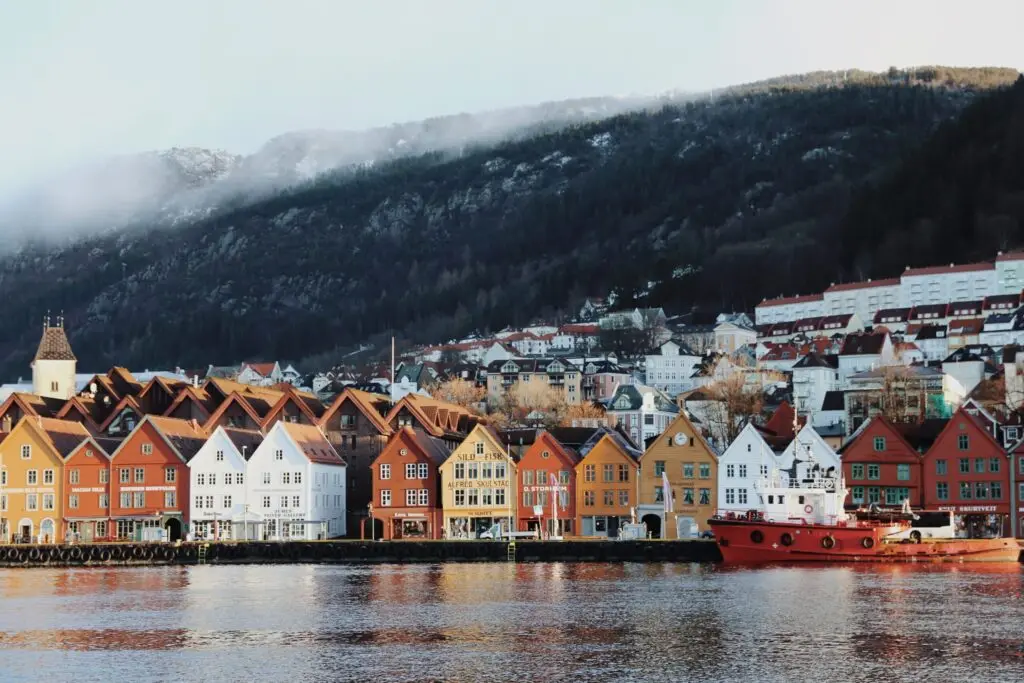
Bergen was Norway's capital and its largest city for centuries, and it still feels like a place that used to run things. It sits in a bowl between seven mountains at the end of a fjord, it rains a great deal, and the old Hanseatic wharf on the harbour is on the UNESCO World Heritage list. It is also the point where most people start a trip into the fjords.
Here is what to see, what is worth the money, and how to plan a day around weather that changes every two hours.
Bryggen
The row of narrow wooden buildings along the eastern side of the harbour is what everyone comes for. It was the trading post of the Hanseatic League, the German merchant network that controlled the North Sea dried-fish trade for four centuries, and it has burned down and been rebuilt repeatedly on the same foundations, most recently after a fire in 1955.
The front row is the photograph. The interesting part is behind it: narrow passages between leaning wooden galleries, worn stairs, overhanging upper floors, and workshops in the back. Walk into the alleys. Most visitors photograph the façade and leave, which is the wrong way round.
Two things worth adding. The Bryggens Museum, built over the excavation that followed the 1955 fire, shows the medieval town beneath the current one. The Hanseatic Museum next door reconstructs how the German merchants and their apprentices actually lived, which was cold, dark and strictly hierarchical. Check opening arrangements before you go, as parts of these buildings have been under restoration in recent years.
The mountains
Fløyen
The funicular from the centre takes about six minutes and puts you on a wooded hilltop directly above the city, with a view over the roofs, the harbour and the islands. There is a café, a playground and a network of walking trails going further up into the forest.
The local move is to take the funicular up and walk down, which takes half an hour on a well-made path and costs nothing. If the queue for the funicular is long, the walk up is steep but perfectly manageable.
Ulriken
The highest of Bergen's seven mountains, reached by cable car from outside the centre. Higher, wilder and considerably less busy than Fløyen. Serious walkers do the ridge walk between Ulriken and Fløyen, which takes several hours and needs proper footwear and a check of the forecast; the top is exposed and the weather turns fast.
The fish market, honestly
The Fisketorget on the harbour has been in the same place for centuries and is now largely a tourist operation with prices to match. It is worth walking through, and the covered market hall next to it is better than the outdoor stalls.
If you want to eat well rather than photogenically, look at what the city eats: fish soup, which is creamy and served everywhere and is genuinely excellent; skillingsbolle, the cinnamon bun that is a Bergen speciality; and whatever whitefish is on the day's menu at a normal restaurant away from the water. Norway is expensive and the harbour is the most expensive part of it.
The other Bergen
Nordnes
The peninsula west of the centre, with steep lanes of small painted wooden houses, an aquarium at the tip and a public sea-water pool that opens in summer. This is where Bergen looks like people live in it.
Bergenhus
The fortress at the harbour mouth, with Håkon's Hall, a thirteenth-century royal banqueting hall, and the Rosenkrantz Tower. Both were badly damaged in a 1944 explosion in the harbour and rebuilt.
Troldhaugen
Edvard Grieg's villa outside the city, with his composing hut on the water and a small concert hall where recitals are held in summer. Grieg is to Bergen roughly what Mozart is to Salzburg, and the house is a short bus or light-rail ride away.
KODE
Four museum buildings around the city lake, holding one of the larger art collections in the Nordic countries, including a significant group of Edvard Munch works. A good rainy-day plan, and it will rain.
The rain
Bergen is one of the wettest cities in Europe and the locals have made peace with it. There are public umbrella dispensers, everyone owns proper waterproofs rather than a fashion raincoat, and nothing is cancelled because of weather.
Plan accordingly: bring a waterproof jacket and shoes you do not mind soaking, keep an indoor option in reserve for each half day, and do the mountain when the sky clears rather than when your itinerary says so. A dry morning in Bergen is a resource to spend immediately.
The fjords
Bergen is the usual base for the fjords. Day trips run to the Hardangerfjord and, further out, to the Sognefjord and the Nærøyfjord, most commonly as a combination of train, bus and boat. Book ahead in summer and treat a fjord day as a full day, not an afternoon.
Seeing the centre on foot
Bergen's centre is small and the good parts, Bryggen, the alleys behind it, Nordnes, the fortress, are within twenty minutes of each other. A city game gives you a route between them with something to solve at each stop, which suits a city where the interesting details are in the back lanes rather than on the main front.
Frequently asked questions
How many days do I need in Bergen?
Two for the city itself: one for Bryggen, the museums and the centre, one for the mountains and Troldhaugen. Add a full day for each fjord trip.
When is the best time to visit?
May to September for the long days and the fjord season. June and July have close to endless evening light. Winter is dark and wet but the city is quieter and cheaper.
Is Bergen very expensive?
Yes. Food and drink especially. The savings are in the walking, the funicular-up-walk-down trick, supermarket lunches and the fact that the best views cost nothing.
Do I need to book the fjord trips in advance?
In summer, yes. The popular combined routes sell out days ahead in July and August.
Is English widely spoken?
Almost universally, and fluently. You will not need Norwegian at any point as a visitor.
Does Bergen work for a group?
Yes. The centre is compact, the funicular takes groups easily, and there is a genuine indoor fallback for bad weather in the museums. For organised group activities, see what we run for companies and groups.
Plan the day
A shape that survives Bergen weather: Bryggen and its alleys in the morning, the museums or KODE if it is raining, up Fløyen the moment the sky clears, and dinner away from the harbour. If you want the morning to have a route, here is how our games work, and you can get in touch about organising one for a group. Travelling on through Europe? Our guide to the many sides of Zurich covers another city built between water and mountains.