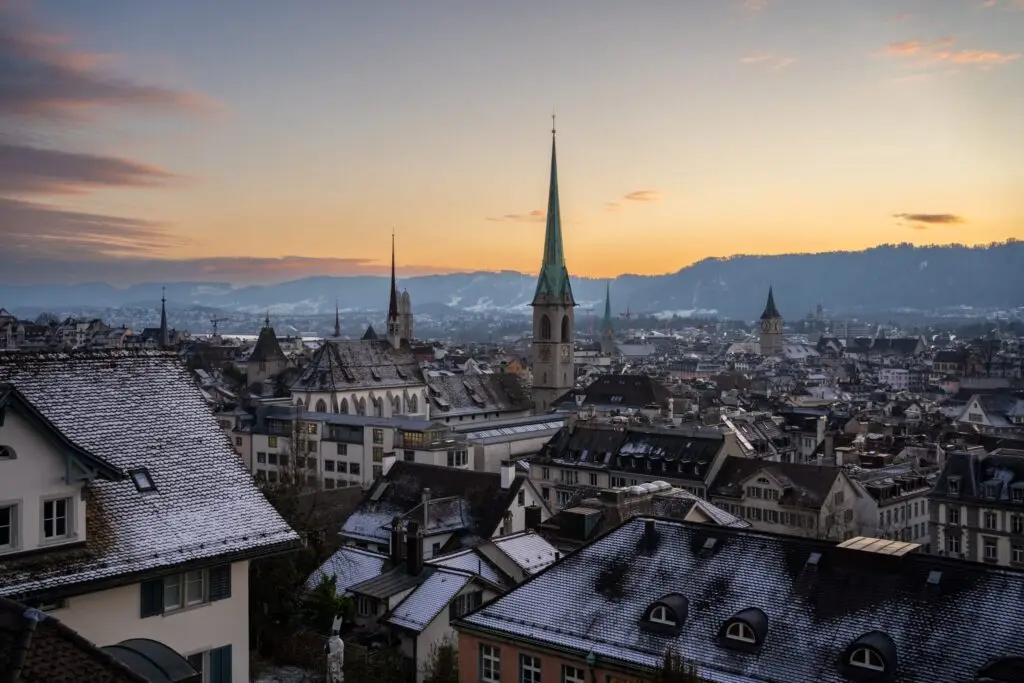
Zurich has a reputation for money and precision, and that reputation is not wrong so much as incomplete. The same city that runs the Swiss financial system also invented Dada in a back-street bar, hosts one of Europe's largest street parties every summer, and empties its offices at five o'clock so that everyone can go and swim in the river.
The trick to enjoying Zurich is understanding that it is several distinct places within walking distance of each other. Here is what each one is for.
The Old Town
The Altstadt straddles the river Limmat and holds almost everything historic in the city.
Grossmünster
The twin-towered church on the eastern bank, and the place where Huldrych Zwingli began the Swiss-German Reformation in 1519. That single fact shaped Zurich more than anything else: the stripped-back interiors, the work ethic, the suspicion of display. You can climb one of the towers for a view down the river to the lake.
Fraumünster
Directly opposite, and the reason many people cross the bridge. Marc Chagall designed five stained-glass windows for the choir, installed in 1970, and they are extraordinary, deep blues and reds that change completely depending on the hour. Photography inside is restricted, which is unusual and, on balance, correct.
St Peter
A short walk away, with the largest church clock face in Europe. It is the kind of superlative that sounds like tourist-board filler until you stand under it, at which point it is genuinely startling.
Lindenhof
The small hill in the middle of the old town, where the Romans built their customs post. Today it is a gravel terrace with lime trees, chess players and the best free view over the roofs. Legend has it the women of Zurich dressed as soldiers here in 1292 to fool a besieging army; the story is old, well told and impossible to verify.
Zurich West
North-west of the centre, the old industrial quarter has been rebuilt into the city's creative district. The railway viaduct now has shops and a market hall built into its arches, the Frau Gerolds Garten is a stack of shipping containers with bars and a garden, and Prime Tower, for a while the tallest building in Switzerland, has a bar at the top.
This is where Zurich stops behaving like a bank and starts behaving like Berlin, and it is where most of the nightlife has moved.
Where Dada started
In 1916, in a bar at Spiegelgasse 1 in the old town, a group of exiles and refuseniks began staging nonsense performances in reaction to the First World War, and called it Dada. Cabaret Voltaire still occupies the building and functions as a small arts venue and café. Lenin lived a few doors up the same street at the time, which Zurich mentions with a certain relish.
The water
Zurich sits at the northern tip of its lake, with the Limmat running out of it through the centre, and the city's relationship with that water is the thing visitors least expect.
In summer the badis, public bathing houses, open along the lake and the river. Some are historic wooden structures on stilts; the Frauenbad is women-only by day and becomes a bar in the evening. The Oberer Letten is a stretch of the river where people jump in upstream and swim down. Entry is cheap or free, the water is clean enough to drink by most standards, and the whole city goes.
If you would rather stay dry, the lake boats run from Bürkliplatz and a short round trip costs very little on a standard transport ticket.
Up the mountain
The Uetliberg rises directly behind the city and a suburban train takes about twenty minutes from the main station. From the top you get the lake, the city and, on a clear day, a long stretch of the Alps. It is a normal after-work walk for people who live here.
Eating and drinking
Zürcher Geschnetzeltes, sliced veal in a cream and white wine sauce, served with rösti, is the local dish and is on almost every traditional menu. Fondue and raclette are winter things and locals genuinely eat them. Prices are high; the way to eat cheaply is lunch menus, the market halls in Zurich West, and the fact that supermarket food in Switzerland is unusually good.
Seeing it on foot
The old town, the lake front and the start of Zurich West are all within half an hour of each other, and the walk between them is the best way to feel how different the city's parts are. A city game gives you a route through the old town with something to solve at each stop, which works well in a place where the interesting things are small and easy to walk past.
Frequently asked questions
Is Zurich the capital of Switzerland?
No. It is the largest city and the financial centre, but the seat of government is Bern. Switzerland has no formally designated capital at all.
How expensive is it really?
Very, for restaurants, drinks and hotels. Less so for transport, museums and everything outdoors. A day built around walking, swimming and a lunch menu costs far less than one built around dinners.
How many days do I need?
Two. One for the old town and the lake, one for Zurich West and the Uetliberg. Add a third if you want the Kunsthaus and the National Museum properly.
When is the best time to go?
June to September, when the badis are open and the city lives outdoors. April has Sechseläuten, the spring festival where a snowman effigy is exploded on a bonfire and the time it takes to burn is said to predict the summer. August has the Street Parade.
Do I need to speak German?
No. English is spoken everywhere in the centre. The local Swiss German dialect is markedly different from standard German, so do not be surprised if your school German does not get you far in a conversation between locals.
Does Zurich work for a group?
Yes, and the transport makes it easy: trams go everywhere, the lake boats take groups, and the old town is compact. For organised group activities, see what we run for companies and groups.
Plan the day
A shape that works: the old town and the Chagall windows in the morning, Lindenhof and lunch, the lake or the river in the afternoon, Zurich West in the evening. If you want the morning to have a route, here is how our games work, and you can get in touch about organising one. Travelling on? Our guide to the landmarks of Bern covers the quieter capital an hour away.