
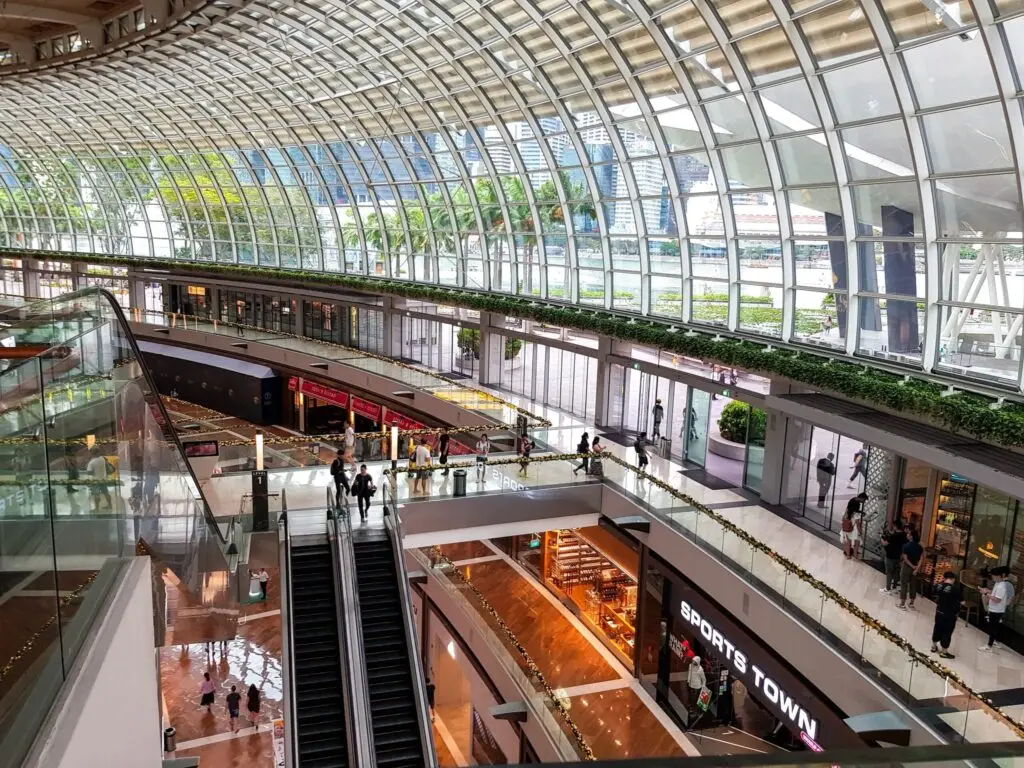
Malls in Dubai are not really about shopping. In a city where the outdoor temperature makes walking impossible for half the year, they are the public space: air-conditioned streets where people meet, eat, take their children and pass an afternoon. Understanding that changes how you use them.
Here are the five worth going to, what each is actually for, and the alternative for anyone who would rather not spend a day indoors.
The Dubai Mall
The big one, at the base of the Burj Khalifa, and among the largest malls in the world by total area. Shopping is the least interesting thing in it.
What is worth your time: the aquarium, whose enormous viewing panel is visible free from inside the mall (the walk-through tunnel is ticketed); the ice rink; and the fact that this is where you enter the Burj Khalifa observation decks, which must be booked ahead.
Outside, on the terrace, the Dubai Fountain runs shows every half hour in the evening against the lake and the tower. It is free, it is genuinely good, and the terrace restaurants charge a premium for the same view you get standing up.
Practical warning: it is enormous and badly signposted for first-timers. Pick your destination before you go in and use the mall's own map, or you will lose an hour.
Mall of the Emirates
Home of Ski Dubai, an indoor ski slope with real snow, a chairlift and a colony of penguins. It sounds absurd, it is absurd, and it is one of the more memorable hours you will spend in the Gulf. You can also just watch the skiers through the glass from the food court, which is free and slightly surreal.
The mall itself is more manageable than the Dubai Mall and better for actual shopping.
Ibn Battuta Mall
The most interesting building of the five. It is organised into six courts themed on the regions the fourteenth-century Moroccan traveller Ibn Battuta wrote about, Andalusia, Tunisia, Egypt, Persia, India and China, each decorated in a heavy pastiche of that region's architecture, with a full-size Chinese junk in one of them.
It is theme-park history and it is not subtle, but it is free to walk through, it is on the metro, and it is far more interesting to look at than another marble atrium.
Dubai Marina Mall
Small by local standards and better for it. It sits on the water at the Marina, and the reason to come is the walk outside it: the Marina Walk promenade, which in the cooler months is one of the few genuinely pleasant outdoor strolls in the city, and the beach at JBR ten minutes away.
Nakheel Mall and the Palm
On Palm Jumeirah, and useful mainly because The View at the Palm observation deck is here, looking down the length of the artificial island. Book ahead; capacity is limited and sunset slots go first.
The better alternative: the old city
If you have one free afternoon in Dubai, spend it in Deira rather than a mall.
The Gold Souk is a covered lane of jewellers with more gold in the windows than most countries keep in reserve, and prices are negotiated by weight plus a making charge. The Spice Souk next to it is smaller, older and better smelling. Neither is a museum piece; both are working markets.
To get between them and the Bur Dubai side, take an abra, the small wooden boats that cross the Creek constantly for a fare of a single dirham. It is the cheapest and best thing in the city.
On the other bank, the Al Fahidi historical district preserves the wind-tower houses that cooled buildings before air conditioning, along with courtyard cafés and small museums. This is what Dubai was seventy years ago, and it takes an hour.
Practical notes for shopping
Visitors can reclaim VAT on purchases above a minimum value, processed at kiosks in the malls and at the airport; keep your receipts and your passport. The Dubai Shopping Festival runs from around late December into January and is when the discounts are real. Malls open late, many until midnight at weekends, and the evening is when the city actually uses them.
During Ramadan, hours shift and eating and drinking in public during daylight is restricted, though mall food courts generally have screened areas. Check the dates if you are travelling then.
Seeing the city on foot
Between November and March, Dubai is walkable in the right places: the Creek, Al Fahidi, the Marina and JBR. A city game gives you a route with something to solve at each stop, which is a good use of the months when you can be outside.
Frequently asked questions
Which mall should I go to if I only visit one?
The Dubai Mall, because of the Burj Khalifa, the fountain and the aquarium, but go for those rather than the shops.
Are things cheaper in Dubai?
Not automatically. Gold and electronics can be competitive, and the VAT refund helps. International fashion brands are usually not cheaper than in Europe.
Do I need to book the Burj Khalifa?
Yes, in advance. Sunset slots sell out first and cost the most.
Is haggling expected in the souks?
Yes, in the souks. Not in the malls, where prices are fixed.
What should I wear in a mall?
Shoulders and knees covered is the posted expectation in most Dubai malls, and it is enforced more in some than others. Beachwear stays at the beach.
Does this work for a group?
Malls handle groups easily, and the metro connects most of the ones above. For organised group activities, see what we run for companies and groups.
Plan the day
A shape that works: Deira souks and an abra crossing in the morning, Al Fahidi before lunch, a mall through the hottest hours, and the Dubai Fountain in the evening. If you want the morning to have a route, here is how our games work, and you can get in touch about organising one. Travelling on around the Gulf? Our guide to the skyscrapers of Doha covers the neighbour that took a different approach.
