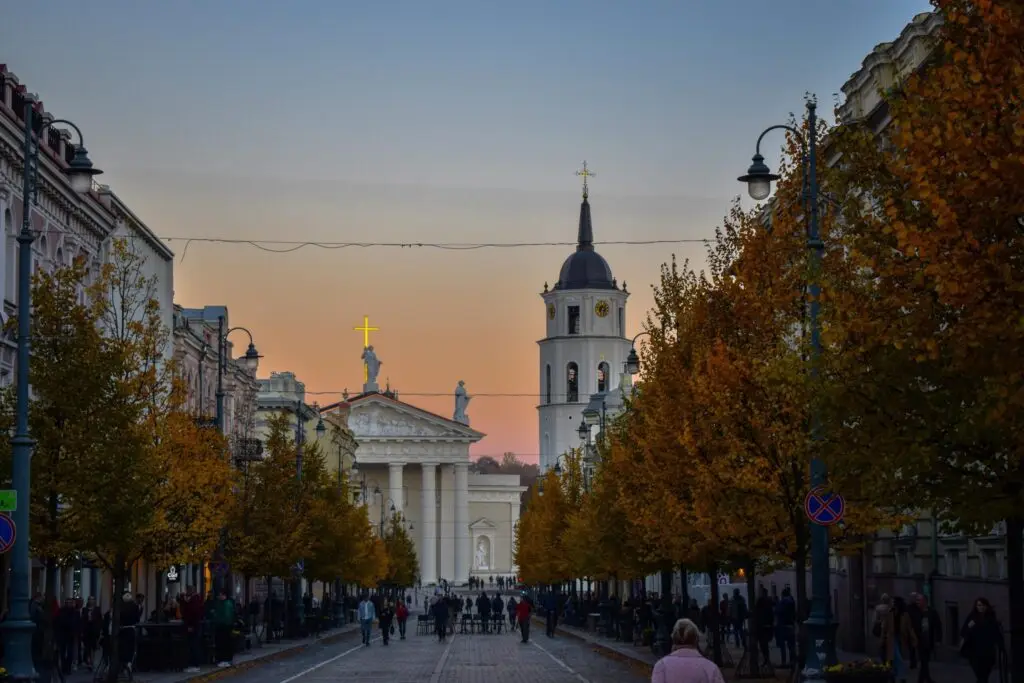
Vilnius has one of the largest surviving medieval old towns in this part of Europe, listed by UNESCO in 1994, and almost none of the crowds you would find around a comparable centre further west. It is a baroque city, a green city, forest reaches almost into the middle, and a city with a difficult twentieth century that it does not hide.
Cathedral Square and the tile
Start at Cathedral Square, with the white neoclassical cathedral and its free-standing belfry. Somewhere in the paving there is a single tile marked stebuklas, meaning miracle. It marks the southern end of the Baltic Way: on 23 August 1989, roughly two million people joined hands in an unbroken chain of about 675 kilometres from Vilnius through Riga to Tallinn, in protest at the Soviet occupation of the three Baltic states. Lithuania declared independence seven months later.
People stand on the tile and turn around three times for luck. It is worth knowing what it actually commemorates.
Gediminas Hill
The brick tower above the square is what remains of the upper castle, and the climb takes about ten minutes on a steep path, or a minute in the funicular. The view takes in the Old Town roofs on one side and the glass towers of the modern business district across the river on the other, which is the clearest picture of the city you will get.
The hill has had drainage and landslide problems in recent years, so check whether the path and funicular are open before you set off.
The Old Town churches
Vilnius has an enormous number of churches, and three are worth the time. St Anne's is a small late-Gothic church made of thirty-three different shapes of brick; the story that Napoleon wanted to carry it back to Paris in the palm of his hand is a nineteenth-century legend rather than anything documented, and it is repeated everywhere.
St Peter and St Paul, just outside the centre, has an interior covered in around two thousand white stucco figures, which is overwhelming in the best way. And the Gates of Dawn, the only surviving city gate, holds a gold-covered Madonna icon that draws pilgrims from across Poland and Lithuania. Cover your head or not as you wish, but be quiet: people are praying.
Užupis
Across a small river from the Old Town, Užupis declared itself an independent republic on 1 April 1997. It has a constitution, mounted on mirrored plaques in dozens of languages on Paupio Street, which includes the rights to be unique, to be idle, and to be misunderstood, along with the observation that a dog has the right to be a dog.
It began as a run-down district occupied by artists and is now partly gentrified, which the residents will tell you themselves. It is still the most enjoyable half-hour walk in the city.
Jewish Vilnius
Before the Second World War, Vilnius was one of the most important centres of Jewish life and learning in Europe, known as the Jerusalem of the North. Roughly a third of the city's population was Jewish. During the German occupation, the great majority of Lithuania's Jews were murdered, many of them at Paneriai, a forest site outside the city that is now a memorial reachable by train in twenty minutes.
In the Old Town, the streets of the former ghetto are marked, and the Vilna Gaon Museum of Jewish History tells the story across several sites. The Great Synagogue was damaged in the war and demolished under Soviet rule; excavations of its remains continue. If you visit one thing beyond the sights, make it this.
Modern Vilnius
The MO Museum, in a Daniel Libeskind building opened in 2018, shows Lithuanian art from the 1960s onwards and is the best single explanation of the country's recent culture. Lukiškės Prison 2.0, a former prison that closed in 2019, now runs as a cultural venue with studios, bars and events, and has been used as a film location. Halės Market is the place for lunch.
Day trips
Trakai, a red-brick island castle on a lake half an hour away by train, is the standard day trip and deserves to be. The Karaim community there sell kibinai, a filled pastry worth the journey on its own. The Baltic coast at Palanga and the Curonian Spit are four to five hours away and belong to a different trip, not a day out.
Turn the Old Town into a game
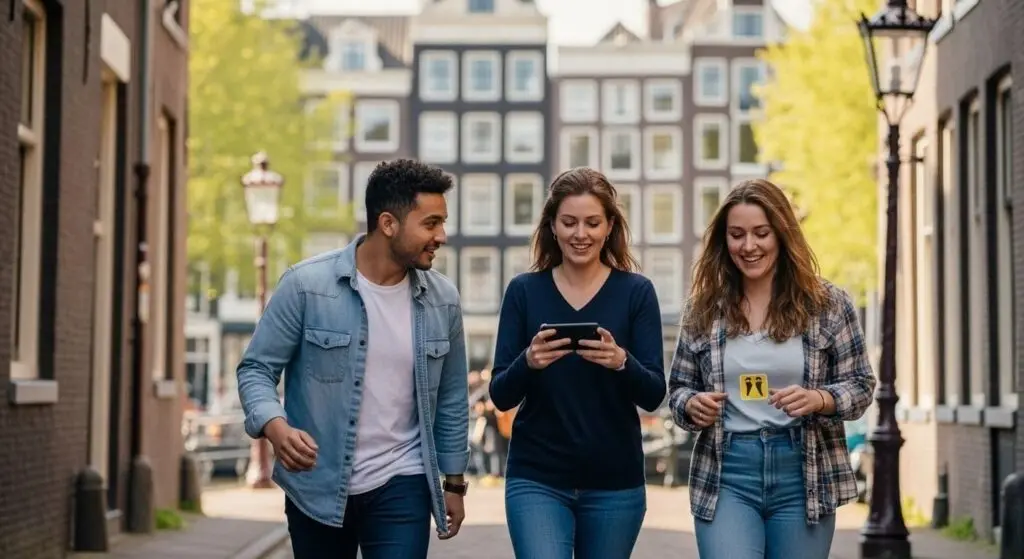
A tangled medieval street plan is ideal for a city game: you explore in small teams with your phone, solve puzzles tied to real courtyards, gates and churches, and end up in the parts of Vilnius that a walking tour never reaches. No guide and no fixed start time, so you set your own pace and stop wherever you like.
It works for friends, families and company outings and larger groups. The how it works page explains it step by step.
Frequently asked questions
How many days do you need in Vilnius?
Two days for the Old Town, Užupis and one museum. Three if you add Trakai or Paneriai.
Is Vilnius cheap?
Noticeably cheaper than western Europe for food and drink, less so for hotels in summer. Lithuania uses the euro.
What is the Baltic Way?
A human chain of about 675 kilometres formed on 23 August 1989 by roughly two million people across Estonia, Latvia and Lithuania, protesting Soviet occupation.
Is Užupis a real country?
No. It is a district of Vilnius that declared symbolic independence in 1997, with its own constitution, flag and annual independence day on 1 April.
When is the best time to visit?
May to September for warm weather and long evenings. Winter is cold and dark but the Old Town handles snow beautifully.
Is Vilnius walkable?
Yes. The Old Town, Užupis and Gediminas Hill are all within twenty minutes of each other on foot.
Go and get lost in it
Vilnius is the least crowded and most surprising of the three Baltic capitals. See all the cities where we run games, read about the north in the best places in Tallinn, or get in touch if you are planning something for a group.