Ostend is the largest town on the Belgian coast and the one with the most going on when the weather turns. It was the fashionable royal seaside resort of the nineteenth century, it was bombed flat in the twentieth, and it produced one of the strangest painters in European art. All of that is still visible if you know where to look.
The beach and the galleries
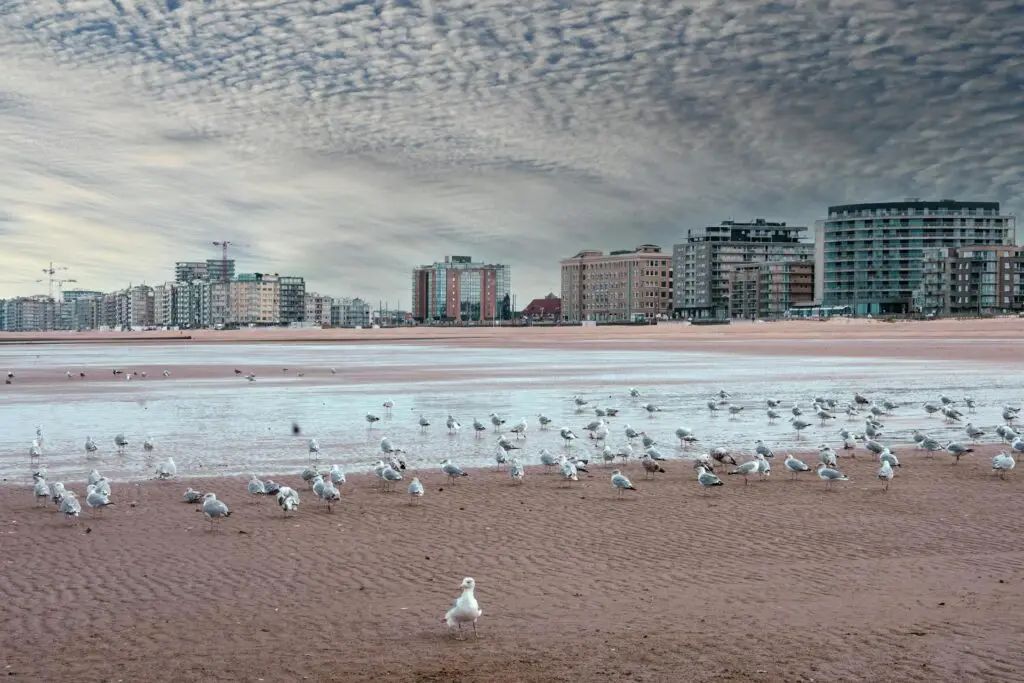
The beach is wide, sandy and long, with the promenade above it. Along the western end runs a colonnade built for Leopold II so that the court could walk by the sea without getting wet, a long, elegant covered gallery that is now simply part of the seafront. Walk it when it rains; that is what it is for.
Be honest with yourself about the North Sea: it is cold, it is windy more often than not, and the swimming season is short. The coast is at its best on a bright day in spring or autumn when the light is enormous and the beach is empty.
James Ensor
Ensor was born here in 1860 and spent almost his whole life in Ostend, painting masks, skeletons, carnival crowds and the sea. He is one of the most original artists Belgium produced and he was working in a souvenir shop above which he lived. That house is now a museum, and the city's art museum holds his work alongside that of Léon Spilliaert, another Ostend painter, whose bleak seafront drawings are the best thing anyone has made about this coast.
The Mercator
A three-masted sailing ship is moored in the marina in the middle of town. She was a training vessel for the Belgian merchant navy, sailed all over the world, and is now open to visit. Children like it and adults quietly do too.
The coast tram
One tram line runs the entire length of the Belgian coast, from the French border to the Dutch one, about sixty-seven kilometres of it, and it is often described as the longest tram line in the world. It stops constantly, it costs very little, and it is the best thing to do on a grey day: get on, ride for half an hour, get off somewhere you have never heard of, and come back.
The bunkers
West of the town, at Raversyde, a stretch of dune holds one of the best preserved sections of the German coastal defences from both world wars, gun positions, bunkers and connecting tunnels, left in place and open to walk through. It is a serious and rather sobering site, and it is a good deal more interesting than most museums about the same period.
Fort Napoleon, east of the harbour, is a pentagonal fort from 1811, sitting in the dunes and still intact.
The fish
By the harbour there is a row of stalls selling fish and shellfish straight off the boats, including the small grey shrimp the coast is known for. Eat them there, peeled, from a paper cone. The other thing to order in any local restaurant is tomato stuffed with those shrimp, it sounds unremarkable and it is a genuinely good dish.
Marvin Gaye
In 1981 Marvin Gaye moved to Ostend to get away from his life in America, stayed for around two years, walked on this beach every day and wrote Sexual Healing here. The city has marked a walking route through the places connected with his stay. It is an unlikely piece of Ostend history and locals are quietly delighted by it.
Why the centre looks like this
Ostend was heavily damaged in the Second World War and rebuilt quickly, and a lot of the seafront was replaced with apartment blocks in the decades after. That is why a town with a royal past has a modern skyline. The nineteenth-century city survives in fragments, the galleries, a few streets, the park, rather than as a whole.
Seeing the town on foot
Ostend rewards knowing what used to be where. A city game gives you a route of puzzles from the harbour through the old streets to the seafront and explains each stop as you reach it, which is a much better use of an afternoon than another walk along the promenade.
Not sure how it works? Read how to play first.
Frequently asked questions
Is Ostend worth visiting?
Yes, particularly out of season. It has the best museums on the coast, a proper harbour and the tram, and it is fifteen minutes from Bruges.
How long do I need in Ostend?
A day for the beach, the galleries and one museum. Two if you want Raversyde and a ride along the coast.
What is the coast tram?
A single tram line running the full length of the Belgian coast, about sixty-seven kilometres, stopping at every resort along the way.
Who was James Ensor?
A painter born in Ostend in 1860, known for masks, skeletons and carnival scenes. His house in the town is open as a museum.
Can you swim at Ostend?
In summer, yes, with lifeguards on the supervised sections. The North Sea is cold and the season is short, so plan around the weather rather than the calendar.
Does Ostend work for a group outing?
It does, beach, tram, museums and a lot of places to eat, and easy to reach by train. See the options for companies and groups.
Take the tram, then come back for the shrimp
Museum in the morning, tram in the middle of the day, beach and fish stall at the end. Want help planning something for a group? Get in touch. Coming from inland? Our guide to the quiet corners of Bruges is fifteen minutes away by train.