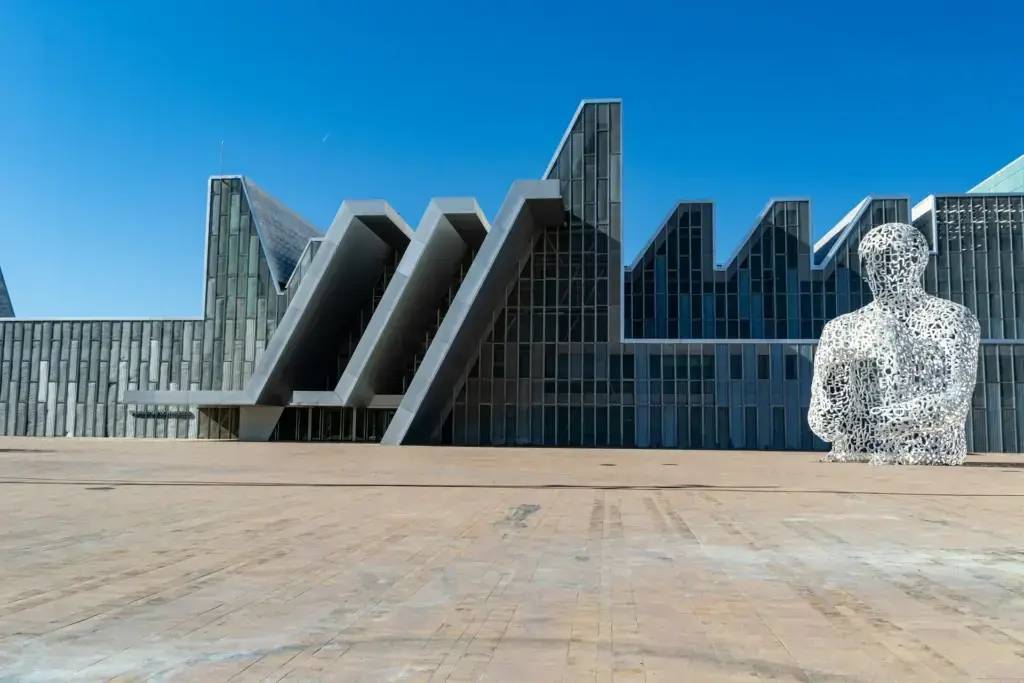
In the summer of 2008 Zaragoza hosted a world exposition on the theme of water and sustainable development. The city cleared a meander of the Ebro on the edge of the centre, built a district of pavilions and bridges, and then had to work out what to do with it afterwards. That second part is the interesting one, and it is why the Expo site is worth visiting today rather than a footnote.
This guide covers what the Expo was, what still stands, what has not worked, and how to combine a morning on the site with the older city on the other bank.
What Expo 2008 was
An international exposition running from June to September 2008, themed around water and sustainable development, timed to coincide with the bicentenary of the sieges of Zaragoza in the Peninsular War. Its mascot was a water drop called Fluvi, which most people in the city can still name.
The real purpose, as with most expos, was urban. Zaragoza used it to reclaim its riverfront. The Ebro is a large river running straight through the city, and for most of the twentieth century the city had turned its back on it. The Expo was the excuse to build bridges, parks and promenades along both banks, and those are the parts that outlived the event.
What is still there
The Bridge Pavilion
Zaha Hadid's covered bridge over the Ebro, shaped like a gladiolus and clad in grey shingles, is the single most photographed thing on the site. It works as a pedestrian crossing and as an exhibition space, though it has spent long stretches closed since the Expo. Check before you plan to walk through it; from the outside and from the riverbank it is impressive either way.
The Water Tower
A 76-metre glass tower shaped like a drop of water, and the tallest thing on the site. It has been closed to visitors for most of the years since the Expo and its future is periodically debated in the local press. You can see it from everywhere; you generally cannot go up it.
The Third Millennium Bridge
A white concrete tied-arch bridge just west of the site, built for the Expo and one of the largest of its type. It carries traffic and pedestrians and is best seen at night, when it is lit.
The Water Park
The Parque del Agua Luis Buñuel occupies most of the meander and is the clearest success of the whole project: a very large riverside park with lawns, canals, a botanical section, a beach area and a whitewater channel used by kayakers. On a hot Zaragoza afternoon it is where the city goes.
The Aquarium
Built for the Expo and still open, organised around the world's great river systems rather than oceans, which suits the theme. Good with children and a reasonable hour indoors when it is 38 degrees outside.
What did not work
Most of the international pavilions were converted into offices for regional government departments, and the site spent years feeling empty outside the park. It is more used now than it was a decade ago, but do not expect a lively district: the buildings are impressive and the streets between them are quiet. That is a normal outcome for expo sites and Zaragoza is fairly open about it.
The older city, across the river
The Expo site takes a morning. The rest of Zaragoza has two thousand years in it.
Basílica del Pilar
The enormous baroque church on the riverbank, with eleven domes and four towers, and the reason for the city's biggest festival. Goya, who grew up in the province, painted one of the domes. You can go up a tower for a view over the river and the roofs.
La Seo
The cathedral two hundred metres away, less famous than the Pilar and considerably more interesting architecturally: Romanesque, Gothic, Mudéjar and baroque layered on the site of the Roman forum and later the main mosque. Its Mudéjar exterior wall is part of a UNESCO World Heritage listing.
The Aljafería
An eleventh-century Islamic palace, later a royal residence of the Crown of Aragon and later still a barracks, now the regional parliament. The Islamic core, with its interlacing arches and courtyard, is the finest surviving palace architecture of its period outside Andalusia, and it is also UNESCO-listed.
Roman Caesaraugusta
Four small museums cover the Roman city: the theatre, the forum, the river port and the baths. The theatre, half excavated in the middle of a block of flats, is the best of them.
Walking Zaragoza
The city is flat and the walk from the Aljafería through the old centre to the Pilar and on across the river to the Expo site is straightforward and covers everything above. A city game turns that walk into a route with something to solve at each stop, which is a good way to see a city whose highlights sit in a line along the river.
Frequently asked questions
Can you still visit the Expo site?
Yes. The site is public and free to walk around, the Water Park and the aquarium are open, and the bridges are in use. Individual buildings vary; several are government offices and closed to the public.
Is the Bridge Pavilion open?
It varies. It has reopened for exhibitions at times and been shut for long periods at others. Check locally on the day rather than relying on older information.
How long do I need in Zaragoza?
Two days: one for the old city and the Roman sites, one for the Aljafería and the Expo riverfront. One long day is possible if you are efficient.
When should I go?
Spring and autumn. Zaragoza summers are very hot and dry, and the winter cierzo, the wind that comes down the Ebro valley, is genuinely cold. If you want the city at its loudest, the Fiestas del Pilar are in October.
Is it worth a stop between Madrid and Barcelona?
Yes, and that is how most people arrive. The high-speed line puts it under ninety minutes from both, so it works well as a stopover of a day or two.
Does this work for a group?
It does: the centre is compact and flat, the riverside park handles large numbers easily and the city is cheaper than either of its big neighbours. For organised group activities, see what we run for companies and groups.
Plan your day
A good shape: the old city and La Seo in the morning, lunch near the Pilar, then across the river to the park and the Expo architecture in the late afternoon when the heat drops. If you want the morning to have a route, here is how our games work, and you can get in touch about running one for a group. Travelling on across Spain? Our guide to pinchos in Valladolid covers another inland city that eats better than its reputation.