Venice has around four hundred bridges, and almost all of them are small, stepped and unremarkable until you know what happened on them. Only four cross the Grand Canal, which is why the crossings that do exist matter so much, and why locals still use gondola ferries to get across in between.
These five are the ones worth going out of your way for.
1. The Rialto Bridge
The stone bridge you see now was completed in 1591 to a design by Antonio da Ponte, replacing a series of wooden bridges that had a habit of collapsing or burning. Da Ponte won the commission against proposals from far more famous architects, and plenty of people at the time predicted his single-span stone arch would fall down. It has not.
It carries two rows of shops and three walkways, and it is one of the busiest places in Italy. Go at seven in the morning and it is nearly empty; the light along the canal is better then anyway. For a photograph of the bridge rather than from it, stand on the Riva del Vin or take the vaporetto.
2. The Bridge of Sighs
Built around 1600 to connect the Doge's Palace with the new prisons across the canal, the Ponte dei Sospiri is enclosed in white limestone with two small barred windows. The name comes from a nineteenth-century idea, popularised by Lord Byron, that prisoners sighed at their last view of Venice through those windows.
It is a good story and it is not really true. By the time the bridge was in use, the cells it served held minor offenders, and the serious executions had long since ended. The modern legend that a kiss beneath it at sunset guarantees eternal love was invented much more recently, mostly by people selling gondola rides.
The view from outside is from the Ponte della Paglia. To walk through it, you need a ticket to the Doge's Palace.
3. The Bridge of Fists
In Dorsoduro, the Ponte dei Pugni has four white marble footprints set into the paving at its corners. They mark the starting positions for organised fistfights between two rival factions of the city, the Nicolotti and the Castellani, who met on the bridge and tried to throw each other into the canal.
The bridge had no parapets then, which was the point. The authorities eventually banned the fights, and the footprints are the only thing left of a tradition that lasted for centuries.
4. The Accademia Bridge
The wooden bridge across the Grand Canal near the Gallerie dell'Accademia was put up in 1933 as a temporary measure while a permanent stone replacement was designed. The stone one was never built. What stands now is a faithful rebuild from the 1980s, and Venice has quietly accepted that temporary means something different here.
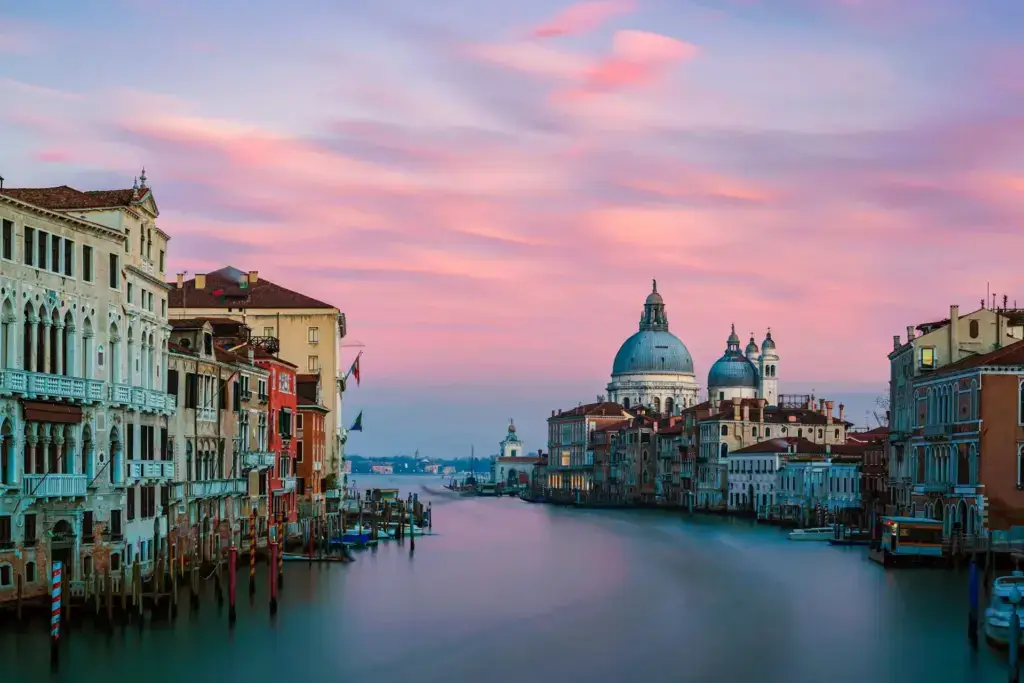
It offers the best view down the canal towards Santa Maria della Salute, and it is the photograph most people actually want.
5. The Constitution Bridge
The fourth and newest crossing of the Grand Canal, designed by Santiago Calatrava and opened in 2008, links the train station area to Piazzale Roma. It arrived years late, well over budget, and without step-free access, and Venetians have been arguing about it ever since.
Its glass steps also turned out to be slippery in the rain, and they have been progressively replaced with stone. Go and look at it anyway: it is a genuinely elegant shape, and the argument around it says more about modern Venice than any guidebook.
Two more, if you like quiet ones
Ponte Chiodo in Cannaregio is one of the very few bridges in Venice left without parapets, as all of them once were. And on the island of Torcello, the Ponte del Diavolo crosses a canal in the middle of nowhere with no railings at all, worth the boat trip for the emptiness as much as the bridge.
Crossing where there is no bridge
Between the four bridges, several traghetto points still ferry people across the Grand Canal in stripped-down gondolas. It costs a small amount, takes two minutes, and locals stand up for the crossing. It is the cheapest gondola ride in Venice and nobody will sing.
Find them all as a game
Venice is a city where getting lost is the correct method. A city game gives that method a shape: you explore in small teams with your phone, solve puzzles tied to real bridges, squares and churches, and end up in corners of Cannaregio and Dorsoduro that the crowds never reach. No guide, no fixed start time, and you stop for a coffee whenever you like.
It works for friends, families and company outings and larger groups. The how it works page explains it step by step.
Frequently asked questions
How many bridges does Venice have?
Around four hundred across the historic centre, though the exact count depends on what you include. Only four cross the Grand Canal.
Can you walk across the Bridge of Sighs?
Only inside the Doge's Palace tour. From the street you can look at it from the Ponte della Paglia.
Is the Rialto Bridge free?
Yes, it is a public street. The shops on it are mostly jewellery and souvenirs, and priced for visitors.
When is the best time to see the bridges?
Early morning, before the day-trip boats arrive. By ten the main crossings are shoulder to shoulder.
Is the kissing legend real?
No. It is a modern invention with no historical basis, though it has been very good for gondola business.
Are the bridges accessible?
Mostly not, almost all have steps. A few key routes have ramps, and the city publishes an accessible-route map worth consulting in advance.
Go and cross a few
Venice makes sense when you stop trying to get anywhere efficiently. See all the cities where we run games, read about our routes further south in Quests in Rome, or get in touch if you are planning something for a group.