Paris has almost no front gardens and very small flats, which is why its public gardens are used as living rooms. People read in them, eat lunch in them, sleep in them and argue in them. Knowing which garden does what saves you from sitting in a formal parterre when you wanted grass.
1. Jardin du Luxembourg
The Luxembourg is the one Parisians name first. It belongs to the Senate, which occupies the palace at its northern end, and it is laid out around a central basin where children push wooden sailboats with sticks, the boats have been rented from the same little kiosk for generations.
The green metal chairs are free and movable, and moving one to wherever the sun is counts as a national sport. Look for the Medici Fountain in the shaded eastern corner, which is the best place in the garden and the least crowded. Most of the lawns are closed to sitting; a few are marked as open, and those fill first on a warm day.
2. Jardin des Tuileries
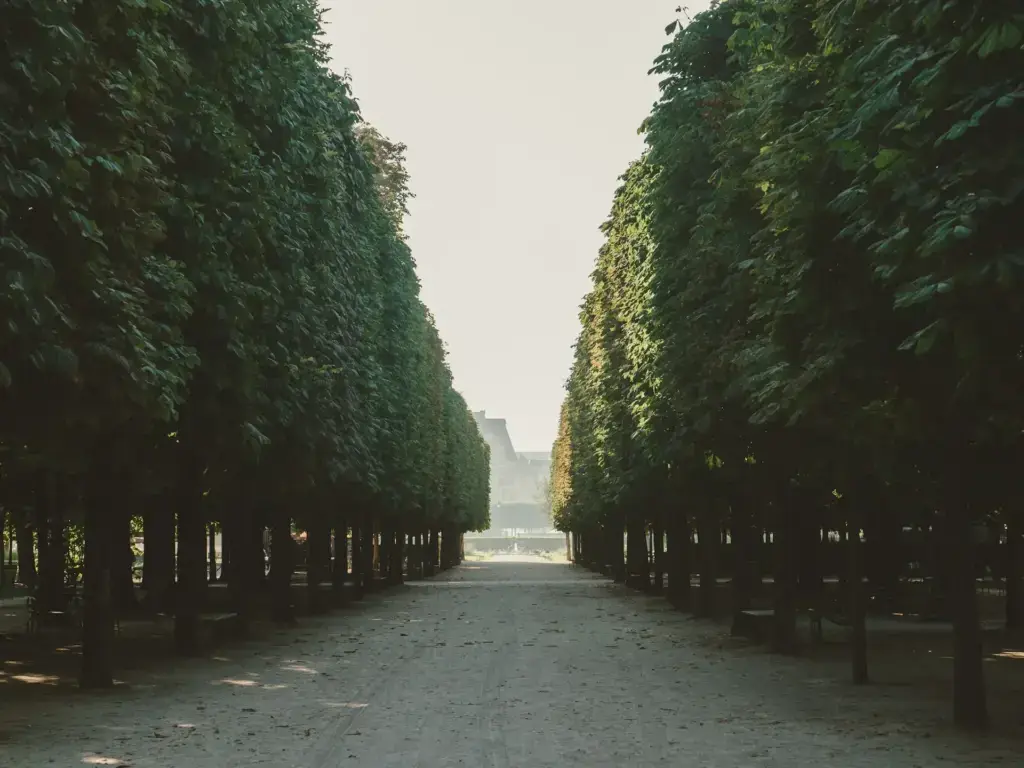
Between the Louvre and the Place de la Concorde, the Tuileries was redesigned by André Le Nôtre in the seventeenth century and is the model that every formal French garden copied afterwards: straight lines, gravel, clipped trees, statues at the intersections.
It is not a garden for lying on grass. It is a garden for walking through slowly, sitting by one of the round ponds, and looking down the axis that runs from the Louvre through the obelisk to the Arc de Triomphe. In summer a funfair sets up along the rue de Rivoli side, which is either charming or infuriating depending on your mood.
3. Parc des Buttes-Chaumont
In the 19th arrondissement, this is the least Parisian-looking park in Paris: steep, wooded, with a lake, a cliff and a small classical temple on top of a rock reached by a suspension bridge. It was built in the 1860s on the site of a gypsum quarry and rubbish dump, and the dramatic terrain is entirely artificial.
Crucially, you are allowed on the grass. This is where Parisians actually picnic, and on a Sunday afternoon the slopes are full of people with cheese and a bottle of something.
4. Jardin des Plantes
Founded in 1626 as a royal garden of medicinal plants, this is Paris's botanical garden and the home of the natural history museum. There is a formal alley of flowerbeds, an alpine garden, greenhouses, and a small menagerie founded in 1794 that is one of the oldest zoos in the world.
The garden itself is free; the greenhouses, galleries and menagerie are ticketed. The Grande Galerie de l'Évolution at the far end, with its procession of animals crossing the hall, is worth the entry on its own and is one of the best museums in Paris for children.
5. Jardin du Palais-Royal
A rectangle of lime trees and arcades hidden behind the Comédie-Française, and one of the quietest places in central Paris despite being minutes from the Louvre. The arcades hold old-fashioned shops selling medals, pipes and lead soldiers.
In the front courtyard, Daniel Buren's black-and-white striped columns of different heights have been dividing opinion since 1986. Children climb them. Photographers queue for them. Nobody is neutral.
Two more if you want to avoid everyone
The Coulée verte René-Dumont runs for several kilometres along a disused railway viaduct from Bastille eastwards, a linear garden above the street that inspired New York's High Line, and still much quieter. And Parc de Belleville, on a hillside in the 20th, has one of the best free views over the city with almost none of the crowd at Montmartre.
Rules nobody tells you
Gardens close at dusk, and the times change with the season, a guard walks through blowing a whistle. Lawns are often protected, with signs marking which ones you can sit on. The free chairs in the Luxembourg and Tuileries are for anyone, and taking one is expected. Alcohol at a picnic is broadly tolerated in the informal parks and not in the formal ones.
See the city between the benches
Gardens are best strung together with a walk, and a city game gives that walk a purpose. You explore in small teams with your phone, solve puzzles tied to real streets and monuments, and end up in corners of Paris you would not have chosen. No guide and no fixed start time, so you can break for an hour in the grass whenever you like.
It works for friends, families and company outings and larger groups. The how it works page explains the format step by step.
Frequently asked questions
Which Paris garden is best for a picnic?
Buttes-Chaumont, because you can lie on the grass. The Luxembourg and the Tuileries are for chairs and benches, not blankets.
Are the gardens free?
All five are free to enter. Greenhouses, the menagerie and museum galleries in the Jardin des Plantes are ticketed separately.
When do the gardens close?
At dusk, so early in winter and late in summer. Times are posted at the gates and change through the year.
Can you sit on the grass?
Only where signs allow it. Formal gardens protect most lawns; the hillier neighbourhood parks are much more relaxed.
What is there for children?
Sailboats and a puppet theatre in the Luxembourg, the menagerie and the evolution gallery in the Jardin des Plantes, and space to run at Buttes-Chaumont.
When is the best season?
Late April to June, and September. July and August are hot and busy, and much of Paris leaves the city anyway.
Go and take a chair
An afternoon in a Paris garden is not wasted time; it is the point of the city. See all the cities where we run games, read more about the capital in Quests in Paris, or get in touch if you are planning something for a group.