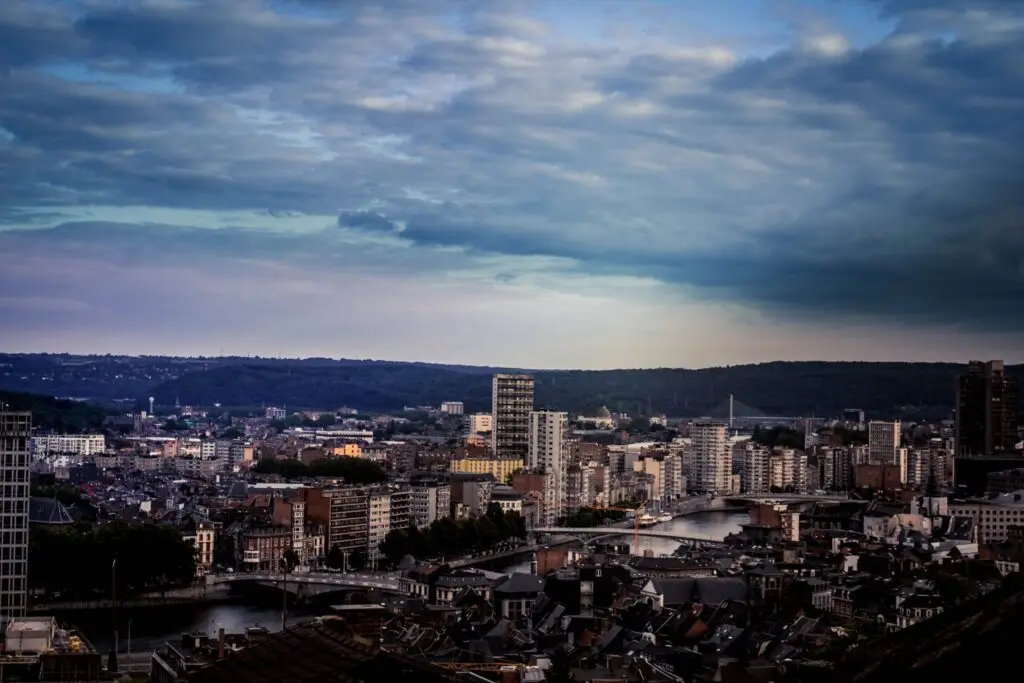
Liège is the largest city in French-speaking Belgium and it does not behave like a provincial capital, because for eight hundred years it was not one. It was an independent principality ruled by prince-bishops, answering to nobody in Brussels, and the confidence that came from that has never entirely worn off. Locals call it la Cité ardente, the fervent city, and mean it.
The station
Start here even if you arrive by car. Liège-Guillemins, finished in 2009 to a design by Santiago Calatrava, is a vault of white steel and glass with no facade at all, the building simply opens at both ends. It is one of the finest pieces of contemporary architecture in Belgium and it is a railway station, so you can walk into it for nothing.
The Montagne de Bueren
A single straight staircase of 374 steps climbs the hillside from the old town to the citadel. It was built so soldiers could reach the fortress without going through the streets. There is no easy way to do it and no shortcut; you simply go up. The view from the top is the reward, and there are terraces at the bottom for afterwards.
Once a year the whole staircase is lit with candles at night, which is worth planning a visit around if the dates work.
The prince-bishops' palace
The palace on the Place Saint-Lambert is where the prince-bishops governed, and its courtyard is the thing to see: around sixty carved columns, no two of them the same, covered in faces, monsters and foliage. It is now a courthouse, so the courtyard is open but the rest is working government. Walk in and look up.
The square outside was where the cathedral stood until the French Revolution, when it was demolished. The outline is marked in the paving.
The baptismal font at Saint-Barthélemy
In a church a short walk from the centre stands a twelfth-century brass baptismal font, cast in one piece and resting on ten oxen, with figures around the bowl modelled with a naturalism that was centuries ahead of its time. It is one of the great objects of medieval European metalwork and it is in a parish church in Liège rather than in a national museum. Go and see it.
La Batte
On Sunday mornings a market runs for well over a kilometre along the Meuse, food, plants, clothes, birds, junk and crowds. It is among the oldest and largest street markets in the country, it is genuinely local rather than a tourist market, and it is the best morning to be in Liège. It packs up around lunchtime.
The waffle, and the rest of the food
A Liège waffle is not a Brussels waffle. It is made from a yeast dough studded with pearl sugar that caramelises on the iron, so it is dense, chewy and sweet on its own, no cream, no strawberries, nothing on top. Eat it warm from a stall.
The other local dishes are boulets à la liégeoise, meatballs in a dark sauce made with the region's thick fruit syrup, served with fries; and peket, the local juniper spirit, drunk cold in small glasses.
The impasses
Scattered through the old town are dozens of impasses, narrow alleys leading to tiny hidden courtyards with a few houses around them. They are easy to walk past and mostly unmarked. Finding one you were not looking for is the best thing about walking around this city.
Seeing the city on foot
Liège is spread out, hilly in places and not obvious. A city game gives you a route of puzzles that links the palace, the old streets, the impasses and the riverside, and explains each stop as you reach it, a better structure than wandering and a lot better than the standard sights list.
Not sure how it works? Read how to play first.
Frequently asked questions
Is Liège worth visiting?
Yes, particularly if you want a Belgian city with almost no tourism. It has real architecture, a great market and a strong local identity.
How long do I need in Liège?
A day for the centre, the palace and the staircase. Try to include a Sunday morning for the market.
How many steps is the Montagne de Bueren?
374. There is no lift and no gentle alternative, though you can reach the top by road if you would rather.
What is a Liège waffle?
A dense yeast-dough waffle with pearl sugar that caramelises during cooking. It is eaten plain and warm, and it is quite different from the lighter Brussels waffle.
When is the La Batte market?
Sunday mornings, along the Meuse, finishing around lunchtime.
Does Liège work for a group outing?
It does, plenty of space, low prices by Belgian standards, and good rail connections. See the options for companies and groups.
Climb it, then eat
Do the staircase early, the palace courtyard afterwards, and the waffle whenever you like. Want help planning something for a group? Get in touch. Seeing more of Wallonia? Our guide to the best places in Namur is an hour down the Meuse.