
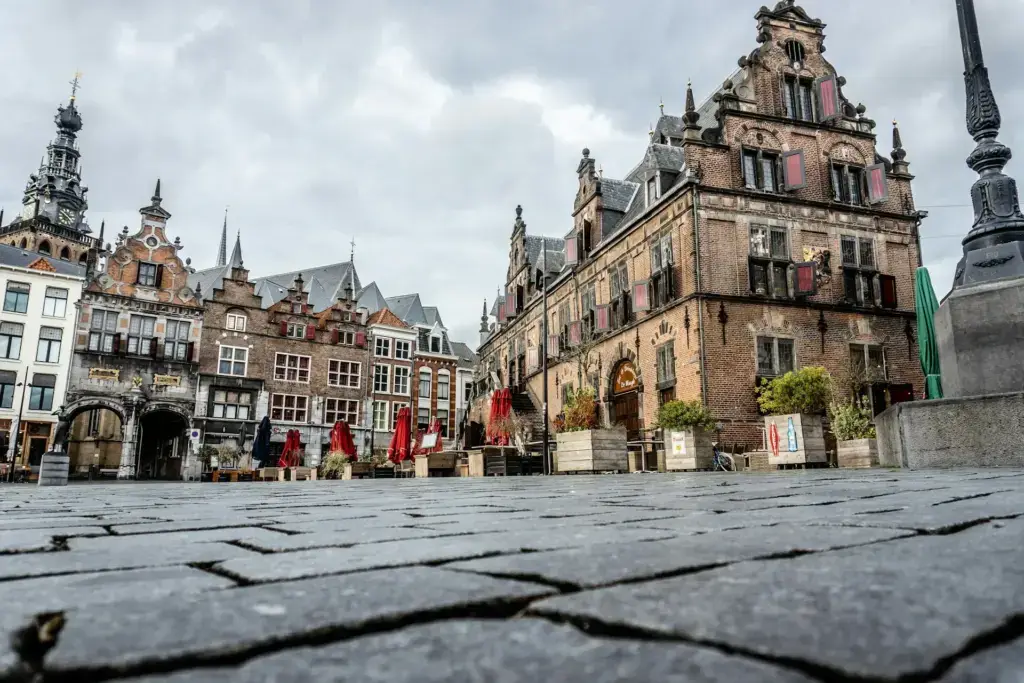
Nijmegen is usually counted as the oldest city in the Netherlands, Maastricht disputes it, and both have a case, and it sits on a ridge above the river Waal, which makes it one of the very few Dutch cities with real hills. Between the Romans, a wartime bombing, a river engineering project and the largest walking event on earth, it has more going on than its size suggests.
The Valkhof
The park on the height above the river is where the city started. The Romans had a settlement here, Charlemagne had a palace, and Barbarossa rebuilt it. What survives is fragmentary but real: a sixteen-sided chapel from around 1030 and a fragment of the imperial palace, standing in an ordinary park with an extraordinary view over the Waal. Go at the end of the day for the light on the river.
Museum Het Valkhof
The museum next to the park holds the Roman finds from the region, and the object to see is a cavalry face mask, a helmet made in the shape of a human face, dug up nearby. Standing in front of it is a strange experience. The rest of the collection covers the region from prehistory to modern art.
The river and the island
Nijmegen has done something unusual with its river. To give the Waal room in flood, the dike on the north bank was moved back and a side channel was dug, which turned a strip of land into an island in the middle of the city. You can walk out to it across a low bridge that floods deliberately when the water is high, and stand between two channels of the same river. It is the best free hour in Nijmegen and most visitors have no idea it is there.
The Waalkade below the old centre is where the city meets the water, and the 1936 road bridge above it is the one the city fought over in 1944.
1944
Two things happened here. In February 1944 an Allied bombing raid hit the city by mistake and destroyed a large part of the centre, which is why the streets around the Grote Markt are a mix of old fragments and post-war rebuilding. Then in September, during Operation Market Garden, American paratroopers crossed the Waal in canvas boats in daylight to take the bridge from the far side. Both are marked in the city, and both are worth knowing before you walk around wondering why the architecture jumps.
The Grote Markt and the Stevenskerk
The market square keeps the Waag from 1612 and a covered passage through to the church. The Stevenskerk behind it is the city's big medieval church, badly damaged in the war and rebuilt; its tower can be climbed for a view over the river and, on a clear day, well into Germany.
Kronenburgerpark and Velorama
The Kronenburgerpark holds a surviving stretch of the medieval wall and a squat round powder tower, dropped into a public park on a slope. And on the Waalkade, Velorama is the national bicycle museum, a proper collection of the machine this country runs on, from boneshakers onwards, and more interesting than it sounds.
The Vierdaagse
Every July, tens of thousands of people walk long distances into and out of Nijmegen over four consecutive days, in the largest walking event in the world. The city throws a week-long festival around it. If you want to see Nijmegen at maximum volume, come then. If you want to see the city itself, come at any other time of year, during that week you will not get a hotel room anyway.
Seeing it on foot
The centre is small, the history is layered and much of it is not obvious from the street. A city game gives you a route of puzzles from the Grote Markt up to the Valkhof and down to the river, telling you at each stop what happened there. It suits families and groups better than a guided tour, and it gets you to the parts of the city you would otherwise walk past.
Not sure how it works? Read how to play first.
Frequently asked questions
Is Nijmegen worth visiting?
Yes. It has genuine Roman history, a striking river setting and a student population that keeps it lively, and it is quiet compared with the west of the country.
How long do I need in Nijmegen?
A day covers the Valkhof, the museum and the centre. Two days lets you add the island, the Stevenskerk tower and a walk along the river.
Is Nijmegen really the oldest city in the Netherlands?
It has the strongest claim, based on continuous Roman settlement, but Maastricht argues the point. The safe answer is that they are the two oldest.
What is the Vierdaagse?
A four-day walking event held every July, the largest of its kind anywhere, with a city-wide festival alongside it.
Is Nijmegen hilly?
By Dutch standards, yes. The old centre climbs from the river, which is unusual enough here to be worth mentioning.
Does Nijmegen work for a group outing?
It does. The centre is compact, the riverfront gives you somewhere to end up, and a route keeps a group together. See the options for companies and groups.
Start on the height and walk down to the water
Begin at the Valkhof, take in the view, and let the route bring you down through the centre to the Waal. Want help choosing the right game for your group? Get in touch. Doing both river cities? Our guide to things to do in Arnhem is twenty minutes up the line.