The German city that looks like nowhere else in Germany
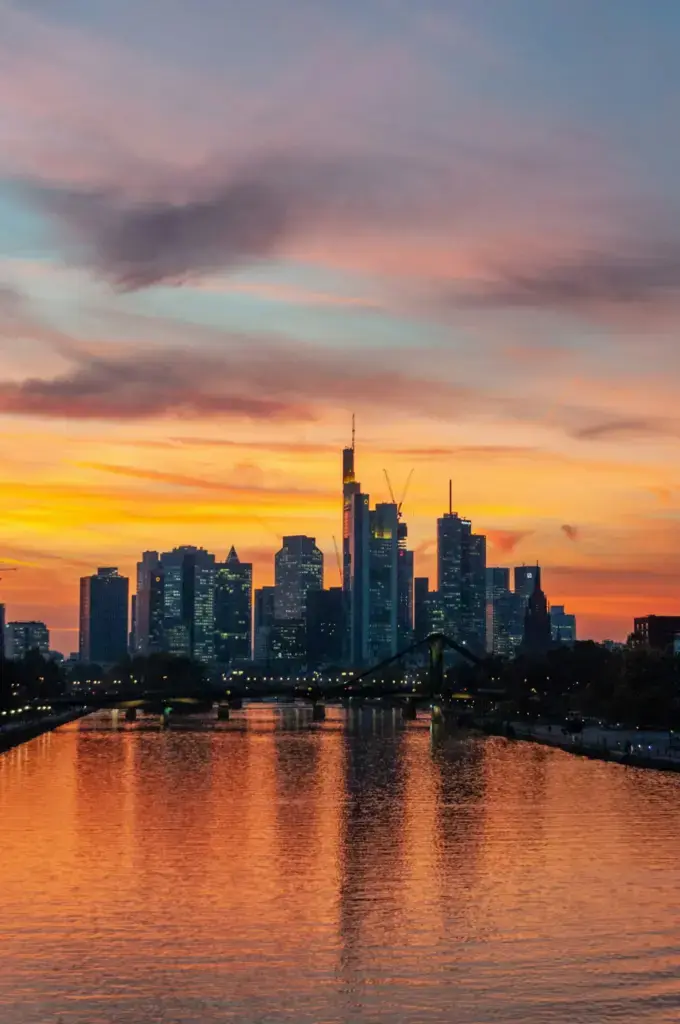
Frankfurt has the skyline. Banks, the European Central Bank and a cluster of towers gave it the nickname Mainhattan, and from the right angle it genuinely does not look European. Then you walk five minutes and you are in a square of stepped-gable houses that could be five hundred years old.
They are not. Frankfurt was bombed heavily in March 1944 and the old town was flattened. What you see today is reconstruction, some from the 1980s and some as recent as 2018. Knowing that does not spoil it. It explains it.
Main Tower: the view you actually get to see
Most Frankfurt skyscrapers are offices you cannot enter. The Main Tower is the exception, with a public viewing platform around two hundred metres up, reached by a lift and a short flight of stairs. It is open-air, which makes a real difference to the photographs, and it is the fastest way to understand how the city is arranged: towers in the middle, the river below, and the old town looking tiny in the middle of it all.
Go about an hour before sunset. Bring something warm, because it is windy up there in any season.
The Römer and the Römerberg
The Römer has been Frankfurt's town hall since the early fifteenth century, and its three-gabled façade is the city's standard photograph. Opposite it, the row of half-timbered houses on the Römerberg looks medieval and is a careful post-war reconstruction. The square was where Holy Roman Emperors were celebrated after being crowned in the cathedral around the corner.
Step into the cathedral too. This is where those coronations happened, and the tower can be climbed if you want a second, older view over the city.
The new old town
Between the Römer and the cathedral, a whole quarter of lanes opened in 2018 on the site of a 1970s concrete building. Some houses are faithful reconstructions of ones destroyed in the war, others are new architecture that follows the old plot lines. The debate about whether this is honest or theme-park was fierce in Germany, and walking it with that question in your head is more interesting than just admiring it.
Hammering Man and the Eschenheimer Turm
Outside the exhibition grounds, Jonathan Borofsky's Hammering Man is a black steel figure over twenty metres tall whose arm slowly hammers all day. It is a monument to work in a city built on money, and the pairing is deliberate.
For the other extreme, find the Eschenheimer Turm, a round medieval gate tower stranded among office buildings. It survived because it was too useful to knock down, and it is the clearest surviving piece of the walled city Frankfurt used to be.
The Museumsufer and the Städel
The south bank of the Main carries a row of museums along the embankment, the Museumsufer, which is unusual density even for Germany. The Städel is the one to pick if you only do one: a serious painting collection running from the Middle Ages to the present, with a modern underground extension lit by round skylights set into the lawn above it.
In late August the embankment holds a large museum festival, and the riverbank paths are a good walk at any time of year.
Apfelwein in Sachsenhausen
Frankfurt's drink is Apfelwein, locally Ebbelwoi: dry, sour apple cider, poured from a blue-grey stoneware jug called a Bembel into a ribbed glass. The ribs are not decoration; they let you grip the glass with greasy fingers.
Drink it in Sachsenhausen, across the river, where the traditional taverns are. Order Grüne Soße, a cold green sauce of seven herbs served with potatoes and egg, and Handkäs mit Musik, a small sour-milk cheese with onions, if you want the full local test. Both are better than they sound.
Seeing Frankfurt by playing it
Frankfurt rewards people who notice the seams between old and new, and it punishes people who only walk the shopping street. A city game routes you between the towers, the Römerberg and the riverbank while you solve clues, so the contrast becomes the point rather than a confusion. It works well for a work group, since Frankfurt is where a lot of teams end up anyway.
Frequently asked questions
Is Frankfurt worth visiting for more than a layover?
Yes, for a day or two. The mix of skyline, museums and cider taverns is genuinely unlike other German cities, though it is smaller than its reputation suggests.
Can you go up a skyscraper?
The Main Tower has a public open-air viewing platform. Most other towers are private offices.
Is the old town real?
It is reconstruction. The Römerberg houses were rebuilt after the war and the quarter beside the cathedral opened in 2018.
What should I eat and drink?
Apfelwein from a Bembel, Grüne Soße, Handkäs mit Musik, and whatever looks good in the Kleinmarkthalle at lunchtime.
Do I need a car?
No. The airport, the main station and the centre are all connected by S-Bahn, and the centre is walkable.
Come and play in Frankfurt
If you have a day here and do not want to spend it in a hotel bar, walk the city with a playing route. Here is how it works, and for team outings and larger groups we have formats on this page. Questions about dates, group sizes or routes? Get in touch. An hour south by train: Heidelberg.