In short: if you only see one palace, make it Changdeokgung with its Secret Garden (book ahead); add Gyeongbokgung for scale and the changing of the guard. Wear hanbok for free entry and check each palace's closing day before you go (sources at the end).
How many palaces does Seoul have?
Five royal palaces of the Joseon dynasty, all in the old centre.
Seoul has five royal palaces from the Joseon dynasty, all within walking distance of each other in the old centre. They were not five competing courts: the kings moved between them, rebuilt them after wars, and abandoned some for decades at a time.
Almost everything you see is reconstruction, and that is not a criticism. The palaces were burned in the Japanese invasions of the 1590s, rebuilt, and then systematically dismantled during the Japanese colonial period in the twentieth century. What stands today is the result of decades of restoration work that is still going on.
What should you know before visiting Seoul's palaces?
Look at ticket options, rent a hanbok for free entry, and check closing days.
First, ask about a combined ticket: for years one has covered the four main palaces and the Jongmyo shrine at a lower price than paying separately. Ticket options change, so check what is sold at the first palace you visit.
Second, and better: if you wear hanbok, entry is free. Rental shops sit outside the main gates, the price is modest, and you will be far from the only person doing it. Koreans do it too. It is the single best tip for a palace day in Seoul.
One practical warning: each palace closes one day a week, and the day is not the same for all of them. Check before you plan a route, or you will walk to a locked gate.
Why visit Gyeongbokgung?
For scale: it is the largest palace, with the changing of the guard at its gate.
Gyeongbokgung was founded in 1395 as the main palace of the dynasty, and it is the largest and grandest. The throne hall stands at the end of a long stone courtyard, and the Gyeonghoeru banquet pavilion sits on pillars in an artificial pond, which is the photograph everyone takes.
The changing of the guard at the main gate happens several times a day, in full costume with drums and flags. It is a reconstruction of a ceremony, not an unbroken tradition, and it is still worth timing your arrival for.
Two museums stand in the grounds, on Korean folk life and on the palace itself, and both are included or nearly free.
Which Seoul palace is the best?
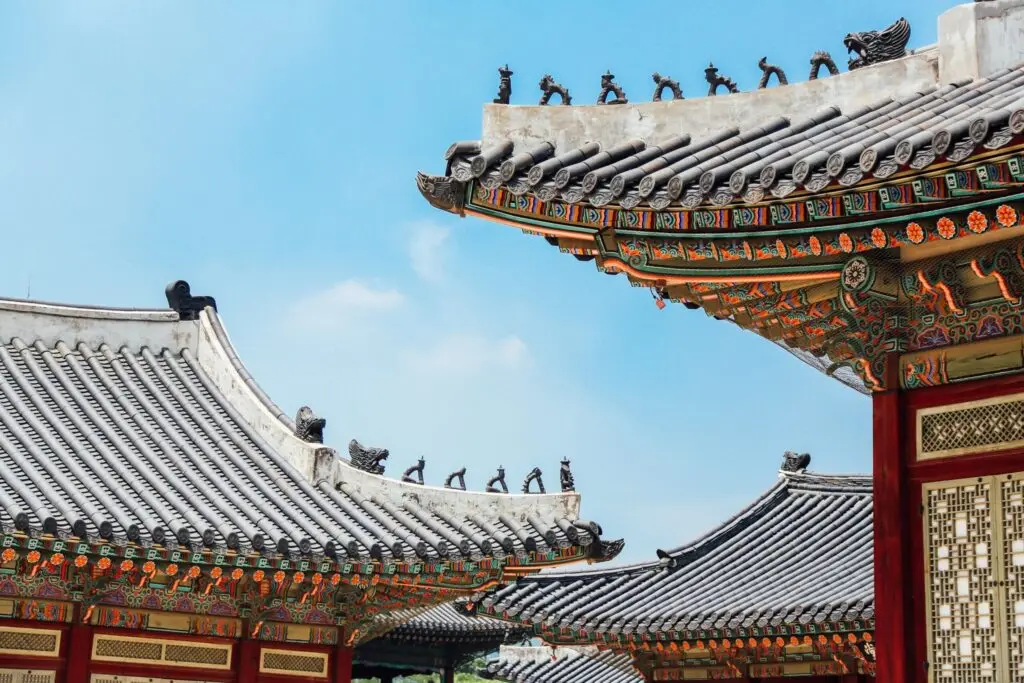
Changdeokgung: if you only do one, do this one. Changdeokgung is the best preserved of the five and a UNESCO World Heritage site, and it was built to follow the shape of the hillside rather than to impose a grid on it. That makes it feel less like a monument and more like a place people lived.
Behind it lies the Huwon, the rear garden, often called the Secret Garden. It is a wooded valley with pavilions and ponds, and access is by timed guided tour with a separate ticket, in limited numbers. Book it in advance; it sells out, and it is the best hour you will spend in Seoul.
Why was Changgyeonggung once a zoo?
Next door and connected by a gate, Changgyeonggung has the strangest history of the five. Under Japanese colonial rule it was converted into a zoo and botanical garden and its status as a palace deliberately downgraded. The animals were moved out in the 1980s and the palace restored, but the great iron-and-glass greenhouse from that period was kept, and it still stands among the wooden halls.
That contradiction is exactly why it is worth an hour. It is also the quietest of the main palaces.
What are Deoksugung and Gyeonghuigung like?
Deoksugung, beside City Hall, is the odd one: alongside the traditional wooden halls stand Western-style stone buildings from the turn of the twentieth century, when Korea was trying to modernise under enormous outside pressure. It has its own guard-changing ceremony, and the stone-wall path along its side is a favourite city walk, especially in autumn.
Gyeonghuigung is the smallest, the least restored and the least visited, and entry is free. Go if you want a palace courtyard with almost nobody in it.
What else is near the palaces?
Jongmyo, the royal ancestral shrine, has long been part of the combined ticket and is a UNESCO site: long, low, austere buildings holding the spirit tablets of the kings. Visits are usually by guided tour on most days.
Between Gyeongbokgung and Changdeokgung lies Bukchon Hanok Village, a hillside of traditional tiled houses. Two things about it: the views are lovely, and people live there. There are signs asking visitors to keep quiet and stay out of the lanes at night, and they mean it.
How can you explore the palace district as a game?
The palace district is walkable and full of things between the gates: the old city wall, the alleys of Bukchon, the shrines and the tea houses. A city game gives that walk a route with clues, which is a better way to link the palaces than trailing between them on a map. It works well with a family or a group.
Frequently asked questions
Which Seoul palace should I visit if I only have one?
Changdeokgung, for the buildings and the Secret Garden. Gyeongbokgung if you want scale and the changing of the guard.
Is it true that hanbok gets you in free?
Yes. Wearing hanbok gives free entry to the palaces, and rental shops sit right outside the gates.
Do I need to book the Secret Garden?
Yes. Access to the Huwon at Changdeokgung is by timed guided tour with limited places, and it sells out.
Are the palaces original?
Mostly reconstructions. They were burned in the 1590s invasions and dismantled under Japanese colonial rule; restoration has been running for decades and continues.
How many palaces can I do in a day?
Two properly, three if you are quick. Four in a day turns into a blur of courtyards.
In short: start at Changdeokgung
If you want the streets between the palaces, walk them with a playing route. Here is how it works, and for team outings and larger groups we have formats on this page. Questions about dates, group sizes or routes? Get in touch. More of the city: top places in Seoul.
Sources
World Heritage listings: Changdeokgung Palace Complex and Jongmyo Shrine (UNESCO). Opening days, tickets and hanbok entry: VisitKorea, the official Korea tourism site.