If you arrive in the Netherlands expecting American-style Halloween, you will find some of it and not all of it. Carved pumpkins appear in windows, shops fill with costumes, and clubs run themed nights. But Dutch autumn has two older traditions of its own, and once you know about them the season makes a lot more sense.
In short: Halloween (31 October) is a recent import with parties, decorations and trick-or-treating only in some streets; the Dutch door-to-door tradition is Sint-Maarten on 11 November, with lanterns and songs; and Allerzielen on 2 November is a quiet day of remembrance.
Do the Dutch celebrate Halloween?
Some do: it is a recent import, celebrated strongly in some places and not at all in others.
Halloween is not a traditional Dutch holiday. It arrived through films, shops and student parties, and it is celebrated in a patchy way: strongly by some people and neighbourhoods, barely at all by others in the same street.
What you will actually see on 31 October:
- Costume parties in bars, clubs and student houses, especially in cities with large student populations.
- Decorated houses in some neighbourhoods, often the ones with lots of young families, sometimes organised through a neighbourhood app or a street group.
- Trick-or-treating ("snoep of je leven" in Dutch), but only where a street has agreed to do it. Knocking on random doors will more often get you a confused face than a handful of sweets.
- Halloween events at amusement parks, which run horror programmes through October. Dates and age limits change every year, so check the park's own site rather than a list.
Whether it belongs here is a genuine discussion in the Netherlands, usually framed as an American import crowding out a Dutch tradition. That Dutch tradition is the next one.
What is Sint-Maarten on 11 November?
The Dutch version of going door to door: children with lanterns sing for sweets.
On the evening of 11 November, children walk from door to door with home-made lanterns, sing a short song at each house and are given sweets. It is the closest thing the Netherlands has to trick-or-treating, and it is far older.
The feast is named after Martin of Tours, a Roman soldier who, according to the story, met a beggar shivering in the cold on a winter night and cut his cloak in two to share it. His feast day is 11 November.
Where is Sint-Maarten celebrated?
Sint-Maarten is regional rather than national. It is strong in the north (Groningen and Friesland) and in parts of Noord-Holland, Utrecht, the east and Limburg. In much of the south and west, it is barely marked. If you want to see it at its liveliest, the northern cities are the place; our guide to things to do in Groningen covers the city the rest of the year.
Utrecht has a particular claim to it: Saint Martin is the city's patron saint, the cathedral is dedicated to him, and the city marks the date with its own events.
What can you expect on Sint-Maarten if you live here?
Groups of children with paper or hollowed-out lanterns start ringing doorbells around dusk and carry on for a couple of hours. The song comes first, then the sweets. If you would rather not take part, leaving the porch light off is the usual signal, and it is respected.
What is Allerzielen on 2 November?
All Souls' Day, Allerzielen, is a Catholic tradition of remembering the dead, so it is strongest in the Catholic south: Noord-Brabant and Limburg. Families visit graves and leave flowers or candles.
Several cemeteries around the country hold light-and-remembrance evenings at the start of November, where the paths are lit and people are invited to walk through. They are open to anyone and are worth knowing about, if only because they are the opposite of everything else in this article: no costumes, no noise, just people walking quietly with candles.
Is autumn a good time to visit Dutch cities?
Yes: quieter streets, lit canals and early dark evenings.
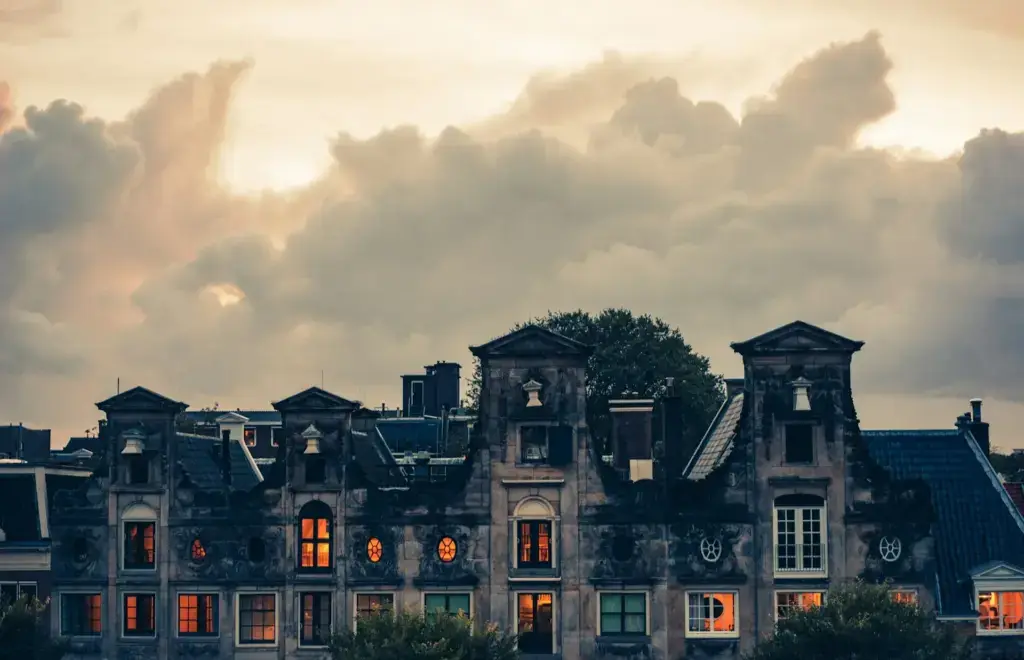
Late October and early November is one of the better times to walk a Dutch city centre. It gets dark early, which sounds like a drawback and is not: canals, brick facades and lit windows look better in the dark than in flat summer light, and the crowds have gone home for the year.
Practical points that make the difference:
- Once the clocks go back at the end of October, sunset comes around a quarter past five, and before five by mid-November, so plan the outdoor part of the day early.
- Rain is likely rather than possible. A jacket with a hood beats an umbrella in Dutch wind.
- Cobbles and canal edges get slippery with wet leaves.
- Museums are busier on rainy afternoons than on dry ones. Go in the morning.
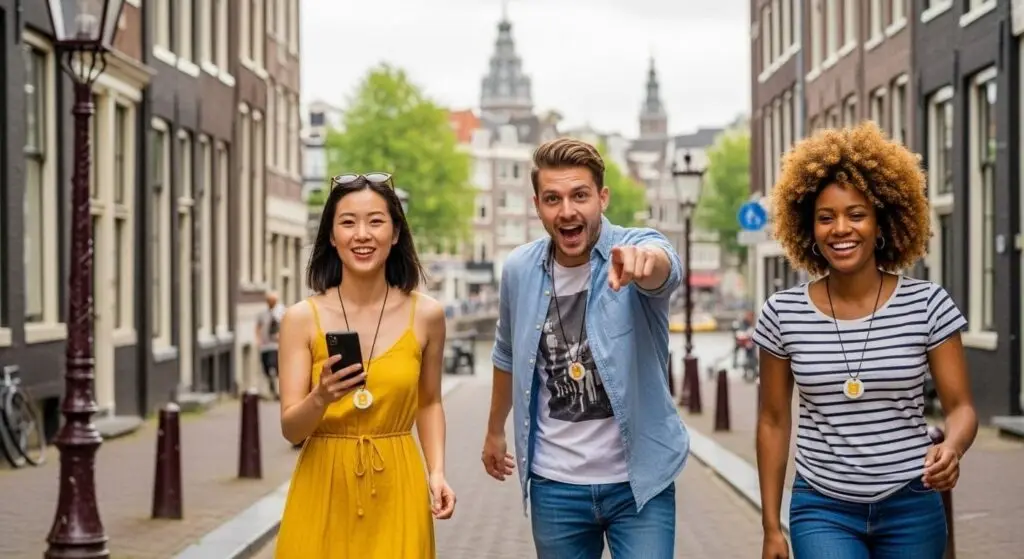
If you want a reason to be outside in the dark rather than in a bar, a walking route with something to solve works well in this season. A city game is a self-guided route with puzzles along the way, and the early darkness genuinely adds to it. In Amsterdam, our Ghost Hunters game takes your team past the city's ghost stories, made for exactly these dark evenings. Here is how a game works before you decide.
Frequently asked questions
Do Dutch people celebrate Halloween?
Some do, many do not. It is popular as a party and a decoration, less so as a household tradition. It is not a public holiday and nothing closes for it.
Is trick-or-treating a thing in the Netherlands?
Only in streets that have agreed to do it. The Dutch equivalent is Sint-Maarten on 11 November, when children go door to door with lanterns and sing for sweets.
What is Sint-Maarten?
The feast of Saint Martin of Tours on 11 November. Children carry lanterns from door to door and sing a song in exchange for sweets. It is celebrated regionally, most strongly in the north.
Should I give out sweets on 11 November?
If you live in a region where it is celebrated, yes: a bag of small sweets is enough. If you would rather skip it, leave the outside light off.
Are there Halloween events for adults?
Yes: club nights, costume parties and horror programmes at amusement parks through October. Programmes and dates change annually, so check the venue directly.
Is Halloween a good time to visit the Netherlands?
For cities, yes. It is quieter than summer, the light is better for photographs, and the tourist pressure in Amsterdam and the other big centres has dropped. Bring rain gear.
In short: three traditions in one season
Dutch autumn holds an imported party, an old children's tradition and a quiet day of remembrance within two weeks of each other. You do not have to choose between them, but knowing which is which explains a lot about what you see out of the window. If you are here with a group and looking for something to do on a dark evening, we help arrange days out for companies and larger groups, and you can ask us anything through the contact page.
Sources
Background on the traditions: St. Martin's Day and All Souls' Day on Wikipedia. Sunset times: any Dutch weather service such as the KNMI.
Ghost Hunters
Track down the ghosts and save the city's famous painter. See the games ›